Artificial Intelligence
CNIL's blueprint for AI data protection: notes, audits, and alliances
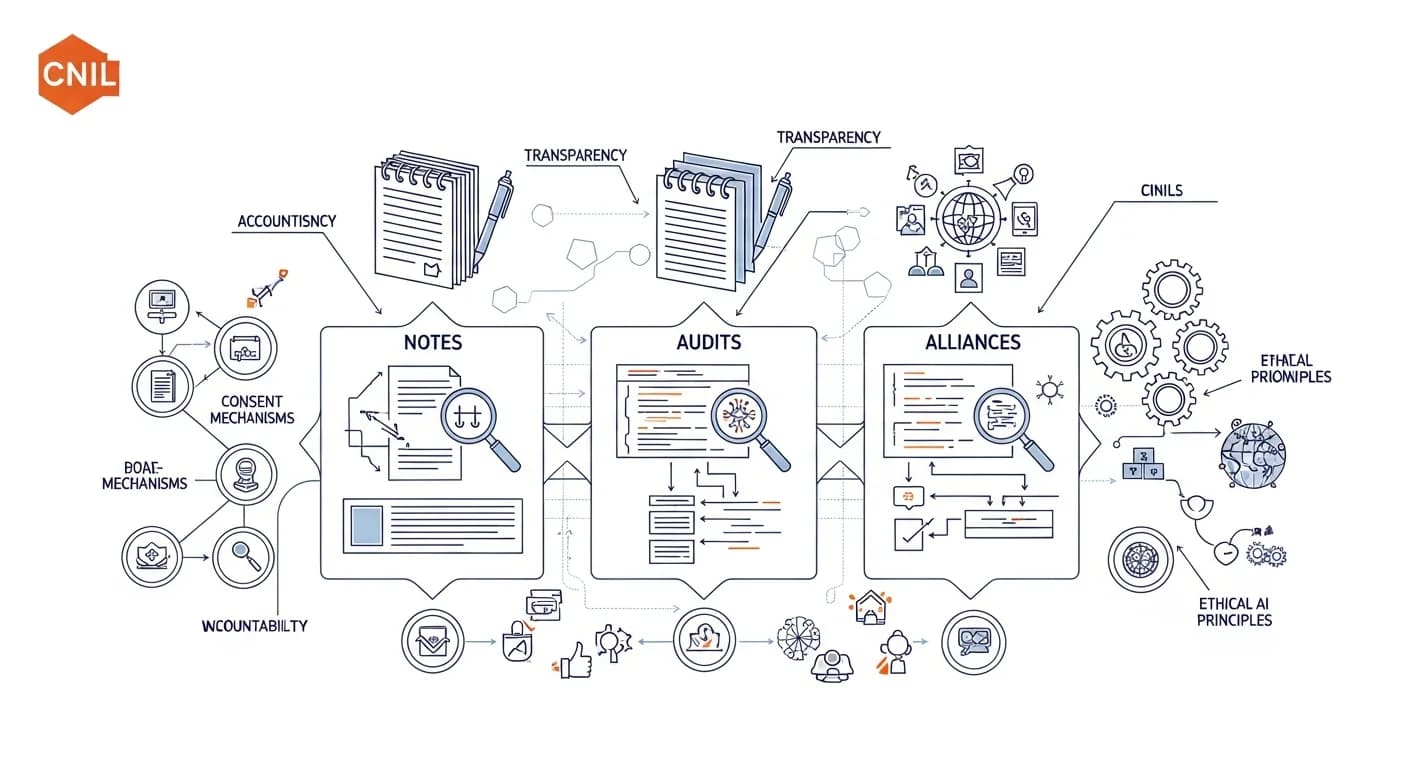
The CNIL is moving from guidance to enforcement with a series of coordinated actions: an exploratory note on agentic AI, a practical audit tool called PANAME, and active participation in EU and international data protection standards.
Emmanuel Fabrice Omgbwa Yasse AI-assisted
2026-08-08 · 3 min read
Agentic AI and personal data: CNIL's exploratory note
On 20 July 2026, the French data protection authority (CNIL) and the Conseil de l'IA et du Numérique released an exploratory note on agentic AI and personal data. It addresses the challenges of AI systems that act autonomously on behalf of users, handling tasks and interacting with services without direct human oversight. The document outlines the risks this creates for data protection, especially when agents execute actions across multiple platforms, accumulating personal data across services. While the note does not prescribe hard rules yet, it signals where the regulator sees the most urgent gaps. The risks are not theoretical: benchmarks show that current oversight tools miss embedded sabotage in research agents nearly half the time, as a new benchmark found.
As one recent preprint on dynamic capability scoping for enterprise AI agents notes, permission architectures are fragmenting: different agents rely on different scoping mechanisms, making oversight difficult. The CNIL's exploratory note can be read as a call for shared standards before the fragmentation becomes structural.
From guidance to tools: the PANAME audit project
The CNIL is not stopping at written notes. On 26 February 2026, it launched PANAME, a joint project with ANSSI, PEReN, and Inria. The tool is designed to audit AI models for GDPR compliance, specifically their level of confidentiality and their conformity to data protection principles. An open call for participation invites organisations to test the tool and help shape its final version.
PANAME turns abstract regulatory guidance into a practical enforcement tool. It gives auditors a measurable way to assess whether a model leaks training data, respects consent boundaries, or exposes personal information through inference. The project is still in its testing phase, but it already points to what enforceable AI compliance could look like inside the EU regulatory framework. The need for such oversight is underlined by the lack of visibility enterprises have over their own AI coding agents, as recent analysis shows.
European and international coordination
On 7 July 2026, the European Data Protection Board (CEPD) adopted final guidelines on anonymisation and web scraping in the context of generative AI, as well as the final version of its blockchain guidelines. The CNIL actively contributed to these texts. The anonymisation guidelines are directly relevant to AI training pipelines that rely on scraping public data, a practice that remains legally contested under GDPR. The adoption of final versions suggests the EU is moving toward clearer boundaries for how companies can collect and process data for model training. This mirrors a broader global trend toward coordinated AI regulation, as a landmark international agreement has also signaled.
Internationally, the CNIL has deepened its partnership with Korea's Personal Information Protection Commission (PIPC). Together they produced an awareness poster titled “IA générative et vie privée” to help users protect their personal data when using generative AI. The poster was published in May 2026 and targets everyday users, not just professionals.
Practical impact: awareness, youth, and enforcement
Beyond high-level guidelines, the CNIL has invested in understanding how real people, especially young people, interact with AI. A survey conducted with the Groupe VYV across four European countries, published on 5 May 2026, found that nearly 9 out of 10 young people in France use conversational AI, and nearly half discuss sensitive topics with these bots. The results highlight mental health risks and gaps in data protection safeguards for minors.
The CNIL has also run webinars for professionals on how to use the legal basis of legitimate interest when developing AI systems and scraping data. A 2 April 2026 session covered this exact topic. These webinars, combined with the awareness campaigns and the PANAME project, show a regulator covering all fronts: informing the public, training developers, and building enforcement tools simultaneously. Such multi-pronged efforts are part of a wider landscape where industry players are also stepping up policy engagement, as an open letter signed by 41 organizations recently demonstrated.
- Source : CNIL — Intelligence artificielle
Get the tech essentials in 3 minutes every morning
One email, every weekday, with what actually matters in AI and tech.