Climate & Health
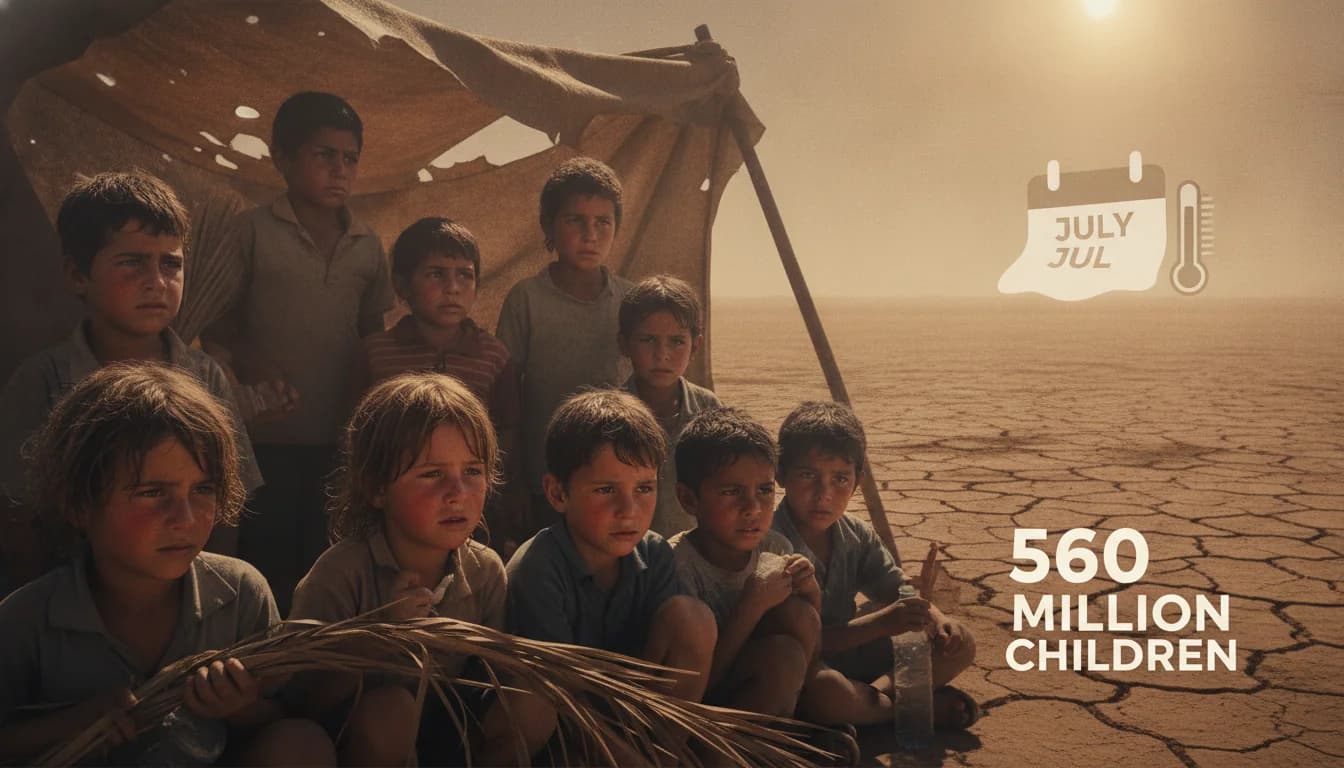
Climate change has already added a month of heat stress to 560 million children
A Science Advances study finds 560 million children under 10 now get an extra month of climate-driven heat stress each year, nearly triple the figure for people aged 60 to 69. A first-person Verge essay shows what that looks like from a Southern California living room.
Emmanuel Fabrice Omgbwa Yasse AI-assisted
2026-09-18 · 5 min read
Too hot for the botanic garden
It is 8:52 in the morning and already 86 degrees Fahrenheit in Southern California. The author is watching her husband come back from the botanic garden with their four-month-old. "It was okay," he says. "It was just too hot."
That exchange opens a first-person essay published by The Verge about raising a baby through a summer of extreme heat. As she writes, an extreme heat warning glares from her phone, effective for at least three days: "Dangerously hot conditions with high temperatures up to 110 [degrees Fahrenheit] expected," it says. "Stay in an air-conditioned room, stay out of the sun."
The American Academy of Pediatrics recommends that parents avoid taking babies outside for long stretches once the "feels like" temperature tops 90 degrees Fahrenheit (32.2 Celsius), the essay notes. For this family, that has meant staying mostly indoors from about 11 in the morning or earlier until past sunset. The baby loves walks, and time outside is good for a postpartum parent's mental wellbeing. But the grandparents' backyard is not safe after a certain hour, and midday errands mean blasting the AC to cool a sweltering car while waiting in a hot parking lot.
"As irritating as this all is, I'm one of the lucky parents with a car and air conditioning at home," she writes.
The essay is personal. The study behind it is anything but.
The science behind those warnings is being rebuilt in real time. AIMIP, an intercomparison project for AI weather and climate models, runs submitted models through the same standardized experiments. In one out-of-sample evaluation, the global ocean surface was warmed by 2 or 4 degrees Celsius at once, and the models' predictions diverged significantly; some were physically implausible. How well those models hold up outside familiar conditions matters to the attribution science behind the new study.
The study behind 560 million
Published in Science Advances, the research relies on an international standard for moderate heat stress: days when protective measures like rest breaks are recommended. The threshold is a WetBulb Globe Temperature of 28 degrees Celsius (82.4 Fahrenheit), a measurement that accounts for heat, humidity, wind speed, and cloud cover. Advances in climate attribution science let the team count how many days crossed that threshold and how many of those were added by climate change.
Their finding: 560 million children under 10, or 43 percent of everyone in the 0-9 age group, now get at least one additional month of heat stress each year because of climate change. That is nearly triple the number of people aged 60 to 69 exposed to the same level of climate-driven heat stress. Children, the researchers found, are disproportionately exposed to dangerous heat compared with older age groups.
"I hope that this increases public awareness that climate change is a problem that is already happening today, that's already affecting us," says Rosa Pietroiusti, the study's lead author and a PhD researcher at Vrije Universiteit Brussel. "It's affecting the health of the most vulnerable."
If countries blow past the targets they agreed to in the Paris climate accord, the figure rises to 650 million children under 10 with just 2 degrees Celsius of global warming, the study finds.
| Measure | Figure |
|---|---|
| Children under 10 gaining at least one extra month of climate-driven heat stress per year | 560 million, 43% of the 0-9 age group |
| People aged 60-69 exposed to the same climate-driven heat stress | Nearly a third as many as children |
| Children under 10 exposed if global warming reaches 2°C | 650 million |
The injustice is global
The highest increases in heat stress caused by human activity take place in the Global South, the countries that have contributed least to the fossil fuel pollution raising temperatures, the study finds. Those countries have younger populations and tend to have less access to air conditioning or infrastructure built to withstand extreme weather.
Heat is a leading cause of weather-related deaths globally, the essay notes, citing the World Health Organization. It can lead to dehydration, heat stroke, and eventually organ failure. Babies are more vulnerable than most adults: their higher surface-area-to-body-mass ratio makes overheating easier, their sweat glands are still developing, and they depend entirely on adults for precautions like staying hydrated. She compares a baby to a small ice cube melting in the sun next to a big block of ice.
Heat-related illness is preventable as long as a child can find somewhere cool, and summers can be stopped from getting even hotter by shifting to energy sources like solar and wind that do not emit planet-heating pollution. The opposite decision gets made too: Amazon's 2040 climate pledge collides with a 33-million-ton gas plant.
She counts herself lucky. When the family lost power one hot July afternoon, they packed up for grandma's house to stay cool and protect the stash of breastmilk in the freezer. Had the milk gone bad, she calculates, it would have been about 20 hours of pumping, much of it during sleepless nights, down the drain. Power outages have grown longer in the US as extreme weather becomes more common, and heatwaves can trigger blackouts through demand peaks or because utility companies preemptively turn off power lines to keep them from sparking wildfires.
She did get the baby to the ocean once. A baby's skin is too sensitive for sunscreen until about six months, so he wore a little blue bucket hat for a short walk along the pier. When she lifted him from the stroller to look at the water, he scowled and fussed as the bright sun hit his eyes. "This is too much?" she asked him. "This is too much."
The study counts the days: one extra month a year for 560 million children, and 650 million if warming reaches 2 degrees. The essay shows what those days feel like from a living room in Southern California: a summer without the botanic garden, a beach visit cut to a short pier walk. Both are describing the same summer.
Get the tech essentials in 3 minutes every morning
One email, every weekday, with what actually matters in AI and tech.