AI Adoption
French SMEs' AI adoption hits 47%, but the hidden costs tell the real story
Nearly half of French SMEs have launched AI projects, but a new Bpifrance report reveals hidden costs and failure factors that leaders ignore at their own risk. Success depends more on objectives and business ownership than on technology.
Emmanuel Fabrice Omgbwa Yasse AI-assisted
2026-08-07 · 2 min read
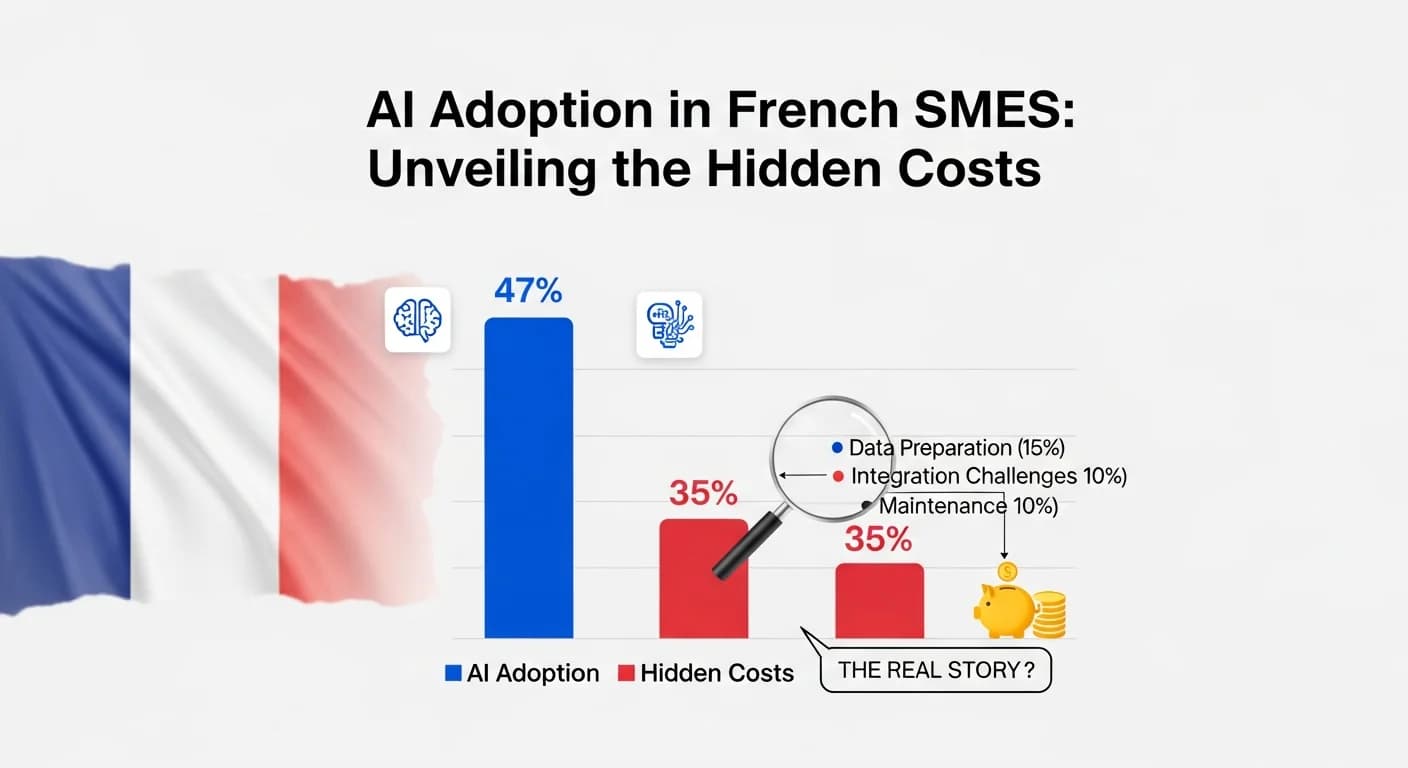
AI is no longer a tech-giant privilege in France. A new Bpifrance report, published in March 2026, shows that 47 percent of small and mid-sized companies have launched at least one AI project, roughly 300,000 businesses. Among companies with more than 200 employees, adoption reaches 95 percent. That is not a forecast. That is where competitors already are.
The acceleration is real. In early 2024 only 29 percent of SMEs had started an AI project. That figure jumped 18 points in two years. Cheap tools explain part of the jump: a customer chatbot now costs less than 2,000 euros a month, a document-processing solution under 1,500 euros. The availability of cheap, open models has been a key driver, as seen in the surge in demand that forced Ollama to pause new subscriptions. Early adopters have published results: a 15 to 30 percent cut in administrative time, a 15 percent increase in sales conversion. Competitive pressure pushed the rest.
Uneven adoption across sectors and regions
Sector speeds differ. Finance and insurance lead with 61 percent of companies engaged, followed by retail (53 percent), manufacturing (50 percent), and the public sector (40 percent). The pattern holds: industries with structured data and measurable gains move faster. Healthcare and administration, where data is fragmented and caution runs high, lag.
Geography also splits the picture. The Paris region concentrates 53 percent of all French AI projects. In less dense areas such as Burgundy or Auvergne-Rhône-Alpes, adoption is around 40 percent. Bpifrance notes that rural SMEs eventually catch up, but with a six-to-twelve-month delay, mainly because they struggle to attract data talent.
What separates success from failure
The report's most useful finding might be the real success rate: 67 percent of projects met or exceeded their original objectives within twelve months. That is far higher than the 10 percent failure rate often cited in media. The breakdown adds nuance: 54 percent hit targets but took longer or reduced scope; only 13 percent beat expectations. The remaining 33 percent fell short or were killed.
Three factors separated winners from losers. Clear objectives: 87 percent of successful projects had quantified goals from the start (cut costs by 200,000 euros a year, reduce processing time by 15 percent). Projects with vague ambitions like "improve customer relations" tended to fail. Business ownership: 83 percent of successes had a named business owner (a sales director, a logistics manager, a CFO) accountable for results. Failures were often confined to IT or data teams with no operational sponsor. Rapid iteration: 84 percent of successful projects shipped a prototype within three months, measured results, and adjusted. The failures spent up to nine months in design without testing real value.
The costs nobody advertises
Bpifrance puts the average first-project investment at 79,000 euros for a typical SME, covering three to six months of deployment. That figure is misleading: hidden costs break the budget. As enterprises struggle to track AI spending, some are discovering that their coding agents are burning millions without clear oversight. Forty-seven percent of SMEs report spending twice as much time as
Get the tech essentials in 3 minutes every morning
One email, every weekday, with what actually matters in AI and tech.