The business model of AI video generation
$6 for a 30-second clip: Alibaba's Wan3.0 puts AI video on the meter
Wan3.0 doubles single-generation AI video to 30 seconds and takes documents and webpages as references. The commercial change is blunter: Alibaba bills per generated second, so a 1080P clip of the full window runs about $6. The meter rewrites production budgets, not just clip specs.
Emmanuel Fabrice Omgbwa Yasse AI-assisted
2026-09-17 · 4 min read
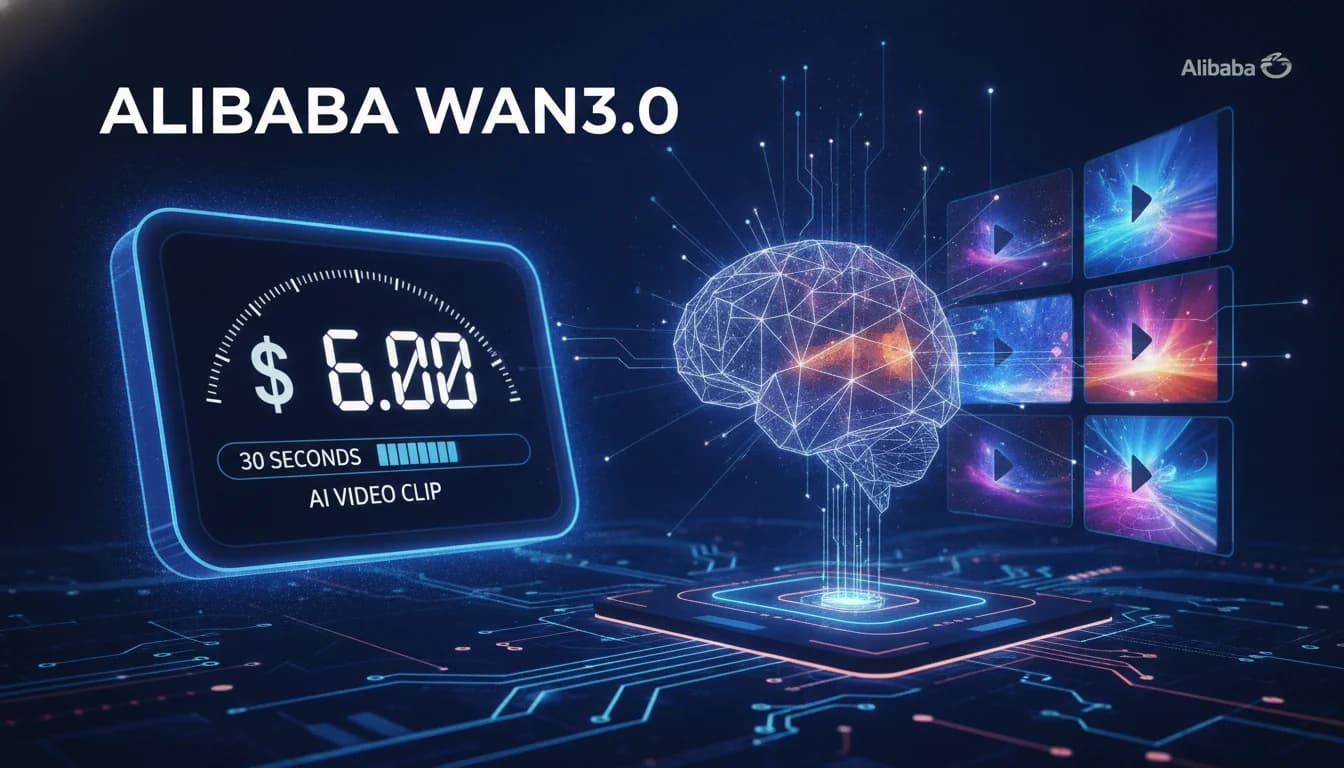
For about $6, Alibaba Cloud will generate a 30-second video at 1080P, billed per second. That meter, more than the longer generation window or the finer facial controls, is the most consequential part of the Wan3.0 launch.
Wan3.0 reached general availability across international channels on Aug. 24, 2026, billed per generated second: $0.05 at 480P, $0.10 at 720P, $0.20 at 1080P. A full 30-second draft at 480P runs about $1.50; the same clip at top resolution runs about $6.00 before any promotional discount, as noted in the Wan3.0-Video pricing breakdown. Johnny Mai, Alibaba Cloud's director of Gen AI product strategy and GTM, makes the argument in the product blog: exploration and finishing can live in separate budgets.
The unit of work just doubled
Wan2.7 generated 2 to 15 seconds per generation. Wan3.0 doubles that to a native 30 seconds. Fifteen seconds is enough for one shot, one beat, or a short social asset. Thirty seconds buys multiple narrative beats, a setup and payoff, a longer product demo, or one uninterrupted camera move, which changes what creators can attempt in a single pass.
The hard question is whether the extra time holds together. Long clips are a known failure point for video models, and the same drift shows up in audio, which is why Music 3.0 moved to a timeline instead of a one-tag prompt. Alibaba's own framing concedes the video version:
"Duration buys production value only when coherence holds across it."
Wan3.0 ships smart duration recommendation, which lets the system pick a length from the prompt and references, plus video extension for continuing past the initial generation. The consistency claims widened too. Wan2.7 focused on identity, voice, emotion, and camera movement across multi-character scenes. Wan3.0 adds facial details, hair, clothing, accessories, props, spatial relationships, camera perspective, and stability across longer clips. Those are Alibaba's claims, and the post includes a disclaimer that third-party figures are quoted as published, not independently verified.
Documents join the prompt
The reference set grew in a different direction. Wan3.0 accepts text, image, audio, and video, plus DOC, XLS, PPT, PDF, TXT, KEY, Pages, Numbers, Markdown, and webpages, within defined intake limits. A brand deck, campaign brief, report, or spreadsheet can carry its own factual and visual context into the generation. Users stop restating information and start directing it: what matters, who the audience is, what tone to carry, how the camera behaves.
The editing foundation Wan2.7 introduced carries forward, so visuals, plot, and dialogue can be modified without regenerating from scratch. Iteration becomes a revision pass, not a do-over. There is a known gap here too: Alibaba's own materials flag legible on-screen text as an active refinement area, which is awkward for a model pitched on turning charts and documents into video. It is the same blind spot Zhipu AI attacked by making accurate Chinese text rendering free and unlimited, per the GLM-Image writeup.
The meter changes the workflow math
| Resolution | Standard price per generated second |
|---|---|
| 480P | $0.05 |
| 720P | $0.10 |
| 1080P | $0.20 |
Wan2.7's pricing was never stated in the public materials, which makes Wan3.0 the first clear picture of what an Alibaba video generation costs. The table is the point: the same 30-second clip costs $1.50 as a draft and $6.00 as a finish, and teams can route cheap drafts and final passes through separate budgets. Mai's broader argument is that generation settings are gradually becoming part of model reasoning rather than a sequence of manual controls, and that each release expands the surface without forcing teams to relearn the creation loop.
The gaps the vendor admits
Wan3.0 is Alibaba's stake in a wider race toward all-in-one generation. MiniMax's H3 already unifies text, image, video, and audio in a single model, so pressure is coming from several directions at once. The Wan family has shipped eight iterations from Wan1.0 to Wan3.0, and Alibaba is pointing the same capabilities at embodied AI, autonomous driving, and industrial simulation. Wan is not the company's only track either; Alibaba recently open-sourced Qwen 3.8-Max, its most capable model.
None of that settles the question the launch actually raises. Per-second billing makes AI video spend predictable, but it does not guarantee the 30 seconds are usable. Alibaba's AMAP team found a version of that wall in code: it pushed AI code generation toward 90% and delivery cycles barely moved, per the AMAP case study. Whether $6 buys a clip a production team can ship is something only a real production run can answer.
Get the tech essentials in 3 minutes every morning
One email, every weekday, with what actually matters in AI and tech.