Humanoid Robotics
Beijing's robot games were 96% Chinese. That's the real story
A 9.39-second 100-meter sprint and a 2.88-meter standing jump made the second World Humanoid Robot Games look like a robotics breakthrough. The real signal ran deeper: 641 of 666 teams were Chinese, and the biggest US humanoid makers stayed home.
Emmanuel Fabrice Omgbwa Yasse AI-assisted
2026-09-16 · 5 min read
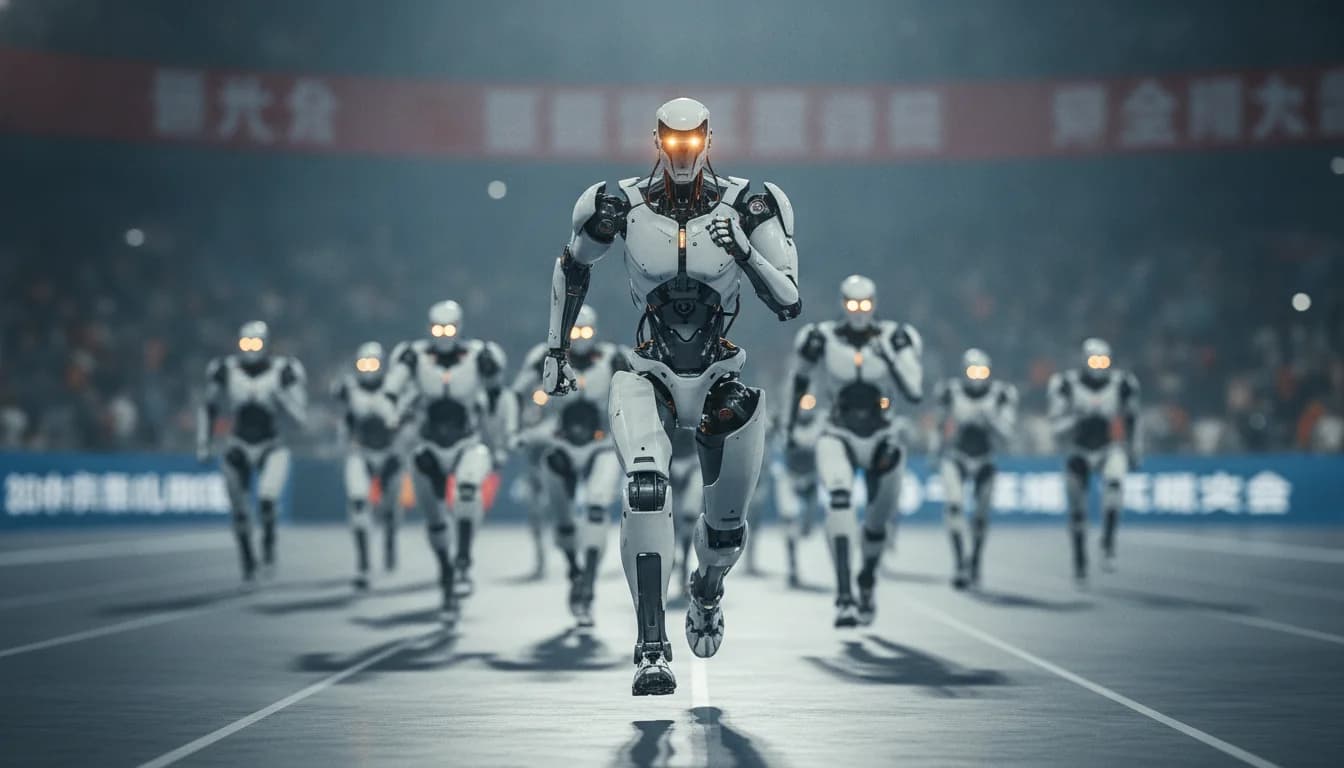
Humanoid robots make good theater and mediocre employees, and Beijing's second World Humanoid Robot Games made both points in five days. A robot ran the 100 meters in 9.39 seconds, faster than Usain Bolt's 2009 world record, and another cleared 2.88 meters in the standing high jump, nearly half a meter above the human high-jump mark that has held since 1993. The same venue produced a different kind of footage: a robot from smartphone maker Honor lost a leg mid-sprint, a finisher hit the crash mat and burst into flames, and a weightlifter toppled backward into the judges' table, arms aloft. The Verge's games coverage logged all of it.
Strip away the spectacle and the scoreboard tells the real story. Chinese teams filled 641 of the 666 slots, representing 157 companies and 200 universities, according to figures from state-run China Daily cited in the same report. Tesla, Boston Dynamics and Figure, the American humanoid builders that dominate Western coverage, were absent. What was billed as a global competition became, in practice, a national industrial review.
The sprint records are the least useful results in Beijing
This was only the second edition, and the jump from last year is startling. In the inaugural event, the winning 100-meter sprint took 21.50 seconds and the best standing high jump reached 0.95 meters. This year's marks go beyond anything a human has ever done.
| Event | First games | This year |
|---|---|---|
| 100-meter sprint | 21.50 s | 9.39 s |
| Standing high jump | 0.95 m | 2.88 m |
Part of that leap is in the rulebook. Many events, including gymnastics, football, tug of war, table tennis and some track races, required robots to operate autonomously. Others allowed teleoperation, with a scoring penalty attached. The records still reflect real gains in actuators, balance and control, which is exactly why they can mislead. Sprinting and jumping reward the strengths robot builders have already industrialized. The events that look like future employment (bed-making, parcel delivery, shelf stacking, clothes folding, hammering nails, even firefighting) are where the machines still feel like prototypes. The Verge's reporter put the gap this way:
"There is still a long way to go before these machines can operate reliably on their own in places like factories or homes."
641 of 666: a scoreboard with almost no outsiders
Chinese teams swept the medals, with AgiBot and Tien Kung standing out in particular. Part of the asymmetry is simply who entered. No public breakdown of international entrants exists, but the absence of Tesla, Boston Dynamics and Figure was conspicuous, and it fits the wider shape of the US humanoid industry.
What China brought instead was institutional density. Two hundred universities and 157 companies is not a sports delegation; it is a pipeline for embodied-AI talent. The games fit a familiar pattern of public robotics spectacle, from dances at a Spring Festival Gala to demos at flagship tech events, and now a second tournament in as many years at an Olympic venue. The same enthusiasm feeds real worries about circular investment, hardware companies without a viable product and talk of a humanoid bubble.
Factory floors are closing the gap the games can't show
The competition says a lot about what remains hard. What happened between the two editions says a lot about how fast the hard part is shrinking. Xiaomi's humanoid robot was handing out gifts and shaking hands at an investor conference in April. Six months later it is sorting soft-molded panels and folding cardboard boxes on the SU7 electric vehicle production line, a step up from the single-station screw insertion it performed six months prior with 98% reliability, as our earlier report on Xiaomi's factory work documented.
Those tasks rely on whole-body coordination, force-sensitive fingertips and real-time adaptation, and they run on a live line for a mass-market car. Xiaomi had no robotics history before 2023, built its own hardware and control stack, and still moved from one workstation to multi-station bimanual work in half a year. That pace made Elon Musk's January claim that Optimus was not yet capable of useful factory work look fragile quickly. The caveat still applies: these are controlled, repetitive actions, not general autonomy, and the warning about homes remains valid. General autonomy in unfamiliar settings is a separate problem; one framework addresses it by letting a robot adapt to a novel setup without retraining. Still, embodied AI cannot be trained on scraped text. Its data has to be generated by machines performing real tasks, and every deployed unit on a line like the SU7's is collecting training material for the next generation. A competition hands out medals. A production line hands out data.
Washington is running a different race
The United States retains an edge in frontier AI and advanced chips, but China is closing parts of that gap while making embodied AI a strategic national priority. Washington has paid robotics far less attention for years and, as The Verge's coverage notes, now trails China in nearly every respect, including manufacturing, deployment and hardware. A US policy push to ban foreign robots, aimed squarely at Chinese machines, could even backfire given how dependent domestic firms are on Chinese components.
The next milestones are already on Beijing's calendar: another humanoid half-marathon in April and the country's first robot-run hotel, planned for next year. Both will say more about real-world readiness than any sprint record. The humanoid race will not be settled on a track. It will be settled in factories, hotels and warehouses, and China is competing on those floors today. The US has not yet fielded a team for that event.
Get the tech essentials in 3 minutes every morning
One email, every weekday, with what actually matters in AI and tech.