Special Report: AI Evaluation
The State of AI Benchmarking in 2026: Inside the Collapse of Static Tests and the Systems Built to Replace Them
A comprehensive tour of the 2026 AI benchmarking landscape: why MMLU, GSM8K, and HumanEval broke, how dynamic benchmarks and expert exams like HLE and GPQA Diamond replaced them, what agentic and jagged-intelligence testing reveals, and how human preference, LLM judges, and production observability now round out the full evaluation stack.
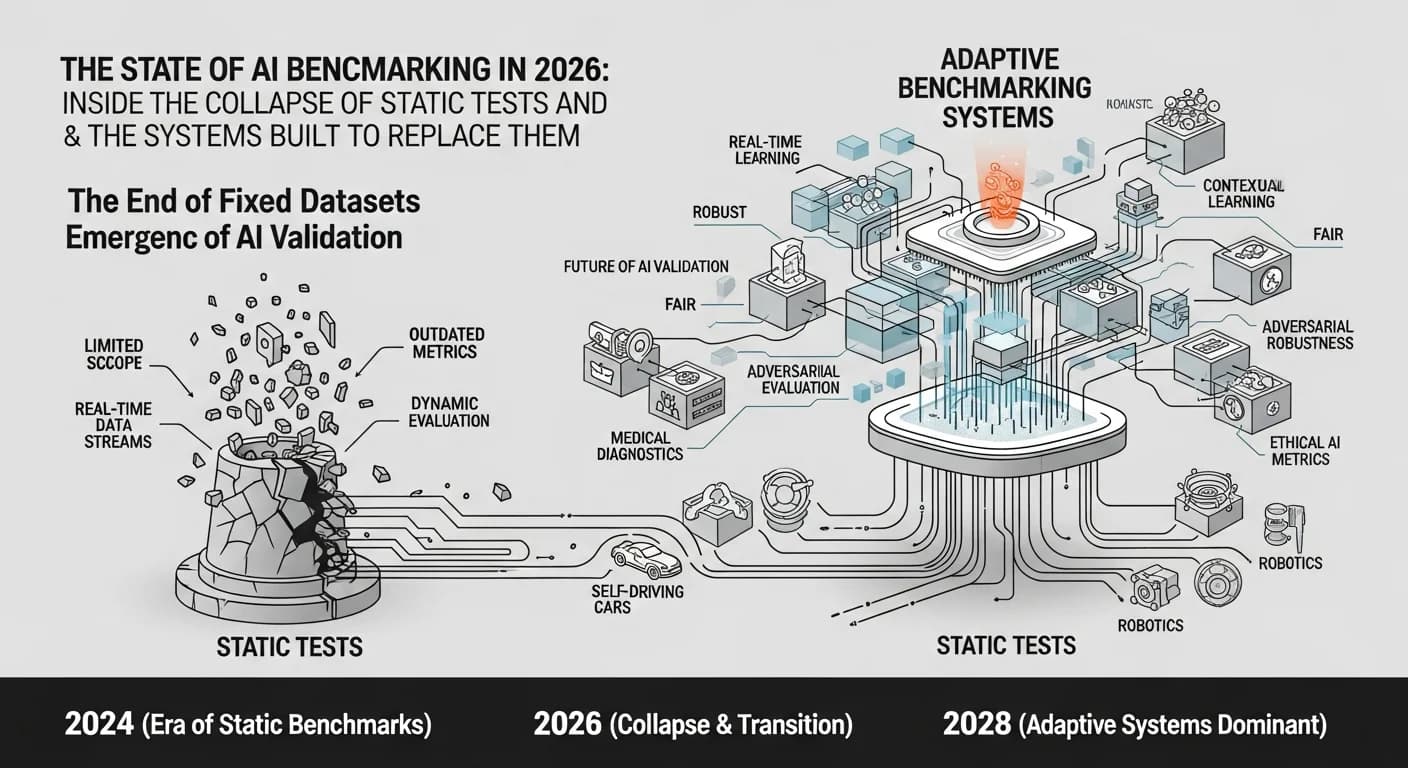
Ask an AI lab how good its newest model is, and it will hand you a wall of numbers: MMLU, GPQA Diamond, SWE-bench, an Elo rating, a cost-per-million-tokens figure. A few years ago those numbers meant roughly the same thing to everyone. They don't anymore. The field spent the past two years discovering, one benchmark at a time, that a fixed test with a public answer key has a shelf life, and that shelf life is shorter than the gap between two model releases.
What follows is a tour of the instruments the industry now uses to measure a model's actual capability, why the old instruments broke, and what still doesn't work even in the newest ones.
The static benchmark crisis
For years, three tests anchored nearly every model comparison: MMLU for general knowledge, GSM8K for arithmetic reasoning, and HumanEval for code generation. All three now sit past the point of usefulness, for two separate reasons that compound each other.
The first is contamination. Public benchmark questions eventually end up scraped into pretraining corpora, deliberately or not, and once that happens a model can pass by recall instead of reasoning. Independent audits of multilingual test sets found contamination rates as high as 91.8% in large models, with memorization scaling directly with parameter count. The second is that the tests themselves were never as clean as their reputations suggested: audits found roughly 2% of MMLU's math questions outright broken, and as much as 42% of GSM8K's item pool ambiguous, mislabeled, or wrong. Frontier models clearing 88% to 90% on MMLU looked like triumph. It was closer to a measurement floor, one built partly on flawed questions nobody could answer correctly regardless of skill.
Replacing a fixed answer key with a moving one
The industry's response wasn't to patch the old tests. It was to stop using fixed answer keys altogether. LiveBench and its sibling LiveCodeBench pull in new coding problems and freshly opened repositories on a rolling weekly basis, so a question released this week cannot have contaminated a model trained months ago. ForecastBench and FutureX push further, asking models to predict outcomes of real financial and geopolitical events that haven't happened yet, questions with no historical answer sitting in any training set by construction.
Two other approaches attack the same problem from different angles. LLMEval-Fair maintains a proprietary vault of 220,000 university-level questions and draws a fresh, unpublished subset for each evaluation session, paired with anti-cheating detection and relative ranking instead of fixed thresholds. Flame goes further still, synthesizing entirely new questions on demand from academic source material and verifying their logic with checker agents rather than storing pre-written items at all. None of this is free: a benchmark that changes weekly is harder to reproduce, and trust shifts onto whoever maintains the generation pipeline. But it's the trade researchers concluded was necessary once it became clear that fame and contamination arrive on the same benchmark at the same time.
Expert-level exams: HLE and GPQA Diamond
The other response to saturation was to write questions hard enough that saturation would take years, not months, to arrive. Humanity's Last Exam, built by the Center for AI Safety and Scale AI and published in Nature, opened with GPT-4o scoring 2.7% against a roughly 90% human expert baseline. Two years later, the leading model, Claude Opus 5, has climbed to 64.7%, still 25 points short of expert performance on a test explicitly engineered to resist both web search and memorization.
GPQA Diamond tells almost the opposite story. Written by PhD-level experts and validated against search-equipped non-experts, it was designed to be just as resistant to shortcuts. But frontier models are now clearing 89% to 96% on it, Claude Sonnet 5 leads at 96.2%, which means the test is running out of the room at the top that HLE still has in abundance. The two benchmarks sitting at opposite ends of their saturation curves, run side by side, is itself a useful signal: it tells you where the genuine frontier of difficulty currently sits.
Agentic evaluation and the jagged-intelligence problem
Conversational and exam-style benchmarks miss an entire category of failure that only shows up once a model has to act, not just answer. SWE-bench is the sharpest illustration: models clearing 96% on curated public GitHub issues (SWE-bench Verified) collapse to roughly 23% on private, recently created enterprise repositories (SWE-bench Pro), and further still, down to 15% to 18%, on a strictly confidential holdout set no model provider could plausibly have seen.
Beyond code, OSWorld tests agents on real operating-system administration through the interface and command line; average accuracy there climbed from 12% to 66.3% between 2024 and 2026, closing in on the 72.4% human baseline. BrowseComp measures complex web navigation and Terminal-Bench 2.1 measures shell scripting under realistic conditions.
What all of this exposes is a pattern researchers now call jagged intelligence: the same model can be world-class at one task and baffling at an adjacent one. Gemini Deep Think won an International Mathematical Olympiad gold medal, scoring 35 out of 42 in natural language. The same model manages only 50.6% on ClockBench, a test of reading analog clocks, against 90.1% for an average human. Robotic manipulation tells a similar story: 89.4% success in simulation on RLBench collapses to roughly 12% once the same models are deployed on physical robots facing an unpredictable real home. Abstraction and physical grounding, it turns out, are not the same capability, no matter how much a leaderboard implies otherwise.
Human preference and the judge that judges the judges
LMSYS Chatbot Arena measures something none of the closed-book tests can: whether people actually like the answers. Close to five million blind, paired votes now rank the top labs within a 25-point Elo band, Anthropic at 1,503, xAI at 1,495, Google at 1,494, OpenAI at 1,481, Alibaba at 1,449, DeepSeek at 1,424, with closed models holding roughly a 3.3% edge over open-weight ones and the US-China gap narrowed to about 2.7%.
Because human voting doesn't scale to every evaluation a lab wants to run, most production pipelines lean on LLM-as-a-Judge: a frontier model scoring other models' outputs against a rubric, at 500 to 5,000 times lower cost than a human panel and 80% to 90% agreement with human raters. The disagreement isn't random. Judge models reliably reward longer, more elaborately structured answers regardless of whether the length adds information, favor whichever response appears first in a comparison, and rate more favorably any answer that flatters the framing of the judge's own prompt. Verbosity bias, position bias, and sycophancy are now a standard part of interpreting any judge-scored result.
Watching models after the leaderboard: production observability
None of the benchmarks above run in production. Once a model ships, a separate stack takes over, and in 2026 that stack has become a four-layer discipline credited with cutting deployment failures by roughly 60%. Tracing tools like W&B Weave, Langsmith, and Langfuse record the full lineage of a request, tying every output to the exact prompt, code version, model, and dataset that produced it. Quality-gate frameworks such as DeepEval, Confident AI, and Deepchecks run automated regression tests before deployment and block a release if hallucination rates cross a defined threshold. Real-time monitoring tools like Arize Phoenix and Helicone watch the distribution of live queries in embedding space and flag semantic drift when user behavior starts diverging from the offline evaluation set. And for retrieval-augmented systems specifically, RAGAS scores the retrieval and generation components separately, measuring context fidelity, answer relevance, and retrieval precision as distinct numbers rather than one blended score.
The other leaderboard: quality, cost, and speed
Capability is only half the purchasing decision. The other half is what a model costs to run and how fast it responds, and the field has split cleanly into two architectural families. On one side, heavy-inference reasoning models trade latency for accuracy: GPT-5.6 Sol and Claude Opus 5 both report variable, reasoning-dependent response times and price out at $5 per million input tokens, $25 to $30 per million output. On the other, distilled and speed-optimized models chase real-time interaction: Llama 4 Scout pushes 2,600 tokens per second with a 0.33-second time-to-first-token, and DeepSeek V4 Pro and GLM 5.2 combine million-token context windows with 175 to 347 tokens per second at a fraction of the cost of top-tier closed models, DeepSeek V4 Pro prices at roughly $0.44 input and $0.87 output per million tokens, against $5 and $25 for Claude Opus 5. That gap is reshaping enterprise deployment math as much as any accuracy leaderboard does.
What a rigorous evaluation protocol looks like now
Put together, the shift amounts to a single instruction for anyone still leaning on 2023-era methodology: retire MMLU, GSM8K, and early HumanEval from any process that decides real technical direction, and replace them with audited expert exams like HLE-Verified and GPQA Diamond for reasoning, dynamic benchmarks like LiveBench and LLMEval-Fair for anything that needs to stay contamination-resistant over time, and agentic tests run on private, unpublished code and interfaces, not curated public datasets, for anything meant to act autonomously. Pair all of it with continuous production observability rather than a one-time offline score, because the gap between a benchmark result and real-world deployment is exactly where the jagged edges of current AI systems keep showing up.
- Source : Stanford HAI — 2026 AI Index Report, Technical Performance
- Source : Vellum — LLM Leaderboard 2026
- Source : Humanity's Last Exam — official site
- Source : LMSYS Chatbot Arena — official site
- Source : SWE-bench — official site
- Source : Measuring Massive Multitask Language Understanding (MMLU) — original paper
- Source : Training Verifiers to Solve Math Word Problems (GSM8K) — original paper
- Source : Evaluating Large Language Models Trained on Code (HumanEval) — original paper
- Source : GPQA: A Graduate-Level Google-Proof Q&A Benchmark — original paper
- Source : SWE-bench: Can Language Models Resolve Real-World GitHub Issues? — original paper
- Source : Chatbot Arena: An Open Platform for Evaluating LLMs by Human Preference — original paper
- Source : LiveBench: A Challenging, Contamination-Free LLM Benchmark — original paper
Get the tech essentials in 3 minutes every morning
One email, every weekday, with what actually matters in AI and tech.