Humanoid robotics
Xiaomi's robot did what Musk said Optimus couldn't: real factory work in six months
Xiaomi's humanoid robot achieved 90%+ success on complex flexible workpiece tasks after six months of factory deployment, challenging Elon Musk's January claim that Optimus isn't ready for useful factory work. The leap from single-station screw insertion to bimanual panel sorting and box folding sets a new pace for humanoid industrialization.
Emmanuel Fabrice Omgbwa Yasse AI-assisted
2026-07-15 · Last updated: 2026-07-16 · 5 min read
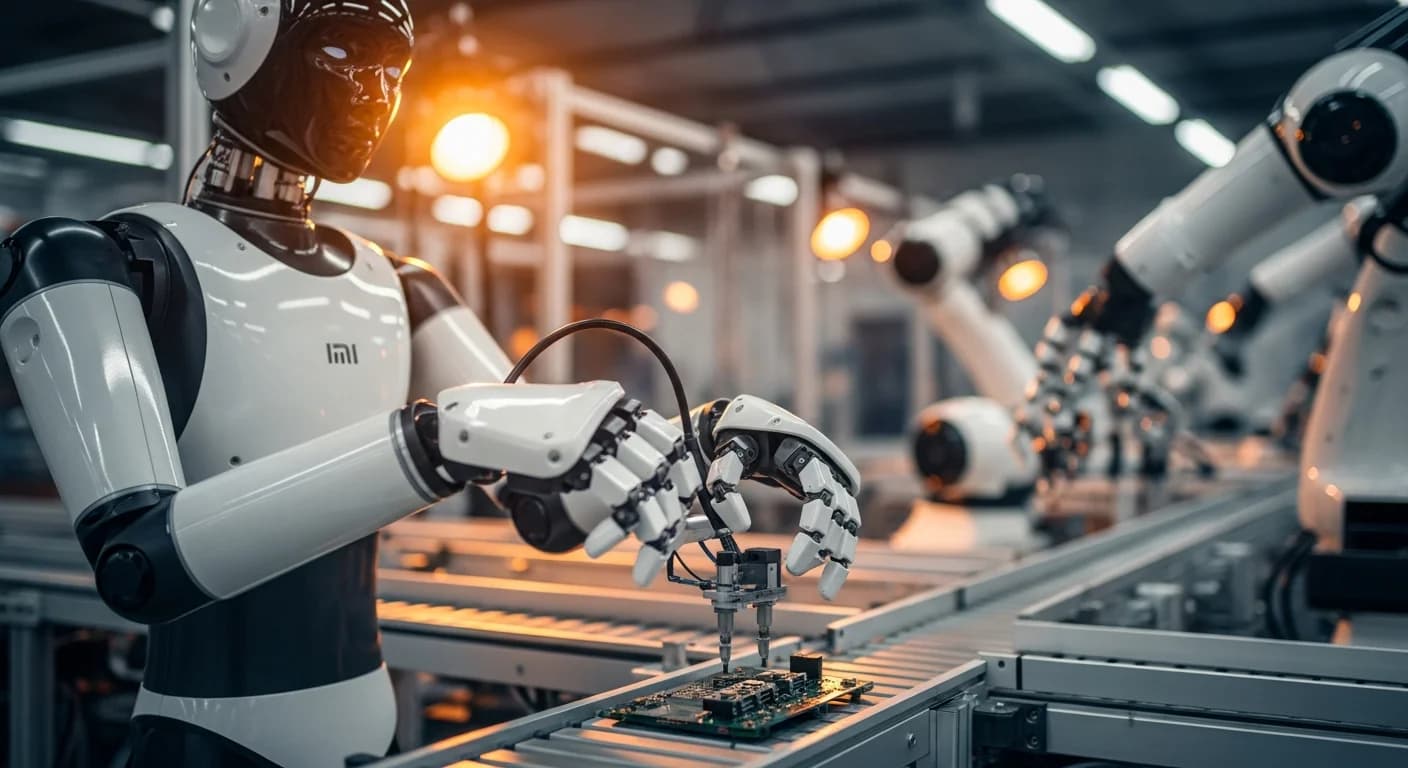
When Xiaomi first showed its humanoid robot at the April 2026 investor conference, the demo was calibrated for social impact: handing out gifts, shaking hands, acting more like a greeter than a factory hand. Six months later, that same robot is sorting soft-molded center console panels and folding cardboard boxes on the SU7 electric vehicle production line, tasks that require whole-body coordination, force-sensitive fingertips, and real-time adaptation.
The fastest route from a robotics showcase to a factory floor just got a new benchmark. And it belongs not to a legacy automaker or a Silicon Valley lab, but to a Chinese consumer electronics company that started selling cars four years ago. This pace of iteration is part of a broader trend where manufacturers leverage their own AI stacks for hardware, as seen with Alibaba's Qwen powering over 150,000 devices.
Two workstations, one leap
Xiaomi's robot now operates two distinct stations that would trip up most traditional industrial arms. At the first station, it extracts irregularly shaped, soft-material center console side panels from three rows of bins and places them into a precision fixture rack. The reach into the far bin forces the robot to grip the edge of the bin with one hand for stability while extending the other, a whole-body compensation move that requires proprioceptive force sensing across its frame. It then executes multi-step hand-to-hand transfers to rotate the panel before insertion. If the panel meets resistance, the robot autonomously retrieves it, re-adjusts the angle, and retries.
At the second station, the robot folds and recycles boxes. It must pull open box latches using fingertip-level force control that typical industrial grippers cannot manage, then fold the box flat using dual-arm coordination, stack multiple folded units, and push them to a target position. Multiple robots coordinate their actions and match production line rhythm, this station is now running in continuous production. Such adaptive behavior echoes a new framework that lets robots handle novel setups without retraining: the In-Context World Modeling approach.
Six months ago, the robot operated a single self-tapping nut station performing repetitive screw insertion at 98% reliability. The jump from a fixed-pose power tool operation to bimanual, force-adaptive logistics is the kind of capability leap that most humanoid roadmaps pencil in over three to five years, not one.
The Musk gap
Xiaomi's achievement undercuts a statement Elon Musk made in January 2026, when he said Optimus was not yet capable of useful factory work. At the time, the claim seemed safely conservative: the humanoid robotics industry had produced more demonstration videos than deployed units. But Xiaomi's robot is now doing precisely what Musk said wasn't feasible, and doing it on a live production line making a mass-market electric vehicle.
The comparison is not apples-to-apples: Figure 03's deployment at BMW remains the global benchmark for humanoid-in-factory integration, with broader task coverage and longer operating history. But Xiaomi's progress is notable because of the starting point. The company had zero dedicated robotics history before 2023. It built the humanoid hardware in-house, developed the whole-body control stack from scratch, and moved from a single-station screw-driving proof-of-concept to multi-station bimanual operations in six months.
That trajectory suggests that vertically integrated AI-hardware companies, those that control the model, the actuation, and the deployment environment, may be able to iterate faster than the modular, standards-based approach favored by Western robotics startups. This mirrors how reinforcement learning frameworks are being streamlined for faster deployment, as seen with the tinker-atropos integration layer.
Why force sensing matters
The key technical differentiator is proprioceptive force sensing paired with an active compliance strategy. Traditional industrial robots execute pre-programmed trajectories and stop, or damage something, when they encounter unexpected resistance. Xiaomi's robot detects resistance mid-motion and adapts: retrieving a misaligned panel, adjusting its grip angle, trying again. This is the difference between a CNC machine and a human hand, and it's the core capability that lets a humanoid handle soft, deformable materials without jamming the line.
The box-latch operation is a telling example. Opening a cardboard latch requires applying exactly enough force to overcome the latch's spring resistance without crushing or tearing the thin cardboard. That's a sensorimotor feedback loop that typical pneumatic grippers treat as a binary success/failure signal. Xiaomi's robot treats it as continuous state estimation, and it's now doing it at line speed. The ability to adapt in real-time is a challenge being tackled across the industry, including in multi-agent coordination, where group chats are becoming proving grounds for multi-agent systems.
The industrialization timeline is compressing
Six months from a handshake demo to a 90%+ success rate on flexible workpiece operations is not a small data point. It suggests that the humanoid robotics industry's longstanding problem, bridging the gap between a compelling YouTube demo and a reliable factory deployment, may be closer to solution than the prevailing skepticism assumes.
For the Chinese manufacturing ecosystem, the implications are direct. If a consumer electronics company can put a humanoid on a car line in half a year, the same playbook can be replicated across assembly, sorting, packaging, and material handling in the thousands of factories that supply Xiaomi, BYD, CATL, and their peers. That is a scale effect that no Western humanoid company can match today.
The question that remains open is whether Xiaomi's approach, tight vertical integration, fast iteration, single-product-line focus, will generalize to the broader multi-task, multi-environment flexibility that humanoids are supposed to deliver. One line, two workstations, one year of total deployment time. The next station will tell the story. As edge AI hardware becomes more accessible, the gap between prototype and deployment narrows further, as shown by the open-sourcing of Nvidia's DeepStream.
- Source : Xiaomi's humanoid robot just did what optimus hasn't: real factory work — 2026-07-15
Get the tech essentials in 3 minutes every morning
One email, every weekday, with what actually matters in AI and tech.