Agent Memory
TEPA: for AI agents, a stale memory is worse than none
Agent memory has a falsifiability problem, a new arXiv preprint argues: stale facts stay retrievable and pollute the prompt. Its TEPA mechanism revokes superseded memories, and in drift tests naive memory scored below no memory (0.210 vs 0.309) while TEPA reached 0.950.
Emmanuel Fabrice Omgbwa Yasse AI-assisted
2026-08-19 · 4 min read
In a controlled drift test where the underlying regime flips completely, a language agent with no memory at all scores 0.309, while an agent with a standard append-only memory scores 0.210. Remembering made it worse, the latest instance of a pattern researchers keep hitting: tools, too, can make easy questions harder.
The inversion is the subject of TEPA, an arXiv preprint submitted on August 7, 2026. The paper's central claim is that long-term memory gives language agents a falsifiability problem: when the world changes, stale memories stay retrievable and pollute the prompt. It names the resulting degradation "memory pollution," defined as the harm caused by active memories that newer conflicting evidence has superseded.
The proposed fix is a revocable evidence-memory mechanism. TEPA represents observations as keyed precedents, and when fresh evidence contradicts an active precedent under the same key, the precedent is revoked. Retrieval then draws from current evidence, while the revoked history is preserved for audit.
Why stale memory scored below no memory
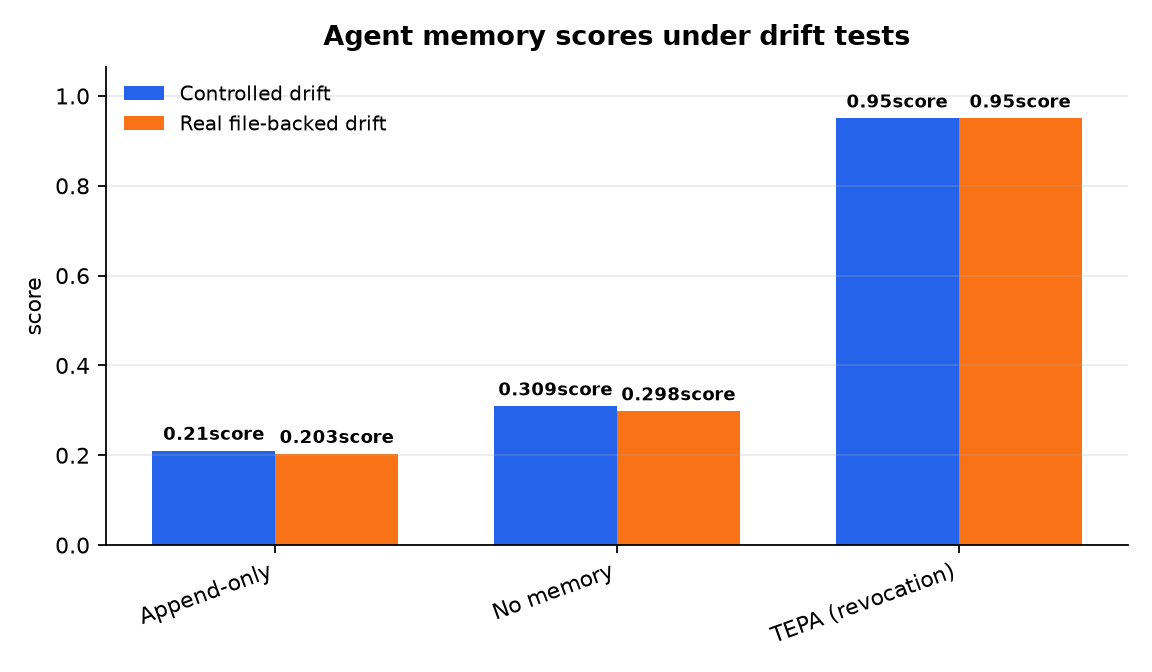
The strongest results come from controlled hidden-regime drift over 50 seeds. During full reversal, append-only and last-write-wins memory both fell to 0.210, below the 0.309 of an agent with no memory at all, while TEPA reached 0.950. The same pattern reproduced under real file-backed executable drift: append-only at 0.203, no memory at 0.298, TEPA at 0.950. The preprint reports the same effect across preference-update streams, where revocation kept stale active memories out of the retrieval set after a reversal.
| Memory strategy | Controlled drift, full reversal (50 seeds) | Real file-backed drift |
|---|---|---|
| Append-only | 0.210 | 0.203 |
| Last-write-wins | 0.210 | not reported in the abstract |
| No memory | 0.309 | 0.298 |
| TEPA (revocation) | 0.950 | 0.950 |
The paper's interpretation is not that TEPA is a better retrieval algorithm. It is that naive memory strategies keep serving superseded facts, and once contradictory evidence exists, those facts drag performance below the no-memory baseline. It rhymes with the regression tax seen when agents are loaded with extra skills: added machinery backfires when the baseline never needed it. A system that remembers nothing at least does not assert an outdated version of the world.
On clean MemoryAgentBench SH-6k data, TEPA only matches a strong last-write-wins cache. The authors read that as confirmation that current-key replacement is the decisive operation for single-hop fact consolidation. The advantage of revocation appears exactly when the world changes, which is the situation a memory system is meant to handle.
Catastrophic remembering vs memory pollution
TEPA arrives alongside a wider body of 2026 research about agent memory that accretes and never lets go. The same trend is visible on the product side, where agents ship with persistent memory spanning the major messaging apps. A companion preprint submitted four days later, "Why Does CLAUDE.md Keep Growing? Catastrophic Remembering in Agentic Coding," charts agentic coding READMEs that grow without bound, stopping only when the repository retires or someone rewrites the file wholesale.
Across 247,694 instruction lifetimes in 1,867 repositories, the authors find that appending an instruction is always cheap, but once an instruction's rationale is gone, deleting it without risking a correctness regression costs O(2^|D|) in a prompt of |D| instructions. They name the divergence catastrophic remembering, the inverse of catastrophic forgetting.
The two papers approach the same gap from opposite ends. One tracks instructions compounding in prompts until a rewrite wipes the file. The other tracks facts going stale in retrieval and poisoning later decisions. Both land on the same diagnosis: agent memory has no lifecycle. Writing to it is cheap, reading from it is cheap, and safe removal is the expensive part that gets skipped. So far the industry response has been compression, not lifecycle management: Qoder 1.0 claims a 40% cut in agent input tokens by rearchitecting around task boundaries. One paper names what happens on the prompt side, catastrophic remembering. The other names what happens on the retrieval side, memory pollution.
Where TEPA runs out of road
The preprint is explicit about its boundaries. Boundary tests on multi-hop and very long-context MemoryAgentBench settings expose retrieval-chain and context-selection bottlenecks that fact-level validity tracking does not address. The same wall shows up elsewhere in agent research: restructuring how agents track task progress lifted success rates from 27% to 79%, with the failures concentrated in long contexts rather than in fact validity.
Those limits mark where the work goes next. The paper closes by arguing that these results establish lifecycle revocation as a core memory operation for agents that must falsify, audit, and later re-promote evolving knowledge. The preserved revocation history is what enables the last of those: if the world flips back, revoked precedents remain available to be re-promoted rather than rebuilt from scratch. Deleting a memory removes the option; revoking one keeps it on file. That is the difference between an agent that adapts to change and one that can only start over.
- Source : TEPA: for AI agents, a stale memory is worse than none — 2026-08-07
Get the tech essentials in 3 minutes every morning
One email, every weekday, with what actually matters in AI and tech.