Coding agents · Devin's two-model harness
Paying 2x more per token made Devin's Fusion 9% cheaper
Devin's Fusion runs a frontier lead model beside a cheaper sidekick, each with its own context. Devin's benchmark tables show task costs dropping as much as 46%, and one case where a lead costing twice as much per token produced a 9% cheaper session.
Emmanuel Fabrice Omgbwa Yasse AI-assisted
2026-09-26 · 5 min read
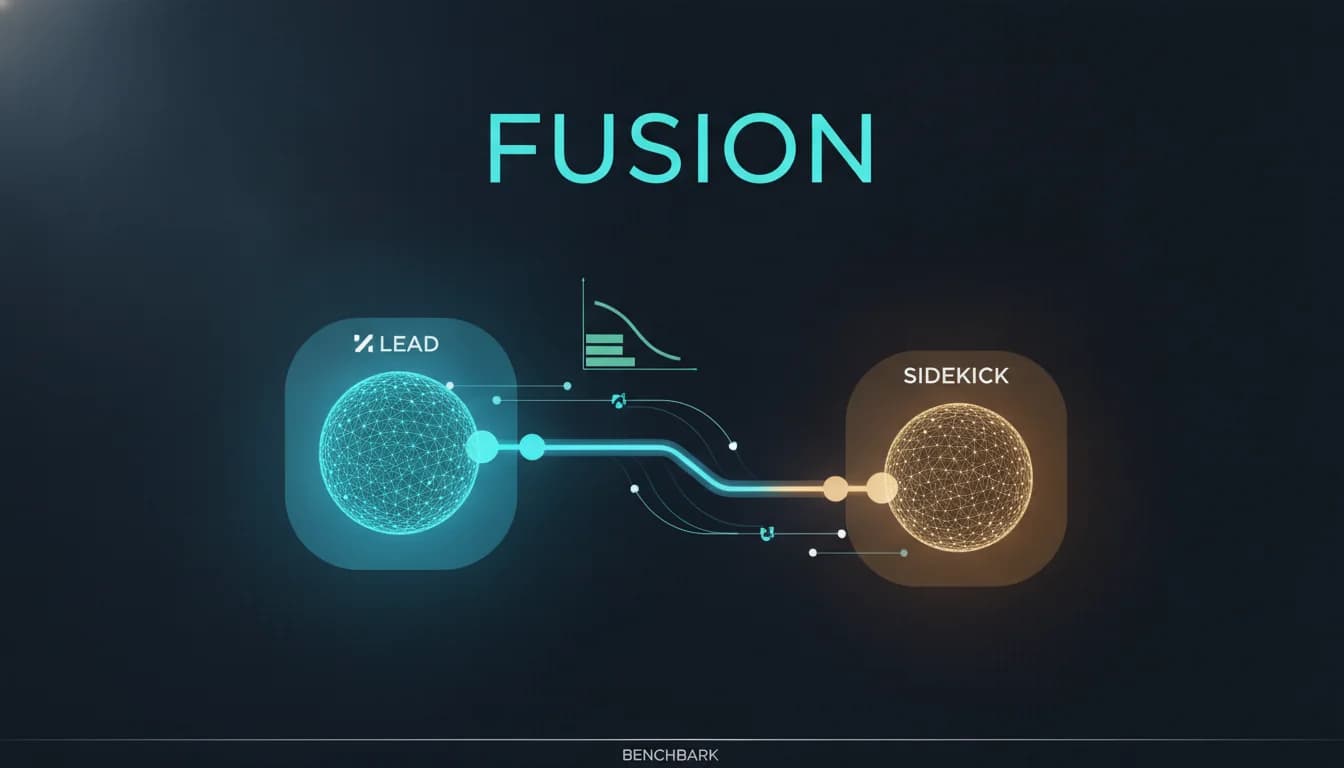
Every argument about the cost of AI coding agents has been fought per token. Devin's Fusion harness, available from today in Devin Desktop and Devin CLI, tries to change the unit. It runs two models instead of one: a frontier model as the lead, which owns the plan and reviews the work, and a cheaper model as the sidekick, which explores code, implements changes, runs tests and reports back. Devin recommends pairing Fable 5.1 with SWE-2.
Devin describes Fusion as up to 39% more efficient than other model harnesses across major coding benchmarks. The benchmark tables, and the way the savings are counted, deserve a closer read.
Fable 5 costs twice as much per token and finishes 9% cheaper
Devin's clearest example is a substitution inside its own harness. Replacing Opus 4.8 with Fable 5 as the lead, keeping the same sidekick, produced sessions that cost 9% less on average while scoring higher on FrontierCode, according to the post. Fable costs roughly twice as much per token.
The sidekick table makes the same point from the other side. Against Astra as lead, moving from GPT-5.6 Luna to SWE-2 raises the list price from $0.20 to $0.75 per million tokens, a 275% increase, while Devin reports the finished FrontierCode task at $2.34 against $2.39, a 2% drop.
Devin's explanation is that price per token measures the wrong thing. A cheap model that needs more attempts, and whose output the lead has to correct, can cost more once the task is finished. Cursor's swarm produced the same effect when it rebuilt SQLite from scratch: the same scores, wildly different bills, per Cursor's SQLite rebuild.
Every number here comes from Devin and its partners
All five benchmark rows were run with Artificial Analysis and Vals AI, according to the post, with savings measured against the single frontier model doing the whole job.
| Benchmark | Fable 5.1 | Fusion (Fable 5.1 + SWE-2) | Astra | Fusion (Astra + SWE-2) |
|---|---|---|---|---|
| DeepSWE 1.1 | 64.3 / $14.63 | 63.1 / $7.88 (-46%) | 67.6 / $7.88 | 67.3 / $4.69 (-40%) |
| Terminal-Bench 4 | 57.6 / $17.46 | 56.1 / $13.37 (-23%) | 55.6 / $10.08 | 50.0 / $6.06 (-40%) |
| SWE-Atlas QnA | 64.8 / $7.57 | 65.9 / $5.00 (-34%) | 61.8 / $5.72 | 59.4 / $3.59 (-37%) |
| Vals Code Migration | 54.6 / $70.97 | 57.3 / $42.00 (-41%) | 67.7 / $44.36 | 61.3 / $35.51 (-20%) |
| FrontierCode 1.1 (Extended) | 63.6 / $2.68 | 63.5 / $1.67 (-38%) | 63.1 / $2.62 | 63.4 / $2.34 (-11%) |
The savings are uneven. The largest cut is 46% on DeepSWE 1.1 with Fable 5.1 and SWE-2, where the score slips from 64.3 to 63.1. The smallest is 11% on FrontierCode 1.1 (Extended) with Astra and SWE-2, where the score edges up from 63.1 to 63.4. Two rows cost the Astra pairing real accuracy: Terminal-Bench 4 falls from 55.6 to 50.0 for a 40% saving, and Vals Code Migration drops from 67.7 to 61.3 for 20%.
The post cites no independent replication, and no benchmark number from a party with nothing to gain from it. Devin says Fusion has run on Devin Cloud for several months.
The prompt-cache problem with switching models mid-task
Devin's case against model routing rests on two claims. The initial prompt does not reveal how hard a task is, since "Fix xyz bug" might be a one-line edge case or a rearchitecture, and the difference shows up only after someone reads the code. Switching models mid-task also breaks prompt caches, pushing cost back onto the expensive model. Routing across a pool of models is now a mainstream design, as Claude Code's model routing shows.
Fusion avoids the switch by keeping both models resident. The lead and sidekick run as parallel agents, each with a persistent context and its own tools, exchanging briefs, results and feedback instead of full conversation histories, so each side keeps its cache intact.
The post names no rival agent that routes mid-session and cites no published routing research. The argument is structural. Devin reports no experiment against a routing agent. Published routing work does target the gap: TRACE-Router treats per-call routers as the blind spot when task-level success is the metric that matters.
Instructions that help one pairing hurt another
The part of Fusion that would be hard to copy is the tuning around the pairing. Devin says it adjusts the harness per combination, because instructions that make one pair efficient can make another worse. That per-combination effect is not unique to Fusion. The regression tax found that loading agents with extra skills can drag performance down rather than up.
- With a weaker sidekick, Fable 5.1 writes more prescriptive briefs, spending lead tokens early to avoid review rounds later. With SWE-2, it leaves more implementation detail to the sidekick.
- Stronger sidekicks are encouraged to challenge the lead's plan, which Devin says catches planning mistakes. Letting weaker sidekicks be opinionated hurts both performance and cost.
- Work needed for planning stays with the lead, because a weaker sidekick may not judge which information matters. Stronger sidekicks are allowed into initial exploration.
Devin calls that last boundary an active area of its research. If the tuning has to be redone per pair, a competitor that copies the two-agent design without it would not reproduce the numbers.
If buyers switch to price per task, token prices stop predicting the bill
Devin's closing recommendation is that models, and model-and-harness combinations, be judged on price per task rather than price per token starting in 2026. Take that seriously and two things follow for procurement. A sidekick's list price stops deciding the deal: SWE-2 costs 275% more per token than Luna and Devin reports it finishing slightly cheaper. Pairing a frontier model with the cheapest available executor also loses its rationale, since the cheapest executor is often the one the expensive model has to fix. That approach demands accounting most teams lack, since their AI coding spend stays largely invisible.
None of this is free of interest. Devin sells a harness whose value depends on buyers accepting per-task accounting, and the only evidence so far comes from benchmarks its own partners helped run. The comparison worth waiting for is a rival routing agent measured the same way on the same tasks.
- Source : Paying 2x more per token made Devin's Fusion 9% cheaper — 2026-09-11
Get the tech essentials in 3 minutes every morning
One email, every weekday, with what actually matters in AI and tech.