Open Source · Vibe Design Workspace
Open Design takes on Claude Design from your own machine
Open Design, an Apache-2.0 vibe design workspace, positions itself as the open-source local answer to Claude Design. Your agent, your keys, your files: no vendor cloud, no subscription, 21 coding agents and 85.5K+ GitHub stars.
Emmanuel Fabrice Omgbwa Yasse AI-assisted
2026-08-22 · 4 min read
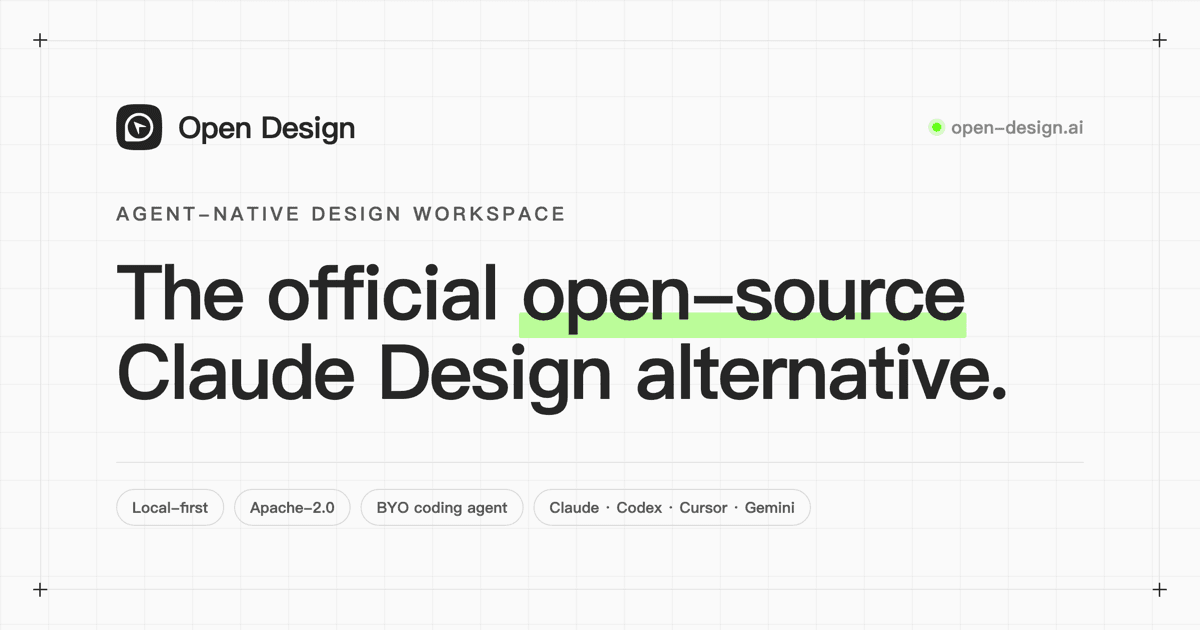
Open Design's founding argument is easy to miss behind the demo shots. When LLMs first proved they could produce real design rather than prose, the project argues, that capability arrived closed, hosted, and tied to a single vendor. Its answer, laid out on open-design.ai, is a workspace that runs on your machine, accepts keys from any provider, and publishes everything under an Apache-2.0 license.
The most striking detail is what does not exist: an Open Design cloud. A local daemon talks directly to whichever provider you bring keys for, and generated artifacts are plain files in your project directory. Only your prompt and the skill context travel to that provider, and billing lands on your own account rather than on an Open Design subscription. The homepage currently runs a campaign banner offering DeepSeek V4 Pro and V4 Flash free for two weeks, a reminder that the tool is built to sit in front of any model, not to lock you into one. The BYOK pattern is spreading across the open-source tooling stack, from API clients to coding agents, and this is one of the clearest expressions of it.
The workflow: your coding agent becomes the design engine
The category it has staked out, "vibe design workspace", means designing by describing intent to an agent instead of placing elements by hand. Open Design does not train agents. It connects the coding agents already on your workstation, among them Claude Code, Codex, Cursor, Gemini CLI, OpenCode and Qwen, to a four-step flow: choose a starting point, define a visual direction, generate the artifact, then deliver it or turn it into an HTML marketing video with HyperFrames. The agent reads the full context, writes executable files, and previews them in a sandbox you can edit live.
A portable brand layer, and a config change between agents
Brand knowledge lives in portable DESIGN.md files. Drop a screenshot or a Figma export into the web interface, and the agent extracts the identity into design-systems/<your-brand>/; every later skill then renders in that brand without re-prompting. Because the skill files and design systems are agent-agnostic, the same SKILL.md renders with Claude Code, Codex, Cursor, Gemini CLI, GitHub Copilot, Grok, Hermes or Qwen. The FAQ compresses the promise into one line: switching agents is a configuration change in the daemon, not a redesign. That portability is the practical difference from a hosted product tied to one provider's models, and it sits on the same rails as the broader push to make skills portable across agents.
The community numbers, the price, and the catch
| Community stat | Figure |
|---|---|
| GitHub stars | 85,500+ |
| Contributors | 402 |
| Plugins | 447+ |
| Design systems | 152+ |
| Coding agents supported | 21 |
The project reports those figures on its site, and the pricing model is as unusual as the architecture: the product is free, there is no subscription, and you pay the API cost of whichever provider you selected, billed directly to you. The trade-offs are stated openly. There is no hosted sandbox yet; the FAQ treats local-first as a design constraint, not a slogan. The minimum setup is a local daemon plus an agent, the daemon runs anywhere Node 24 runs, and teams that self-host typically pin it to a machine on their own network. A hosted sandbox sits on the roadmap, but the FAQ ranks it below the core promise: artifacts in your repo are worth more than documents in someone else's database.
The open-versus-closed fight is not new on this beat. As our earlier coverage of the DeepSeek-V4 preview noted, that release escalated the open-weight race and put pressure on OpenAI and Google to justify their closed-source strategies. Open Design carries the same argument to the design layer, where the lock-in is the workflow rather than the model weights. The same logic is driving xAI to give away Grok Build's full source, and it is why local-first agent frameworks keep shipping desktop-first. Whether local-first can beat hosted convenience at scale is an open question. The pitch, at least, is coherent: you bring the agent and the keys, and what you get back are files you own. It is the same wager behind Bruno's BYOK API client and Andrew Ng's desktop-first OpenWorker: the way to win users off hosted defaults is to hand them their own keys, their own files, and no bill except the compute they actually use.
- Source : Open Design official website
Get the tech essentials in 3 minutes every morning
One email, every weekday, with what actually matters in AI and tech.