Open Source
Sub-200M models are booming while the frontier spends billions
Hugging Face posted a thank-you to the tinkerers behind a finetuning and pretraining explosion of sub-200M parameter models. No benchmarks, no launches, just a signal that open source AI's center of gravity is shifting.
Emmanuel Fabrice Omgbwa Yasse AI-assisted
2026-08-18 · 5 min read
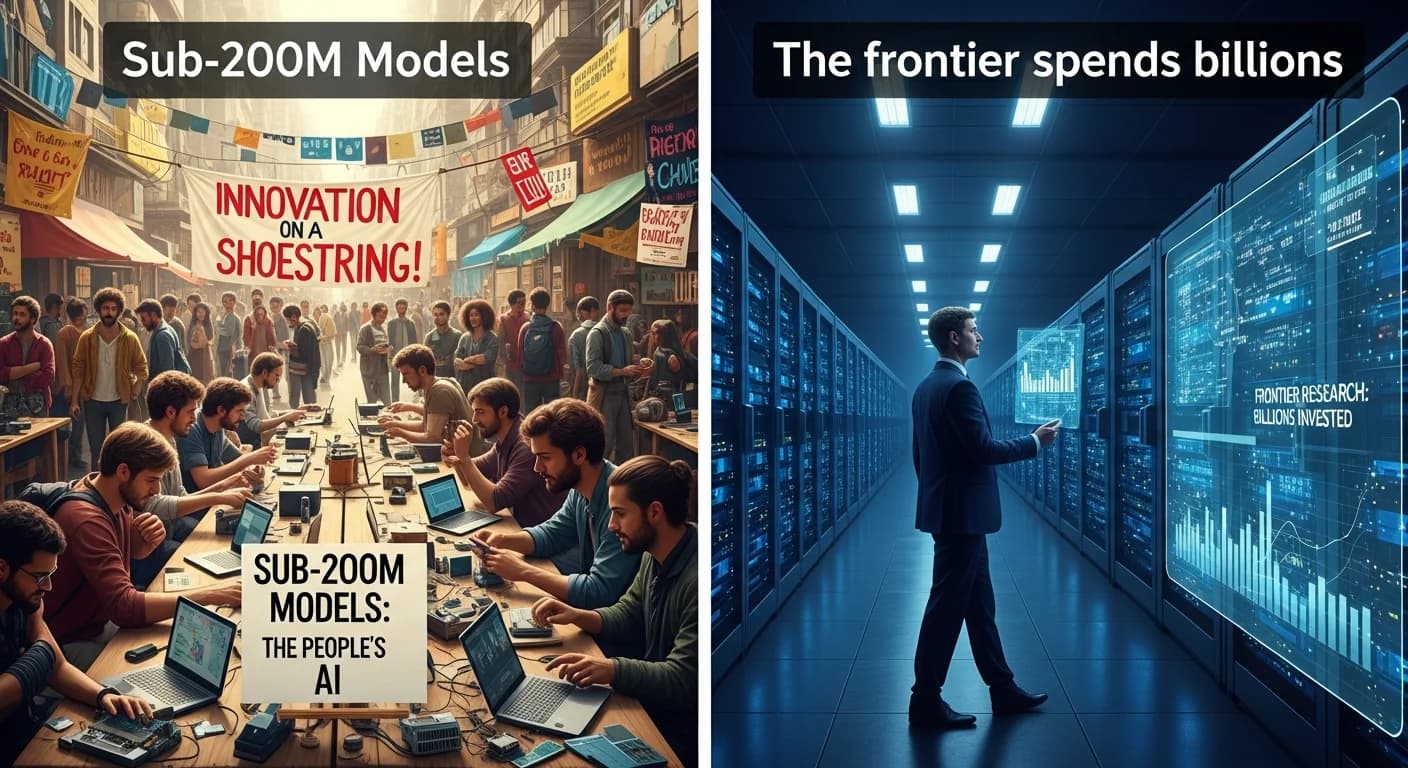
Somewhere between the model launches, the funding rounds and the benchmark bragging, a post went up on Hugging Face that contains no news at all. No release. No score. Just a thank-you note: "I don't know if it was us or one of you guys or maybe all of us at once but lately we have seen a finetuning/pretraining explosion of models below 200m params and we can't be more happy about it." It ends with a call to the people doing the work: "keep coming tinkerers all of this is possible because of you!"
The post names no numbers and cites no projects. It does not need to. Hugging Face is the closest thing this corner of AI has to a census office; when its team says small models are everywhere, that is a data point. The interesting part is what the explosion consists of, and what it says about an industry that has spent two years staring at the top of the model-size chart. The same cheap-training scene produced NanoColibri, a 2.7B MoE trained for about $200 on a relay of rented GPUs.
Small models, oversized training runs
The clearest bet in this corner is BananaMind 2 Micro: 2.9M parameters trained on 75B tokens, a ratio of roughly 25,900 tokens for every parameter. For a model that small the ratio is deliberately lopsided. The project's own word for it is "overtrained," which is useful because it is honest: the imbalance is the strategy, not an accident. Feed a tiny model an enormous volume of data and see how much capability survives per parameter.
What the project has not published is performance. No benchmark scores, no evaluation results, no comparisons. The promise is "maximum intelligence per parameter," and for now that is an intention, not a result. Whether 25,900 tokens per parameter buys real capability is a question the project has pointed at an August training run.
Overtraining is not the only lever that moves small-model scores. A documented experiment added 4.5 points on MATH-500 to a quantized model using an external monitoring controller. Optimizer swaps, Muon in place of AdamW, sit in the same toolbox. The pattern across all of it: at this scale, gains come from training choices, not from adding hardware.
The flood is not limited to language models. The same platform hosts a semantic segmentation model zoo trained on the Varied Drone Dataset, with CABiNet and YOLO26 variants from Nano to XLarge and a top run at 78.83% mIoU. Small, specialized, cheap to run: that is the shape of what Hugging Face is cheering for.
One roof, two races
The contrast with the frontier is not a metaphor. Morgan Stanley has estimated Meta AI's fleet at more than 600,000 NVIDIA H100 GPUs, the largest on Earth, spread across custom superclusters and staffed by roughly 1,200 researchers. A single training run at that scale consumes megawatts and weeks. The sub-200M scene runs on a fraction of that: one GPU, a base model, a dataset, a public weights dump when things work.
Neither race is wrong. Meta ships open weights too, and its lab is measured in adoption rather than revenue; Google's Gemma line hit 300 million downloads on the same math, per the Gemma 4 milestone. The difference is what each side chases: the labs want raw capability, the small-model scene wants capability per parameter. That is the bet behind Liquid's 2.6B agent, which outruns models four times its size. The two have very different economics. The numbers on both sides look nothing alike:
| Project or metric | Number | What it shows |
|---|---|---|
| BananaMind 2 Micro | 2.9M parameters, 75B tokens | 25,900 tokens per parameter |
| BananaMind 2 Micro evals | none published | promise, not a result |
| Quantized model + monitoring controller | +4.5 points on MATH-500 | training levers move small scores |
| YOLO26x-sem (VDD zoo) | 78.83% mIoU | top run on drone dataset |
| CABiNet-Large (VDD zoo) | 77.76% mIoU at 54.8 GFLOPs | efficiency tradeoff |
| Meta AI fleet | 600,000+ H100s, 1,200 researchers | the frontier's scale |
The economics matter because small models run where the users are. A 2.9M-parameter model does not need a supercluster to serve; it can run on a phone, a laptop or a cheap inference box. The same logic works in the other direction: Unsloth squeezed a 975B model from 1.9 TB to 270 GB with 1-bit quantization, per the Inkling compression, holding 74% accuracy. If the overtraining bets pay off, a meaningful share of niche workloads stops needing the frontier's infrastructure at all. That is the open question underneath the celebration.
The credibility gap
The celebration would land better if more of the boom published its results. The drone zoo is what a release looks like when it does the work: model cards, per-class IoU, confusion matrices, training configurations, all public. BananaMind 2 Micro is what a release looks like when it is still a bet. That gap is the distance the movement still has to travel.
Hugging Face's post does not pretend otherwise. It thanks the tinkerers for shipping; it does not claim the results are in. Read charitably, it marks an early milestone, not the destination. The number that will settle the argument is an eval table, from the BananaMind August run or from the next dozen projects in the same vein.
The frontier spends billions and shows its work in press releases. The tinkerers spend almost nothing, and some have yet to publish what the spent tokens bought. The open source economy runs partly on trust, and the projects that do publish are the ones the rest of us can learn from. Ai2 set the bar by opening every checkpoint and data point for Olmo 3 to the public, per that full disclosure. The explosion is real; the receipts are not all in yet.
- Source : Sub-200M models are booming while the frontier spends billions — 2026-08-08
Get the tech essentials in 3 minutes every morning
One email, every weekday, with what actually matters in AI and tech.