AI Platform Strategy
Who controls AI infrastructure: four very different answers just arrived
From Apple's curated ecosystem to ElevenLabs' European independence, four distinct strategies are vying for control of AI infrastructure. Developers and enterprises face a fragmented field with no single winner.
Emmanuel Fabrice Omgbwa Yasse AI-assisted
2026-07-29 · Last updated: 2026-08-03 · 2 min read
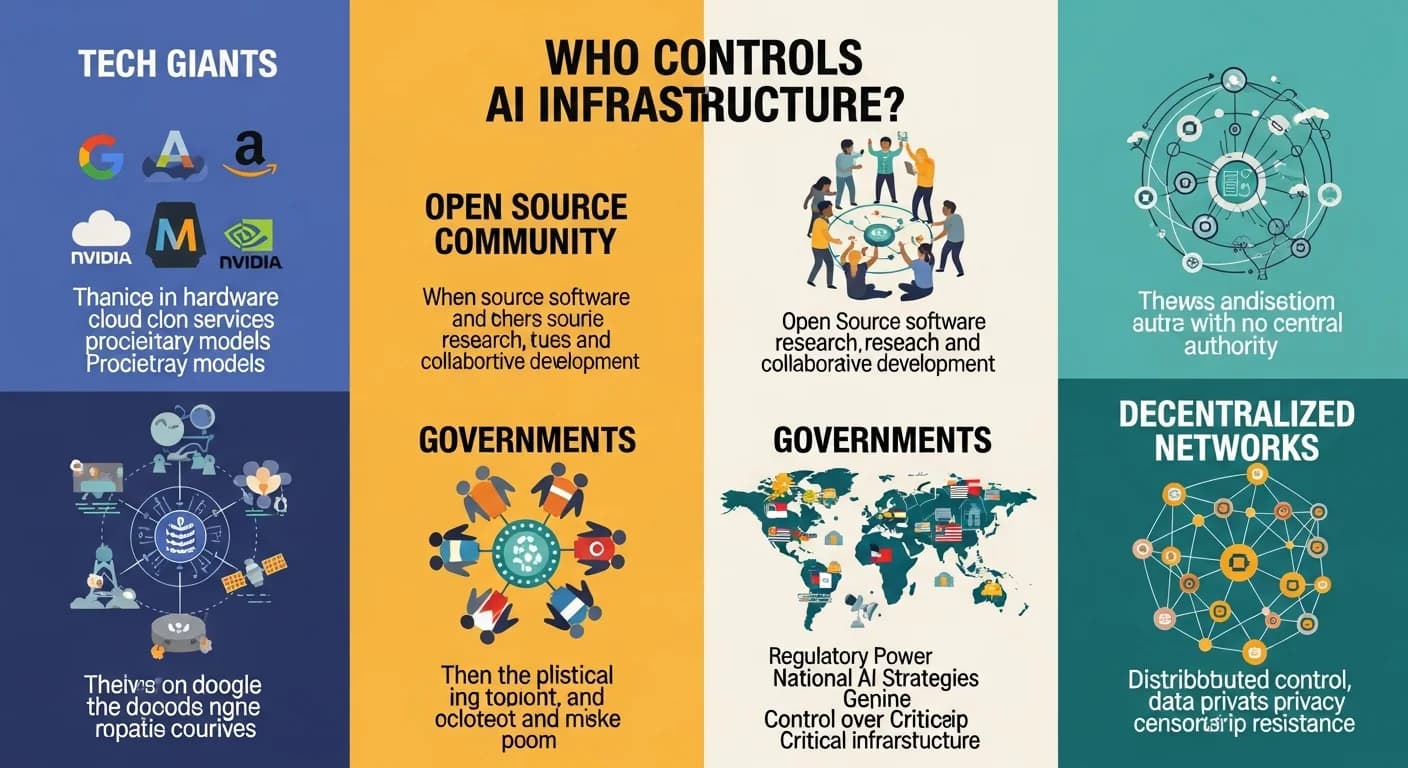
Apple opened a door in its walled garden at WWDC 2025, but kept the keys. Xcode 27 now supports coding agents from Anthropic, Google, and OpenAI. Core AI, a new framework, lets apps run large language models on-device. A language model protocol means any provider can join, on Apple's terms. Developers get third-party models, but the constraints keep Cupertino firmly in control, as our coverage of the announcement detailed.
Nvidia's Nemotron-4, with 8B and 34B parameter variants, aims at Llama and Mistral. The company's own benchmarks show it closing in on GPT-4's reasoning while claiming 30% lower inference costs. But vendor-published numbers need independent verification, as noted in our benchmark analysis. If third-party tests confirm the savings, Nemotron-4 could become a serious self-host option. The deeper play: Nvidia is now a model provider that can tie its software to its chips, making the stack harder to leave. Sakana AI has already integrated Nemotron into its Fugu orchestration system, as reported in a separate report.
AMD targets developers who want local compute. Its Ryzen AI Halo handles models up to 200B parameters on a desktop with 128 GB unified memory. AMD claims a 6x cost saving over cloud GPU rentals over three years. It runs on Windows and Linux, giving it broader reach than Nvidia's Linux-only DGX Spark. For teams tired of per-token cloud bills, this is a fixed-cost alternative that flips the economics of inference, as our earlier analysis examined.
ElevenLabs brought its third summit to Warsaw's National Opera, drawing 2,500 attendees, the Polish president, and a16z investors. Founders Mati Staniszewski and Piotr Dabkowski grew up nearby, making the venue choice personal and political. The company frames its mission around three sovereignties: data, infrastructure, and talent. The message is clear: European AI is building its own ecosystem, not just adopting American or Chinese platforms. Our coverage from the event captured the details.
None of these four plays is a clear winner. Apple keeps control but gives developers options. Nvidia lowers cost but shifts trust from benchmarks. AMD flips the economics but demands upfront cash. ElevenLabs offers a safe harbor but limits integration scale. The market is fragmenting, and the winners will be the ones that ask the least of their users.
The common thread: every move is an attempt to shift the center of gravity in AI. Apple wants control of the user experience. Nvidia wants to own the stack from chip to model. AMD wants to reclaim the desktop. ElevenLabs wants to prove Europe can compete. Developers and buyers should watch which bet pays off, because the platform choices made today will lock in tomorrow's AI applications.
Get the tech essentials in 3 minutes every morning
One email, every weekday, with what actually matters in AI and tech.