Hardware
A 128 GB desktop that undercuts Nvidia cloud rentals by 6x
AMD's Ryzen AI Halo targets local AI development with 128 GB unified memory, support for up to 200B parameter models, and claims of up to 7.3x faster performance than Apple M4 Pro on certain image generation tasks. The platform runs on both Windows and Linux, a differentiator against Nvidia's Linux-only DGX Spark.
Emmanuel Fabrice Omgbwa Yasse AI-assisted
2026-07-25 · Last updated: 2026-08-03 · 5 min read
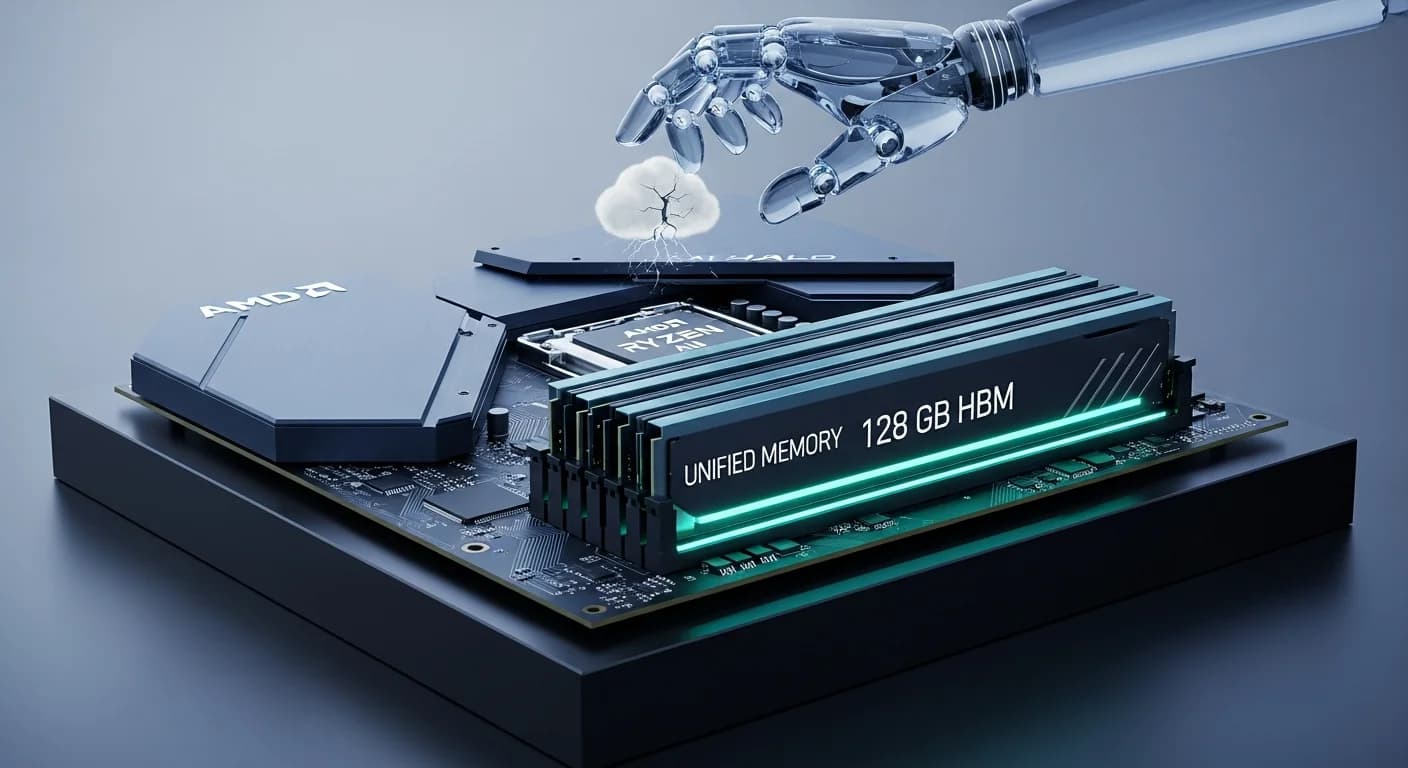
Every AI developer knows the math: rent a cloud GPU, pay per token, watch the bill climb. AMD is now selling a machine that flips that equation, a one-time hardware purchase that, according to the company's own modeling, costs six times less than equivalent cloud API usage over three years. The pitch arrives as Nvidia crosses $3 trillion again, a sign that cloud GPU spending isn't slowing down.
The Ryzen AI Halo platform, built around the Ryzen AI Max+ 395 processor, is AMD's most aggressive push yet into the developer desktop market. It ships with 128 GB of LPDDR5x unified memory, 60 FP16 TFLOPS of GPU performance, and a 50-TOPS NPU. The headline feature: it can run models with up to 200 billion parameters locally, without offloading to remote servers.
AMD is positioning this as a workstation for AI developers who are tired of the cloud treadmill, people who prototype locally, fine-tune models, and run inference repeatedly on the same data. The pitch is that instead of paying per API call, you pay once for the silicon and let the electricity bill handle the rest. For teams that run inference ten thousand times a week, the math shifts from variable to near-zero marginal cost.
Benchmarks that pick fights
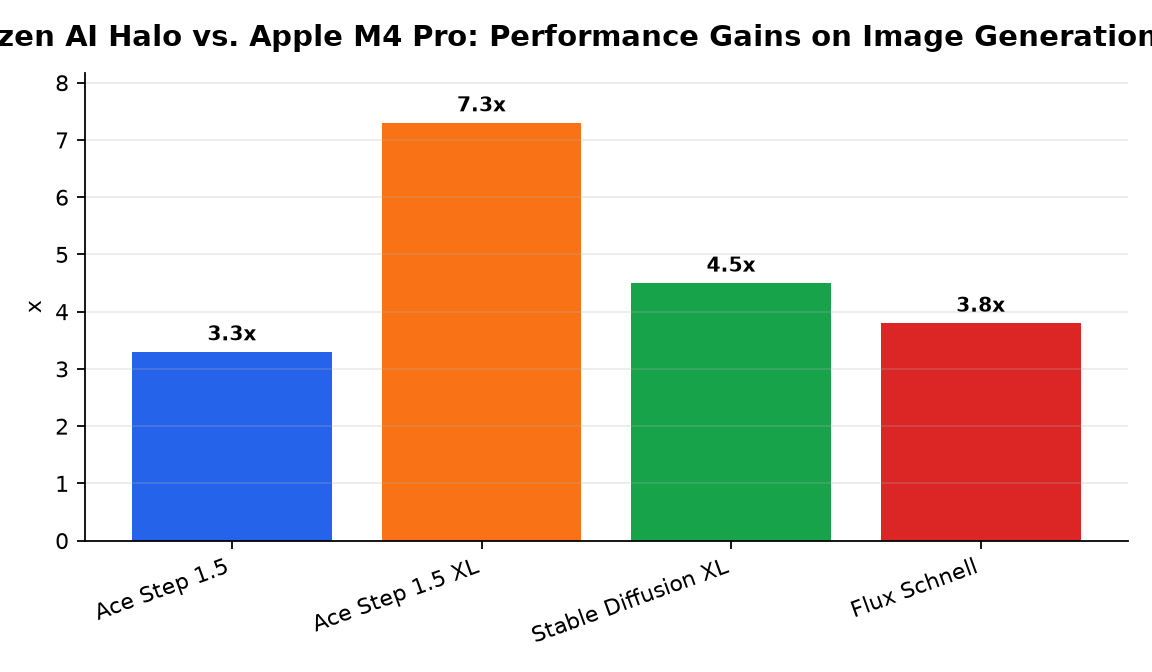
AMD's published benchmarks go after two competitors specifically. Against the Apple M4 Pro, AMD claims the Halo platform is up to 3.3x faster on Ace Step 1.5 and up to 7.3x faster on Ace Step 1.5 XL, both image generation workflows. Stable Diffusion XL runs 4.5x faster. Flux Schnell, a popular open-source model, is up to 3.8x faster.
Against the Nvidia DGX Spark, AMD's numbers are more measured but still punchy. The Halo system shows a 14% lead on GLM 4.7 Flash (a 30B model), 7% on GPT-OSS-120B, and 12% on Qwen 3.5-122B. These are not blowout wins, but they land in the territory where a developer might notice the difference during iterative work. The single-machine setup also sidesteps the distributed-training inefficiencies that eat into cloud GPU hours, as infrastructure bottlenecks increasingly dictate total cost.
What might matter more than raw speed: AMD supports both Windows and Linux out of the box. The Nvidia DGX Spark runs Linux only. For teams that depend on Windows-specific workflows or enterprise IT policies, that difference alone could decide the purchase.
The cloud cost argument
The 6x cost advantage AMD cites depends heavily on usage patterns. The company models a "sustained-use scenario" where a developer runs inference workloads continuously over three years. In that model, the upfront hardware purchase plus electricity beats the recurring cloud API bill by a wide margin. For lighter usage, the math tilts back toward cloud rental. No one buys a workstation to run five inference calls a day.
But the argument gets stronger when models are large enough that cloud GPU memory becomes a bottleneck. Running a 120B-parameter model on a cloud instance with enough VRAM costs more per hour than the standard T4 or A10 instances most startups use. At that point, local hardware with 128 GB of unified memory starts looking cheap. This local-first approach mirrors the efficiency logic of speculative decoding, where cheaper local compute hides latency without sacrificing output quality.
AMD is also shipping pre-configured software through the Ryzen AI Halo Developer Center app, with one-click setups for frameworks like Ollama, LM Studio, vLLM, and PyTorch. The company's AI Playbooks provide guided workflows for image generation, coding assistants, and LLM fine-tuning, lowering the friction of getting started on new hardware, a place where previous AMD developer machines sometimes stumbled.
Nvidia's ecosystem moat
For all the benchmarks and cost arguments, AMD still has a software problem. Nvidia's CUDA ecosystem is the default development environment for nearly every foundation model lab. The barrier to entry for competitors is not just hardware performance but the entire toolchain: training frameworks, inference engines, container images, and community support that has been refined over a decade.
AMD's answer is ROCm, its open-source GPU compute stack, which now supports the Halo platform. AMD claims "Day 0 support" for new generative AI models, and the pre-installed Developer Center app should help. But CUDA's network effects are real: a developer debugging a weird shape error at 2 a.m. is more likely to find a Stack Overflow answer for CUDA than for ROCm. The gap persists even as Nvidia teams with Hugging Face to simplify distributed training, further entrenching its ecosystem.
AMD's play here is not to beat CUDA on the training cluster. No one expects that. It's to win the desktop, the machine where developers prototype before they go to the cloud. If a team builds its pipeline on an AMD workstation and only moves to cloud GPUs for the final training run, AMD captures the daily-use machine. That local-first workflow aligns with the formal agent architectures that benefit from low-latency, offline compute for iterative tool use.
The bigger picture
AMD's Ryzen AI Halo arrives at a moment when the economics of cloud AI are under increasing scrutiny. Startups that based their unit economics on cheap API inference are watching costs rise as models get larger. A one-time $3,000-$5,000 workstation (AMD has not announced final pricing for the Halo line, but comparable Pro-level machines sit in that range) starts to make sense for a team that runs inference ten thousand times a week.
The platform is available in the United States initially, with a PRO version (the Ryzen AI Max+ PRO 495) supporting 192 GB of memory coming later. That bigger memory pool would allow local inference on models approaching 300B parameters, territory that currently requires multi-GPU cloud nodes. For the largest open models, developers might still turn to optimized local hardware like Poolside's 33B model, which achieves strong results on compact silicon.
AMD is not going to displace Nvidia in the data center overnight. But it might just put a local inference machine on 10,000 developers' desks first.
- Source : AMD Ryzen AI Halo product page
Get the tech essentials in 3 minutes every morning
One email, every weekday, with what actually matters in AI and tech.