Physical AI
Nvidia's 4B model does what most small robots can't: act, not just talk
Nvidia's Cosmos 3 Edge packs world modeling into 4B parameters, ranking first on VANTAGE-Bench among its size class. Its dual-transformer design blends reasoning with real-time action prediction for robots, all deployable on Jetson and RTX hardware.
Emmanuel Fabrice Omgbwa Yasse AI-assisted
2026-07-28 · 5 min read
Nvidia released Cosmos 3 Edge on Hugging Face today, a 4-billion-parameter open world model built for edge devices like the newly announced Jetson T2000 and T3000 modules. The model aims to do for small, on-device robotics what larger Cosmos versions do for cloud-based physical AI: help machines understand what they are seeing, predict what happens next, and, crucially, generate actions in real time. The category of compact world models is getting crowded, as seen with Alibaba's Qwen taking a language-first approach to world modeling.
The number that jumps out is parameter count. At 4B, Cosmos 3 Edge competes in a relatively unglamorous part of the model size spectrum, small enough to fit on a single RTX GPU or a Jetson module, yet claiming best-in-class throughput and accuracy among peers of the same size. Nvidia says it ranks first on VANTAGE-Bench for vision analytics and sets a new state of the art for robot policy learning. Those are not vague claims: VANTAGE-Bench is a public benchmark for vision analytics, and the robot policy claim refers to control tasks where the model outputs 32 actions per inference at 15 Hz on Jetson Thor. Nvidia has a track record of pushing the boundaries on benchmarks, as their recent embedding models also topped leaderboards with real-world cost savings in mind, per their embedding model announcement.
Two transformers, one shared brain
The design is the story. Cosmos 3 Edge stacks two transformer towers, autoregressive and diffusion, that share a common set of multimodal attention layers but keep separate normalization and MLP layers. The autoregressive tower processes vision and text tokens for understanding and reasoning. The diffusion tower handles vision, audio, and action tokens for prediction and generation. Tokens flow differently depending on the mode: language uses causal attention (each token sees only earlier tokens), while diffusion tokens attend more broadly to the available context.
That dual tower setup matters because it means the model can reason about a scene first, then generate an output, whether that output is a text caption, a predicted video frame, or a robot joint angle. Most small VLMs top out at captioning or Q&A. They do not produce action sequences. Cosmos 3 Edge does, and it does so by mapping different embodiments, a robot arm's end effector pose, a vehicle's ego motion, a gripper's grasp state, into a common action representation of translation, rotation, and manipulation state vectors. This kind of architectural innovation in small models echoes how parallel agent systems succeed through careful design, not just raw speed.
Policy mode: predict and act together
The model ships with a post-trained variant called Cosmos 3 Edge Policy (DROID), fine-tuned on the DROID dataset for pick-and-place tasks. In policy mode, it predicts an action together with its expected visual consequence. Nvidia says developers can use a small cluster of H100s or a DGX Station to fine-tune the 4B model for their own workflows, then deploy to edge hardware.
The upside of open weights is that you get to own the deployment. The downside is that you are responsible for getting real-time latency out of a 4B transformer on a Jetson module, which is hard, but Nvidia knows its own hardware well enough to release guidance alongside the model. The company also released Cosmos 3 Super 4-Step distillation checkpoints, which cut diffusion steps from 35, 50 down to 4, delivering up to 25x faster inference for text-to-image and image-to-video tasks. That distillation recipe is a separate 64B model, not the 4B Edge variant, but it points to a pattern: Nvidia is building out a family of post-training tools, not just checkpoint drops. The need for such post-training optimization is underlined by research showing that speculative decoding can hide latency without changing outputs, a technique Nvidia might leverage.
How it compares
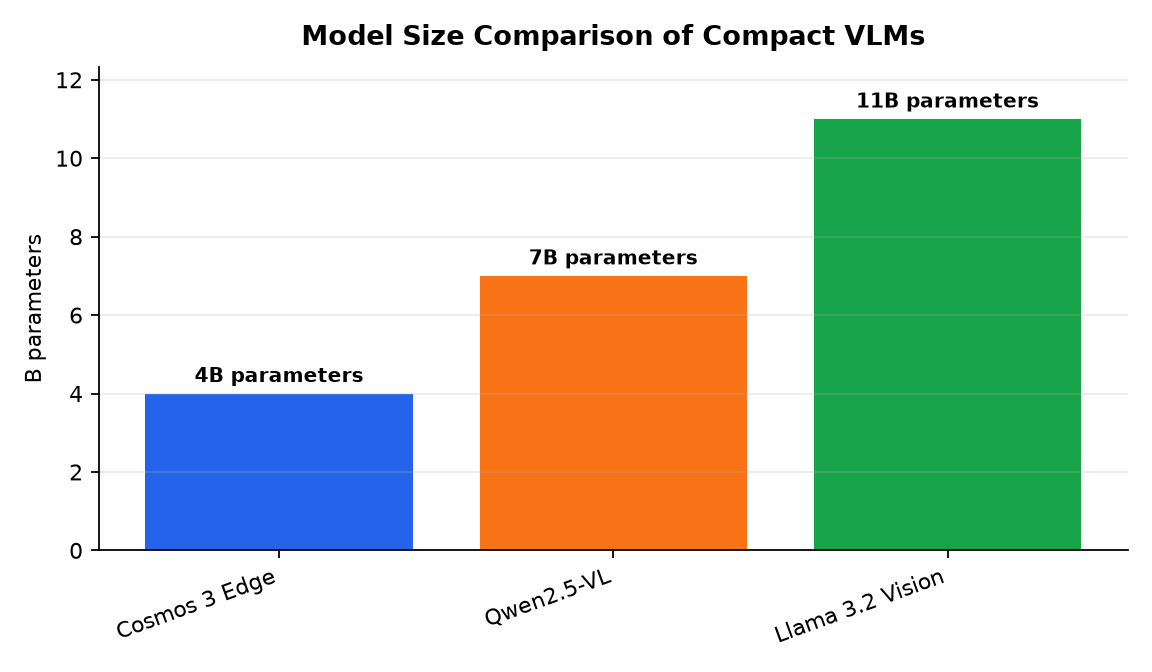
Cosmos 3 Edge is not a direct competitor to frontier closed models like GPT-4o or Gemini, because it does not need to generalize across the entire internet. It is built for a narrower slice: factory floors, warehouses, hospital corridors, any place where a camera and a robot arm coexist. The interesting competition is against other compact open VLMs that claim robotics capability, notably Qwen2.5-VL (7B, but can be quantized) and the various fine-tunes of Llama 3.2 (11B vision). Nvidia's edge is architectural: the dual-tower design with shared multimodal attention and native action output is not something you get from a vanilla VLM. Most robot policies built on top of a VLM bolt a separate action head on top. Cosmos 3 Edge bakes action into the representation from the start.
The tradeoff is that you need Nvidia hardware to run it well. The model was designed explicitly for RTX, Jetson, and DGX. That is convenient if your stack already runs on Nvidia, less so if you are optimizing for a different edge chip. This hardware lock-in is a recurring theme in AI deployment, similar to the strategic moves seen when Google secured a year to lock down Android AI.
What this means for the robotics field
Robotics researchers have been asking for open, compact world models that can run on-device and produce actions, not just descriptions. Cosmos 3 Edge answers that, but it also loads a labor cost onto the user: the model is a foundation, not a turnkey solution. You still need domain-specific data, fine-tuning compute, and robot hardware to close the loop. The open training scripts Nvidia released alongside the model are meant to lower that wall, but they do not eliminate it. The nuance here is that AI agents still struggle with hierarchical rule application, a challenge that robot policy learning also faces.
A few open questions remain. Nvidia did not publish latency numbers for the Jetson T2000 or T3000, the announcement says the model achieves real-time control at 15 Hz on Jetson Thor, but most edge deployments will run on the smaller modules. The VANTAGE-Bench ranking is self-reported in the release. And while the dual-tower architecture is elegant on paper, independent benchmarks will tell whether the shared attention layers actually bottleneck one tower when both are active. Those details will determine whether Cosmos 3 Edge becomes the default edge world model or remains a promising reference design that few teams fully deploy. As the industry has seen with other compact models, the gap between benchmark promise and real-world deployment can be wide, as noted in analysis of BMW's context optimization on limited hardware.
- Source : Nvidia Cosmos 3 Edge on Hugging Face
Get the tech essentials in 3 minutes every morning
One email, every weekday, with what actually matters in AI and tech.