AI Models
Macaron-V1-Venti's 748B four-specialist design beats GPT-5.5 and Opus 4.8
Macaron-V1-Venti from MindLab Research leads benchmarks in personal intelligence, coding, terminal use, and Generative UI, using a novel Mixture of LoRA architecture that keeps the model compact while specialized.
Emmanuel Fabrice Omgbwa Yasse AI-assisted
2026-07-27 · Last updated: 2026-08-03 · 3 min read
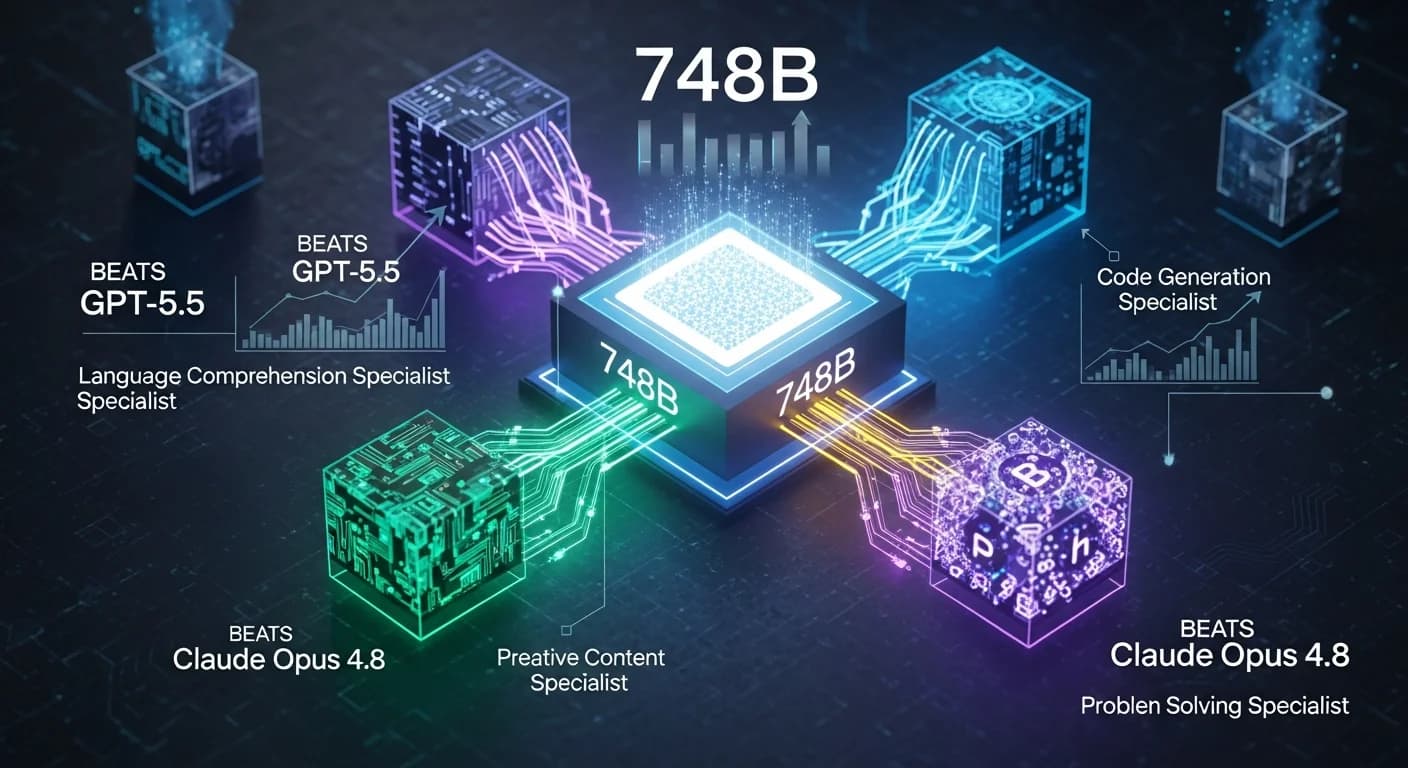
MindLab Research has released Macaron-V1-Venti, a 748 billion-parameter model that claims the top spot on a suite of benchmarks covering personal intelligence, coding, terminal workflows, and Generative UI. The model, released under the MIT license, is the first to be post-trained on GLM-5.2 and uses a Mixture of LoRA (MoL) architecture that splits expertise across four specialist modules rather than relying on a single dense network, echoing a similar multi-specialist approach.
Four specialists instead of one
The MoL design pairs a 744B-parameter GLM-5.2 base model with four 1B-parameter LoRA adapters, each responsible for a domain: chat, agent, coding, and GenUI. A router selects the appropriate specialist for each incoming request. This keeps a compact active parameter count while still accessing deep specialized knowledge. The approach differs from typical mixture-of-experts designs by using LoRA adapters, which are cheaper to train and swap, and highlights model routing's true cost.
Macaron-V1-Venti succeeds the earlier Macaron-V1-Preview and expands training on personal-agent tasks and Generative UI. The post-training pipeline uses MindLab's MinT and MindForge systems, designed to align the model with the production harness used for agentic workflows. The model supports a context length of 1 million tokens, enabled by a long-context training infrastructure called LongStraw that handles multi-million-token reinforcement learning runs.
Benchmark leader across the board
The reported results show Macaron-V1-Venti leading or tying on seven of ten benchmarks compared with GLM 5.2, GPT 5.5, Claude Opus 4.8, Gemini 3.1 Pro, Qwen 3.7 Max, and Minimax M3. On ChatBench, it scores 58.3 against 55.5 for GPT 5.5 and 52.8 for Claude Opus 4.8. On LivingBench, which measures real-world agentic tasks, it reaches 64.0, ahead of Claude Opus 4.8 at 63.8 and GPT 5.5 at 61.9. The model performs strongly on coding benchmarks: it achieves 85.6 on SWE Verified, second only to Claude Opus 4.8 at 88.6, and leads TerminalBench 2.1 at 87.6, well ahead of GPT 5.5 at 83.4 and Claude at 78.9, with Claude Opus 5's benchmark positioning offering contrast.
The biggest gap appears on UI4ABench, where Macaron-V1-Venti scores 87.8, far above GPT 5.5 at 72.1 and Claude Opus 4.8 at 75.9. That benchmark tests Generative UI, the model's ability to generate user interfaces from natural language instructions. The specialist module for GenUI appears to give it a clear advantage there. On PinchBench, which measures tool-use capabilities, Macaron-V1-Venti scores 94.0, ahead of Qwen 3.7 Max at 93.4 and Claude Opus 4.8 at 91.8.
On ClawGym, which measures general agent performance, Macaron scores 77.7, behind GPT 5.5 at 82.5 and Claude Opus 4.8 at 80.5. And on DeepSWE, a more challenging software engineering benchmark, it scores 58.4, behind GPT 5.5 at 70.0, suggesting that while its coding specialist excels at standard tasks, complex multi-step fixes remain a weakness, a pattern also seen in agents hitting creativity walls.
What the numbers say about the approach
The MoL architecture's strength shows most clearly on specialized benchmarks. The coding specialist pushes Macaron ahead of GPT 5.5 on SWE Verified and TerminalBench, and the GenUI specialist creates a large gap on UI4ABench. But on more general benchmarks like ClawGym, which may require dynamic switching or multi-domain reasoning, the model falls behind. The L0 router decides upfront, and when a request needs knowledge from multiple specialists, the current design does not merge them during a single interaction.
MindLab implicitly acknowledges this limitation: the model card notes that ongoing reasoning and tool interactions remain within the selected LoRA, while completed work can be shared across specialists through concise summaries. That suggests collaboration is possible, but not in real time for a single turn.
Open source and availability
The model is released under the MIT license, a move aligned with the open-weight case, though the model card warns users to respect any requirements inherited from GLM-5.2 and its dependencies. Macaron-V1-Venti is available on Hugging Face and can be accessed through a hosted API at mintcn.macaron.xin, which supports OpenAI-compatible chat completions. For self-hosted deployment, MindLab provides a Mixture of LoRA serving harness that keeps the endpoint OpenAI-compatible while adding the router and server-side LoRA metadata.
A companion tool called Macaron Artifacts lets users view generated UIs and sessions, and can be installed as a plugin in Claude Code, Codex, and Kimi Code.
- Source : Macaron-V1-Venti Model Card
Get the tech essentials in 3 minutes every morning
One email, every weekday, with what actually matters in AI and tech.