AI Models | NVIDIA Nemotron 3.5 Lightning
Why Nemotron 3.5 Lightning bets most agent steps don't need a big model
Nvidia's new open model runs locally with 3B active parameters and a 1M-token context, built for agents that stay running. Nvidia claims up to 4x throughput and 30% faster task completion than comparable open models.
Emmanuel Fabrice Omgbwa Yasse AI-assisted
2026-08-14 · 4 min read
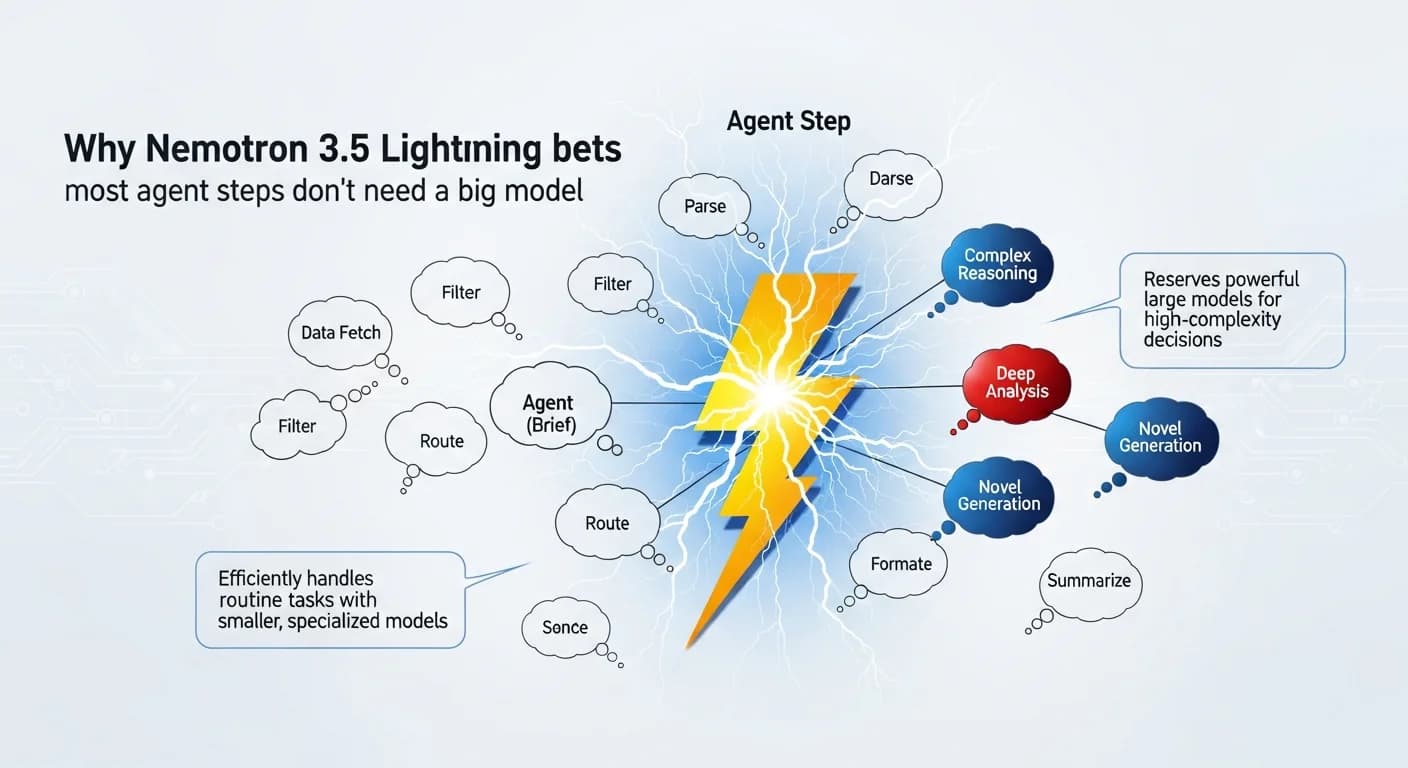
Nvidia's pitch for Nemotron 3.5 Lightning is one sentence: most of the work an agent does doesn't need a big model. Reading a file, calling a tool, sorting a result, retrying a step that failed. Those are the steps that fill an agent's day, and Nvidia thinks a compact model can carry them on hardware you already own instead of billing you per token in a datacenter.
The model arrived on Ollama on August 11. It packs 30 billion total parameters and activates only 3 billion per token, a hybrid Mixture-of-Experts design the company says was built for agents that stay running: gathering context, calling tools, working through multi-step tasks. Run it locally and your data stays on your device, the same data-local logic behind Nvidia's NAIS system.
Three billion active parameters, one million tokens of memory
The number worth pausing on isn't the 30B total. It's the 3B active per token paired with a context window that reaches 1M tokens. The model is cheap to run, which is what you want for the high-volume steps, and the long context leaves room for tool histories that pile up across multi-turn sessions.
Nvidia lists the hardware targets: RTX PCs, RTX PRO workstations, DGX Spark and DGX Station, plus datacenter and cloud. Apple silicon users get a dedicated MLX build, nemotron-3.5-lightning:30b-mlx, the same route Ollama used for Muse Glimmer on Apple Silicon. Setup is one command: ollama run nemotron-3.5-lightning. The model was developed with the Nemotron Coalition and trained for the tools developers already use, across coding, tool calling, instruction following and multi-turn work.
Where a local tier earns its keep
The suggested workloads read like a catalog of the most repetitive jobs in an AI operation. Long-running personal assistants that handle email, calendar and bookings. Coding sub-agents that run tests, search the codebase and apply refactors inside the harnesses teams already use. Security operations: enrich alerts, classify incidents, query logs, correlate indicators, and hand analysts structured findings.
The more interesting suggestion is the hybrid deployment. Nemotron 3.5 Lightning handles the high-volume steps locally, and a larger hosted model picks up the few that genuinely need it. Integrations for Claude Code, OpenClaw, Hermes Agent and OpenCode ship alongside the model, and the same pattern works for models running in Ollama's cloud, so an agent can forward a single step to a bigger model without changing anything else. Open weights and open datasets round out the pitch: teams can post-train the model for one narrow job and run the result anywhere from edge to datacenter.
Throughput is the metric Nvidia is selling
On benchmarks, the company claims 4x higher throughput and 30% faster task completion than comparable open models, with leading accuracy across agentic, coding and reasoning tasks. Those are Nvidia's own figures from its own test configurations; full results live in the launch blog, and independent verification will take time.
The logic behind the numbers is easier to defend. For an agent that stays running, throughput is the number that matters most: more steps per minute means long tasks finish. Nvidia gets there with speculative decoding using multi-token prediction, plus the DFlash and DSpark techniques.
A familiar argument, pushed to the edge
This isn't Nvidia's first pass at the agent-cost problem. Agents burn more tokens per task than a plain Q&A, which pushes up cloud bills even as token prices get cut by 95%. Nvidia's answer across recent generations has been to serve the bulk of those tokens on cheaper hardware.
Nemotron 3 Ultra pushed that logic from the cloud side: a 1M-token context, a fine-tuning recipe built for orchestration, reinforcement learning feedback loops and long-context retrieval, and benchmark graphs that put it in the upper-right quadrant of accuracy versus throughput, ahead of existing open alternatives on agent productivity, code generation and instruction following. Nvidia has also published material arguing that synthetic data matters more than model weights, and that the tuning, not the pretraining, is the moat.
Nemotron 3.5 Lightning carries that pattern to the local tier. The 30B/3B split is a statement about agent economics: most of the steps an agent burns through are cheap to produce, and most of those can run on hardware you already own. The wager is starting to spread: Liquid AI's 2.6B agent fits the same workload under 2.5GB, and Meta's Muse Glimmer is a 30B agent built to run with the cloud off.
None of this settles whether the bet pays off. Vendor benchmarks are a starting point, not proof. What the release does make clear is the direction: Nvidia is treating the local tier as a first-class slice of the agent stack, and a 3B-active model with a million-token memory is a specific, checkable claim about how that tier should work.
- Source : Why Nemotron 3.5 Lightning bets most agent steps don't need a big model — 2026-08-11
Get the tech essentials in 3 minutes every morning
One email, every weekday, with what actually matters in AI and tech.