Governed agentic research
Nvidia's AI ran a hospital study on 286,000 patients, and never touched their data
Nvidia's AI Technology Center unveils NAIS, a governed agentic research system that orchestrates end-to-end biomedical workflows on protected hospital data. In a real-world hypertension GWAS deployment involving 286,422 individuals, the system produced results comparable to expert-led analyses while preserving privacy and enabling human oversight.
Emmanuel Fabrice Omgbwa Yasse AI-assisted
2026-07-19 · Last updated: 2026-08-03 · 5 min read
The promise of AI scientists that can autonomously conduct research has captivated the field. Most demonstrations rely on open data or simulated environments. In a hospital setting, where patient records and genetic data are tightly regulated, the calculus changes entirely.
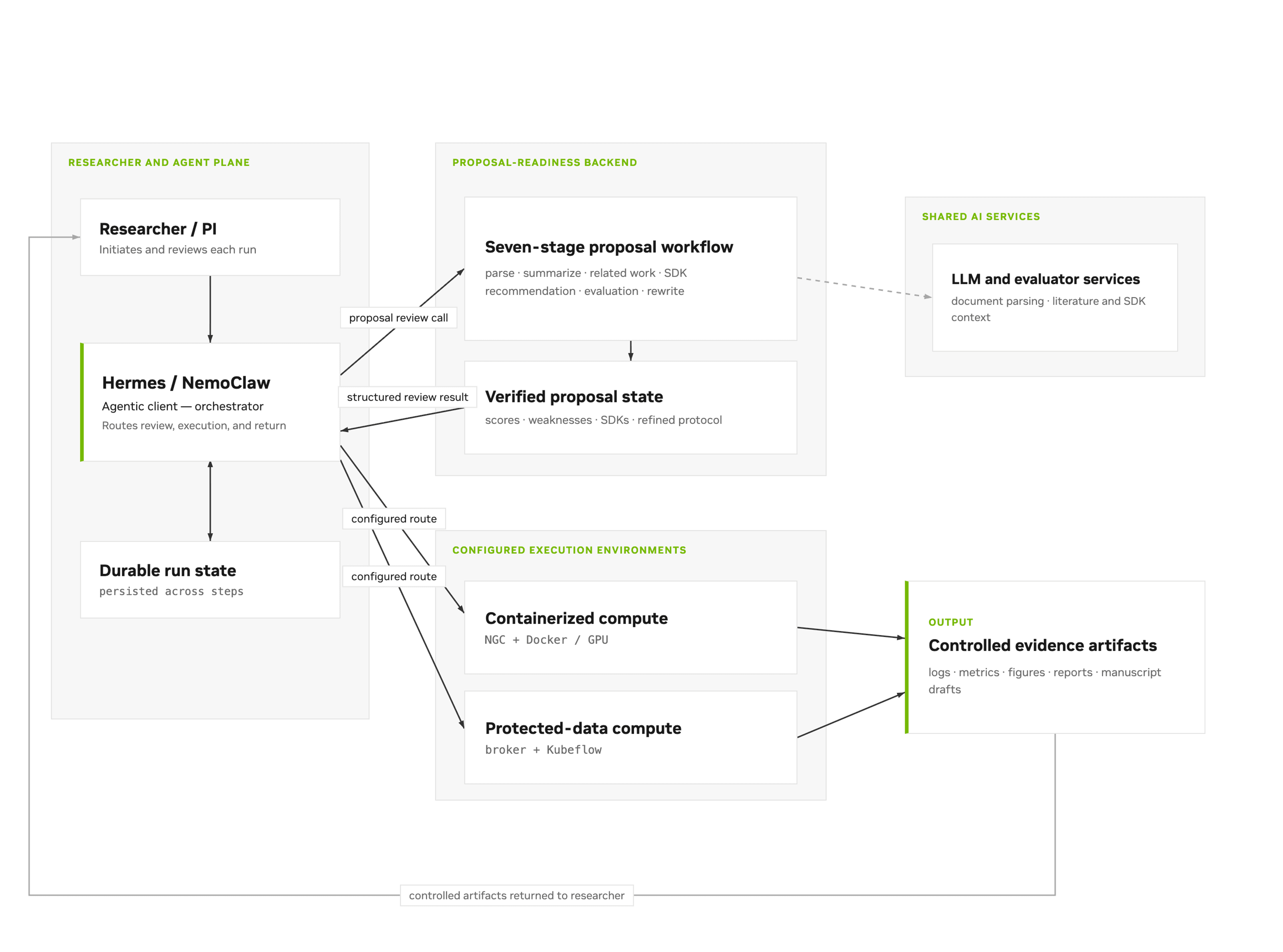
Nvidia AI Technology Center released a paper detailing NVAITC AI Scientist (NAIS), a governed end-to-end agentic research system designed to operate within institutional data boundaries. The primary validation is a real-world hypertension genome-wide association study using hospital-linked genotype and electronic health record data from 286,422 individuals. All of this happened without the AI model ever having direct access to protected health information. This matters because sandbox benchmarks often hide how agents really fail in production environments, according to a new evaluation framework from HKU.
Governance first
The central innovation of NAIS is not its language model capability but its architectural separation between reasoning and data access. Unlike unconstrained AI agents that might get direct database access, NAIS operates through a broker system. The agent submits approved analysis specifications, and the broker materializes cohorts in ephemeral, auditable containers. Only aggregate summaries, quality control metrics, plots, and manifests return to the agent. Raw protected health information never leaves the authorized data warehouse.
This design principle, governance as enabler rather than obstacle, was essential for hospital adoption. The broker v2 API handles SQL cohort extraction, PLINK2 GWAS execution, job polling, and artifact retrieval, all while maintaining a complete audit trail. NemoClaw, the agentic execution component, runs on Nemotron-3 Super with 32,768-token context, deployed entirely on-premise. External network access is blocked by default, requiring explicit team approval for any outbound connections. The infrastructure bottleneck mirrors a broader thesis: as foundation models improve, the binding constraint shifts from language model reasoning to AI research infrastructure, a dynamic explored in Meta's bet on agent infrastructure.
The reality check: phenotype discordance
Perhaps the most instructive finding from the deployment is that the AI's limitations surfaced not in statistical computation but in phenotype design. When NemoClaw initially classified hypertension cases using laboratory blood-pressure thresholds, it produced labels that disagreed with the expert reference definition, which used ICD-10 codes and antihypertensive medication prescriptions, for 3,950 subjects.
This discordance was not random. Among those 3,950 individuals, 73.7% had blood pressure readings exceeding 140/90 mmHg despite absent diagnosis or prescription records. A medication audit ordered by the team found only 125 of the 3,950 subjects had antihypertensive medication records, confirming that the disagreement arose from different conceptual definitions of the disease, not from coding errors.
After team-directed phenotype reconciliation, where discordant cases without medication evidence were excluded, the agent-orchestrated GWAS reproduced established hypertension-associated loci including FGF5, ATP2B1, CNNM2, FTO, and GRB14, matching independently curated expert results in both locus identification and signal direction. The strongest signal at FGF5 reached a -log10 p value of approximately 70.
This iterative refinement process demonstrates a crucial lesson: the value proposition of governed agentic research lies in freeing researcher attention for precisely the kind of scientific judgment that surfaced the phenotype discrepancy, rather than betting on fully autonomous discovery. The gap between prototype and production remains human, as detailed in an analysis of vibe coding's strengths and limits.
Orchestration as primary value
The paper argues that agent value on protected hospital data concentrates in orchestration and phenotype logic, not in replacing statistical genetics. PLINK2 execution is commodity. Deciding whether hypertension means ICD codes, medications, lab thresholds, or their combination is not.
By absorbing repetitive orchestration, drafting and revising SQL cohort plans against the hospital warehouse schema, generating PLINK-compatible phenotype files, submitting and polling Kubeflow GWAS jobs, retrieving Manhattan and QQ plots from manifests, and coordinating reruns after discordance review, NAIS freed researcher attention from script maintenance toward study design and validation.
NAIS also produced a full manuscript draft covering abstract, methods, results, discussion, and tables, as well as presentation materials. All artifacts required team review before any publication use, demonstrating manuscript-oriented output under governance rather than autonomous publication. This orchestration-first approach aligns with findings from Cognition Labs' work on measuring engineering hours saved by AI agents.
Beyond GWAS: a secondary validation
Parallel to the GWAS work, NemoClaw supported a drug-induced liver injury prediction workflow. Starting with near-random baseline performance (AUC 0.491, 0.549), the agent progressively incorporated literature-guided prompts, molecular graphs, DiffDock binding scores, and Boltzmann-weighted probabilities, ultimately achieving a multimodal graph neural network AUC of 0.842. This secondary case study validates that NAIS supports multiple biomedical workflow types on the same governed platform.
Limitations and the road ahead
The authors are frank about the constraints. The NAIS deployment is a single-institution case study, and broader claims require validation across additional hospital environments and data governance frameworks. The GWAS results are replication evidence, not novel discovery, lead loci are identified qualitatively from Manhattan plot inspection, and exact per-SNP effect sizes were not extracted for the manuscript. The DILI prediction dataset of 390 compounds is insufficient for clinical-grade validation.
At the system level, the proposal-review evaluator statistics represent only 18 production runs, and variability in container execution paths warrants continued evaluation.
The infrastructure bottleneck
The paper surfaces a broader thesis about the future of autonomous research: as foundation models improve, the binding constraint shifts from language model reasoning to AI research infrastructure. Future research agents should function as orchestrators coordinating GPU clusters, containers, workflow engines, and domain pipelines rather than universal executors. Progress depends as much on infrastructure, GPU computing, containerized execution, workflow orchestration, experiment management, reproducible environments, as on foundation-model improvements. This resonates with the disappearing cost of GPU hopping in cloud infrastructure.
NAIS is a blueprint for that vision. The system demonstrates that governed agents can contribute meaningfully to the full research lifecycle near protected clinical data, provided persistent experimental state matters more than conversational context.
Get the tech essentials in 3 minutes every morning
One email, every weekday, with what actually matters in AI and tech.