Embodied AI
Qwen's new robotics models skip the usual AI shortcut
Alibaba's Qwen team released three robotics-specific foundation models and a world model for agent environments, shifting from general-purpose vision-language models to purpose-built architectures for physical action.
Emmanuel Fabrice Omgbwa Yasse AI-assisted
2026-07-18 · Last updated: 2026-07-25 · 3 min read
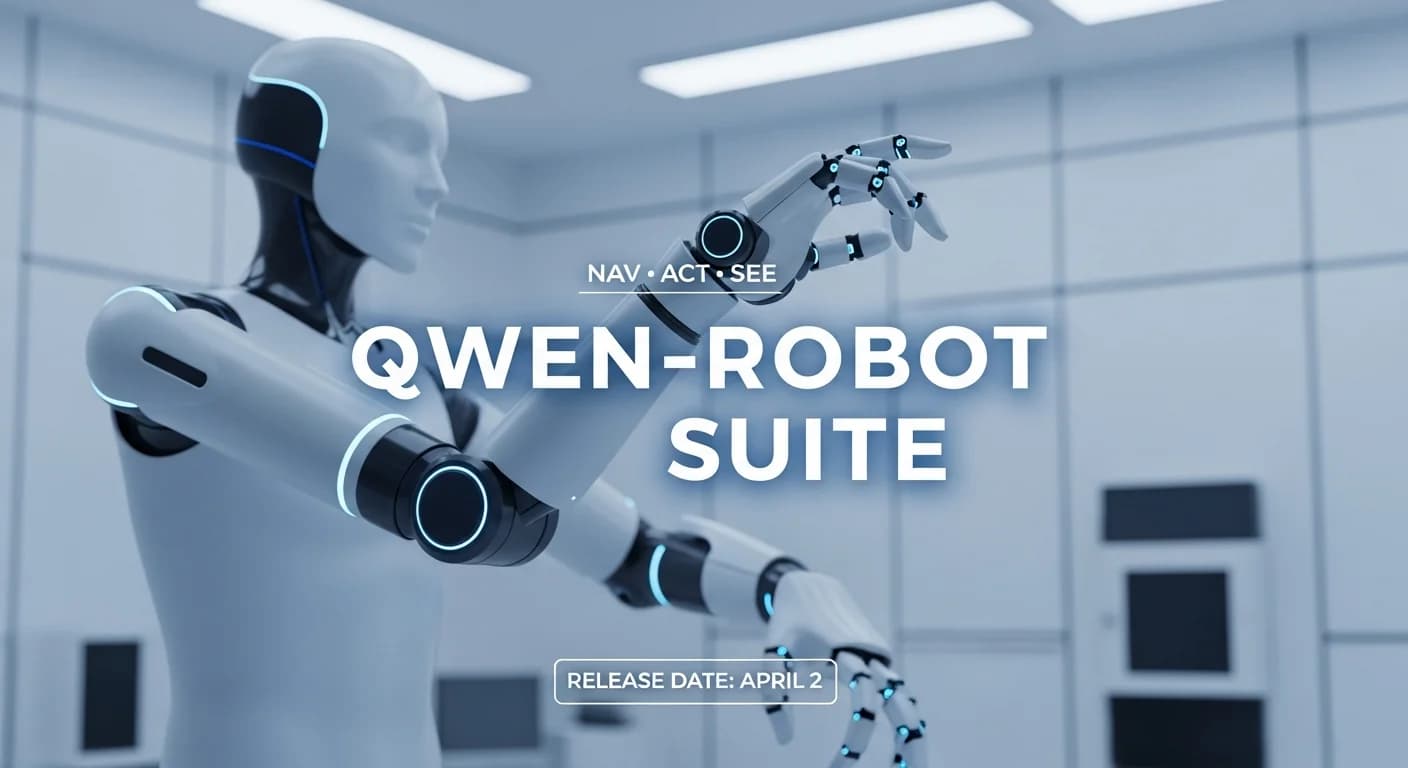
Alibaba's Qwen research group released three robotics foundation models and a world model for agent environments on Wednesday, making a clean break between general-purpose vision-language models and architectures built from scratch for physical action.The verification horizon: why verifying coding agents…
The Qwen-Robot Suite has three distinct models. Qwen-RobotNav handles navigation. Qwen-RobotManip handles manipulation. Qwen-RobotWorld is a world model that simulates embodied physics. Alongside them sits Qwen-AgentWorld, a language-based world model designed to simulate agent interaction across seven domains like search, terminal, and software engineering environments.The real bottleneck in desktop AI agents isn't the…
"The Qwen family of foundation models already gives strong perception and reasoning about the physical world. But seeing is not acting," the team wrote in a blog post. "The gap between vision and language understanding and physical control remains the central bottleneck for embodied intelligence."
The distinction matters because most current robotics AI research takes general-purpose LLMs or video generation models and adapts them to physical tasks. Qwen trains each model from continual pre-training onward with environment modeling as the native objective, not a post-hoc adaptation on top of an LLM trained on text. Qwen-RobotNav learns navigation as its primary task rather than repurposing a language model's ability to describe routes.Fast-LeWM just made visual planning stop stumbling over…
Qwen-RobotManip was validated across multiple real-robot platforms and tasks. In a demonstrated pipeline, Qwen-Omni observes a scene, proposes manipulation tasks via speech, and judges execution in real time, with no pre-defined task list. Each video shows the model completing tasks on the fly, suggesting open-ended instruction following and generalization across unseen environments.
The world model piece tackles a different but related bottleneck. Current world models split into two unsatisfying camps: general video generation models that learn rich visual priors but lack embodied physics understanding, and domain-specific models that are accurate but cannot generalize beyond a narrow scenario. Qwen-RobotWorld aims for a middle path, one model with sufficient generality across physical environments while preserving the physics that matters for robotics control.MiniMax's new video model does anime better, and that's…
Qwen-AgentWorld, meanwhile, simulates environments for language agents rather than physical robots, covering text-based interactions across MCP, search, terminal, and SWE domains. The model was trained with environment modeling as its objective from continual pre-training onward, the same design principle that governs the robotics suite.IBM's new open-source agent framework cuts the…
The releases come as competition in robotics AI intensifies. Google DeepMind has been working on robotics foundation models, and physical-world simulation remains a frontier where few teams have published reproducible benchmarks. Qwen decided to release the suite without a corresponding research paper, at least not yet, which may frustrate some researchers, though the team has made validation videos available showing real-robot performance.
The timing is notable. Qwen's core language models continue to perform strongly on standard NLP benchmarks, but the robotics suite signals that the lab sees physical-world understanding as the next competitive front, one where language model prowess alone is insufficient. Whether the purpose-built approach outperforms adapted general models will depend on benchmarks the robotics community has yet to standardize.
Qwen-AgentWorld, being language-only, may find a faster path to adoption: agent simulation environments are in high demand as companies rush to test autonomous agents before deploying them in production. A single model that covers search, terminal, SWE, and MCP protocols could reduce the tooling overhead teams currently face when assembling test harnesses.
Get the tech essentials in 3 minutes every morning
One email, every weekday, with what actually matters in AI and tech.