AI / Agentic Coding Research
Blast Radius buries dead context. Zero of 450 bodies came back
A new arXiv paper, Blast Radius, treats wasted agent context as dead matter and buries it reversibly: 17-26% token savings across seven OpenAI models, 450 archived contexts, zero recalls. The paper's bolder goal is making agentic coding sustainable, one reclaimed token at a time.
Emmanuel Fabrice Omgbwa Yasse AI-assisted
2026-08-19 · 5 min read
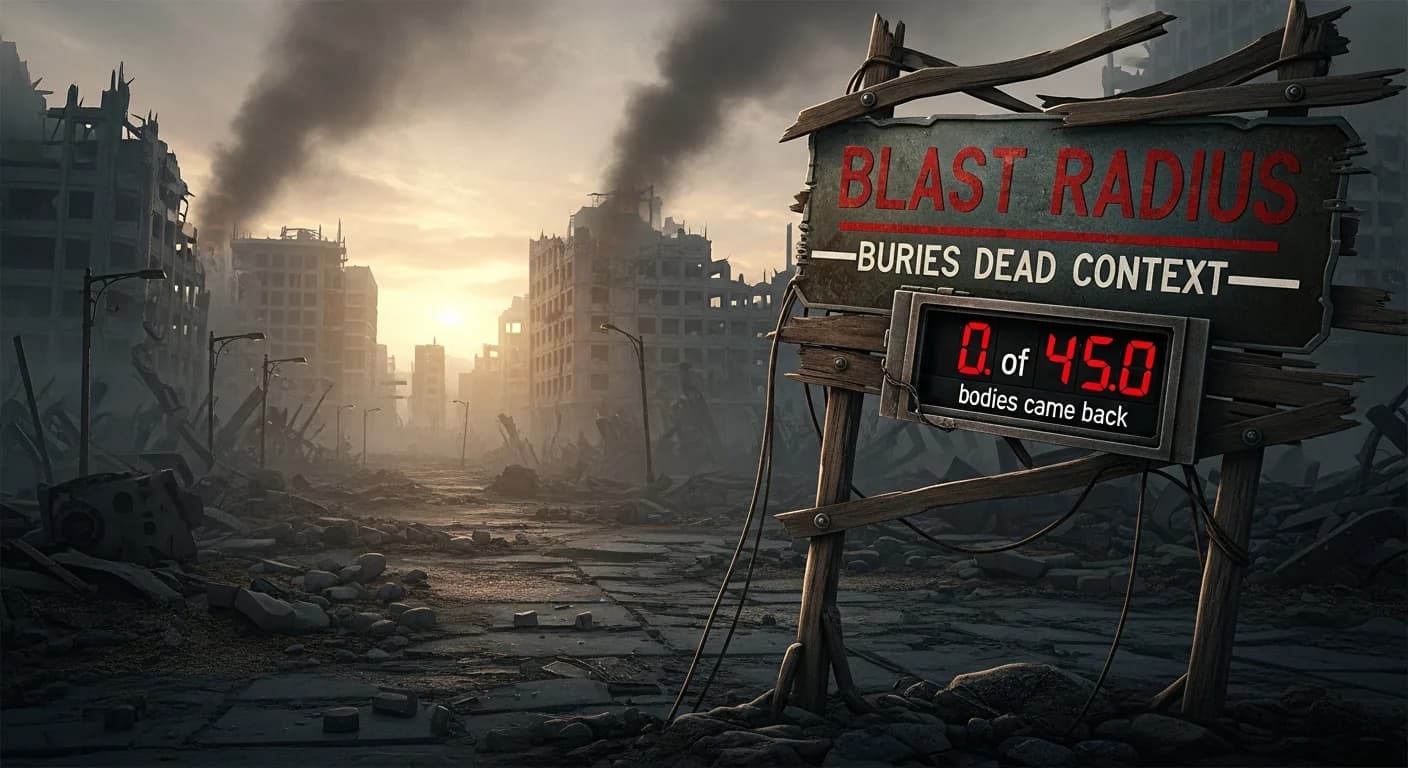
Nobody mourns a dead context window. That may be the quiet thesis of Blast Radius, a paper submitted to arXiv on August 7, 2026. Agentic coding, the paper argues, has an affordability problem. Agents running all day accumulate context the way a codebase accumulates TODO comments, and every token they carry costs money. The bill shows up at scale: Meta's Manus acquisition was a play on infrastructure that already delivers 147 trillion tokens, per the Manus coverage.
The paper's answer is to bury the dead. Blast Radius is a predictive memory management layer that estimates how far an incoming prompt will reach through coupled context and code channels, then evicts what it judges to be dead context. The eviction is reversible, archiving context verbatim rather than destroying it. Across seven OpenAI models, the authors report token consumption down 17 to 26 percent, the lowest overflow rate among the policies they tested, and byte-exact reversibility. Then comes the number that sticks: of 450 buried bodies, 378 were recurring dead matter, and zero were recalled.
The tax on agents that run all day
The cost problem is easy to understate. Anthropic's Claude Sonnet 5, released June 30, 2026, was positioned explicitly for agents that run all day, with pricing to match: a promotional $2 per million input tokens and $10 per million output tokens through August 31, 2026, then standard pricing at $3 per million. Agents do not read a codebase once and stop. They read, plan, edit, re-read, run tests, and read again. Every loop appends to the context window, and the window is not free. Alibaba has been attacking the same bill from the input side, claiming Qoder 1.0 cut agent input tokens by 40%, with Alibaba running the test itself.
The paper's abstract is blunt about the trend: "Agentic coding faces growing problems of affordability and wasted tokens." Wasted tokens here are not a rounding error. They are the repeated instruction, the stale file listing, the transcript of a debugging session that already ended. Blast Radius's claim is that a large share of this accumulated context is dead matter, and that keeping it is more expensive than archiving it.
What Blast Radius actually does
Three layers do the work. Blast Radius estimates an incoming prompt's reach through coupled context and code channels, deciding how far into the codebase it may travel and which records are worth keeping within reach. NECROPHORESIS handles eviction, archiving dead context verbatim so the operation stays reversible. Recurring Dead Matter, RDM for short, identifies transcripts that keep reappearing and buries them.
That last piece matters. A transcript that recurs is the clearest candidate for eviction: it costs tokens every time it resurfaces, and it is apparently never needed. The authors also formalize reversible context eviction over a Polish context space, connecting context entropy to resurrection probability. In plain terms, they give a mathematical account of what it means for a context to be disposable.
Blast Radius does not replace the agent's memory system. It operates beneath HCRC, the paper says, deciding which records get buried and how far an incoming prompt may reach into the codebase. A different strand of memory work bolts memory on instead of burying it: Memory Decoder's 6.9B pretrained memory lifted a 410M model past Pythia-12B, per the Memory Decoder report.
The numbers: 450 burials, zero recalls
The empirical section is where the paper earns its name. Across seven OpenAI models:
| Claim | Result |
|---|---|
| Token consumption | Reduced 17-26% across seven OpenAI models |
| Overflow rate | Lowest among tested policies |
| Reversibility | Byte-exact |
| Buried bodies | 450 total |
| Recurring dead matter | 378 of 450 |
| Recalled | 0 of 450 |
Zero recalls is the kind of result that reads either as a triumph or a red flag. Burying context is safe, the paper suggests, because the buried context was genuinely dead. But 450 evictions is a small sample against the scale of real production codebases, and the paper does not claim these models were put through long-running agent tasks. The claim is narrower: across the models and tasks tested, nothing that was buried ever needed to come back.
Is the dead really dead?
There is a tension the paper doesn't quite resolve. If recurring dead matter is so obviously disposable, why did it recur in the first place? RDM's answer is that recurrence is evidence of waste, not relevance. A transcript that shows up repeatedly and is never actually used is the perfect token thief. Burying it reclaims the budget for context that matters, and the zero-recall result suggests the system's judgment held up in testing.
The paper also places itself inside a larger agenda it calls Algosophy, aimed at making large language models and agentic coding more reusable and sustainable. That is a heavy word. The concrete contribution here is narrower: a measurable, reversible eviction policy with real token savings. Sustainability, in this telling, mostly means not setting money on fire re-reading the same dead transcripts. Shrinking the agent is another way to keep that bill down: Liquid's LFM2.5-2.6B outruns models four times its size, per the LFM2.5-2.6B benchmark coverage.
Context growth in agentic coding is worse in practice than it looks. Related research on the CLAUDE.md problem, where agent instruction files grow without bound, shows why: appending a new instruction is always cheap, but once the rationale behind an instruction is gone, deleting it risks a correctness regression at exponential cost. Blast Radius tackles the disposal side of that equation. It makes eviction cheap enough and reversible enough to attempt. The open question, for a next paper, is what happens when the buried stay buried at production scale.
- Source : Blast Radius buries dead context. Zero of 450 bodies came back — 2026-08-07
Get the tech essentials in 3 minutes every morning
One email, every weekday, with what actually matters in AI and tech.