Artificial Intelligence
LFM2.5-Encoders make the small-model case: 3.7× faster than ModernBERT on CPU
Liquid AI's open-weight LFM2.5-Encoders make the case that production NLP belongs on small models. A 230M encoder beats ModernBERT-base on benchmarks and scans full documents in about 28 seconds on a laptop CPU, roughly 3.7× faster.
Emmanuel Fabrice Omgbwa Yasse AI-assisted
2026-08-05 · 5 min read
For a while now, the default move in NLP has been to point a generative model at the problem and pay for the privilege, and much of what you pay for is reasoning padded with unnecessary steps. Liquid AI's new release makes a quieter argument: the jobs that run around the clock, from intent routing and policy checks to PII scanning and text classification, are better handled by a small encoder sitting on a laptop CPU.
The LFM2.5-Encoders are open-weight and on Hugging Face today, built from Liquid AI's LFM2.5 decoder backbones. The company turns each causal decoder into a bidirectional encoder and positions the result against the class of models that has held this ground since BERT. The pitch is simple: you don't need a multi-billion-parameter model to decide whether a support ticket mentions a refund or a contract contains a banned clause. The largest open model ever released still isn't the best on overall benchmarks, as Kimi K3's debut made clear.
A 3.7× speed edge at the top of the context window
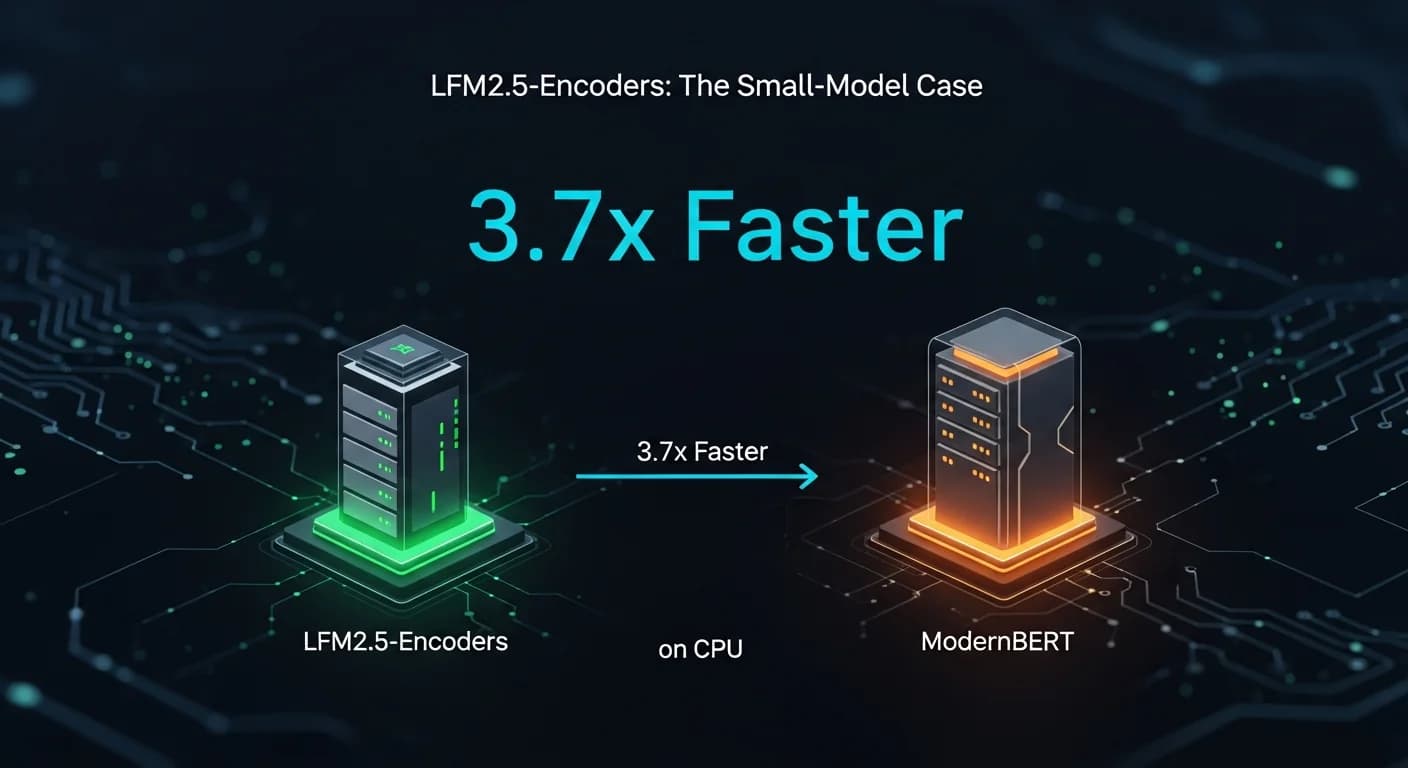
Both the LFM2.5-Encoders and ModernBERT support an 8,192-token context, so the comparison runs across the full range. On CPU, that's where the gap shows. ModernBERT-base takes more than a minute and a half per forward pass at maximum length. The LFM2.5-Encoder-230M does the same pass in about 28 seconds. Liquid AI calls that roughly 3.7× faster, and says the 230M is the fastest model in the comparison at every sequence length, ahead even of the smaller ModernBERT-base on short inputs.
Throughput tells the same story in reverse. As inputs lengthen, ModernBERT's throughput drops sharply, while the LFM2.5 curves rise into a mid-range before tapering. The practical consequence, per the company: a full contract, a transcript, or a long support thread can be scanned or classified in under 30 seconds on a laptop CPU. That is the difference between a job you run selectively and one you can afford to run on everything, and it's the argument behind the 0.8B document parser that beat every pipeline at its own game.
The benchmark table: 14 models, 17 tasks
Liquid AI fine-tuned 14 models on 17 tasks pulled from GLUE, SuperGLUE, and multilingual classification, reporting the mean across five held-out seeds for each. The LFM2.5-Encoder-350M ranks fourth of the 14. The three models ahead of it are all larger, including one at 3.5B parameters, nearly ten times its size. The 230M model beats ModernBERT-base and every EuroBERT model in the table while being smaller than most of them. Both also score above Liquid AI's own LFM2.5-Retrievers from last month.
| Model | Benchmark standing | CPU forward pass at 8,192 tokens |
|---|---|---|
| LFM2.5-Encoder-230M | Beats ModernBERT-base and every EuroBERT model | About 28 seconds |
| LFM2.5-Encoder-350M | 4th of 14, behind three larger models | Mid-range, tapers toward the top |
| ModernBERT-base | Below the 230M in the same table | Over a minute and a half |
These are the company's own numbers, and Liquid AI open-sourced the framework and raw results, so the table is checkable rather than something to take on faith. Benchmark scores do have a habit of softening in production, the way top results on SWE-bench Verified fade on private enterprise code.
Why a 230M encoder beats a generative LLM for always-on jobs
The economics are the point. A fine-tuned encoder is smaller, faster, and far cheaper to run than a generative LLM, and it fits on CPUs a company already owns, according to Liquid AI. Cheaper options have been winning lately; on a recent physics benchmark, the model costing half as much crushed its pricier sibling. The architecture gets credit for the efficiency. Each encoder is initialized from one of the LFM2 decoder backbones, then made bidirectional with three changes: a bidirectional attention mask, non-causal short convolutions padded symmetrically, and a masked-language objective that hides 30% of tokens during training.
Training runs in two stages. The first builds general language competence on a large web corpus at a 1,024-token context. The second extends the context to 8,192 tokens on the full data mix, which the company says strengthens factual, legal, and multilingual competence. The niche is explicit: high-volume understanding tasks, classification, routing, extraction, and scoring, jobs that run constantly and have to stay cheap.
On GPU the pattern holds with a smaller margin. ModernBERT-base leads below roughly 1,000 tokens on the Apple GPU, and the LFM2.5 models take the lead from about 2,000 tokens up. The CPU numbers are where the argument lands: these jobs run all day, usually on CPU.
What you can build, and what it costs to start
Liquid AI shipped five demos, each in a CPU-only Hugging Face space. Zero-shot prompt routing scores a whole prompt against routing lanes written as free text in one pass. Policy linting checks text against company rules, also free text, scoring every token against every rule. Spell checking corrects misspellings token by token. PII detection strips 40 kinds of personal information across 16 languages. A bonus demo turns the encoder into a masked-diffusion chatbot, generating text by iterative unmasking instead of left to right.
Entry cost is a few lines of transformers code. Load the model with AutoModelForMaskedLM for masked-token prediction, or load the body with AutoModel and attach your own head for classification, token classification, regression, or retrieval. Fine-tuning is per task: the company points to the 350M when accuracy matters most and the 230M for tighter hardware or higher throughput, with a tutorial covering long legal documents at 8K context.
Encoders never really went away, they just fell out of fashion next to generative models. What Liquid AI added is the thing that pushed teams toward generative models in the first place: long context and fast inference. The result is a model class that competes on the metrics people actually feel, latency and cost per document, shipping both sizes as open weights on Hugging Face.
- Source : LFM2.5-Encoders make the small-model case: 3.7× faster than ModernBERT on CPU — 2026-07-28
Get the tech essentials in 3 minutes every morning
One email, every weekday, with what actually matters in AI and tech.