Document AI
The 0.8B model that beat every pipeline document parser at its own game
Alibaba's OvisOCR2, a compact 0.8B end-to-end model, achieves state-of-the-art scores on OmniDocBench (96.58) and PureDocBench (75.06), overtaking larger pipeline-based parsers. Its success comes from a data engine mixing filtered real documents with synthetic pages, reinforcement learning on a 4B teacher, and on-policy distillation into the small model.
Emmanuel Fabrice Omgbwa Yasse AI-assisted
2026-07-24 · 4 min read
Document parsing has always meant stacking two stages: first a layout analysis model splits the page into regions, text blocks, tables, formulas, figures, then a recognition model reads each crop. The approach works but it is brittle. Errors in the first stage cascade into the second, and deploying two models with different runtime profiles adds operational complexity.
End-to-end models, which generate a Markdown representation straight from the page image, have always looked cleaner on paper. But in practice they trailed behind the modular systems that dominate public benchmarks like OmniDocBench. That gap just closed, and with a 0.8-billion-parameter model, no less. The broader shift toward unified parsing has accelerated, as shown by Mistral's own OCR benchmarks.
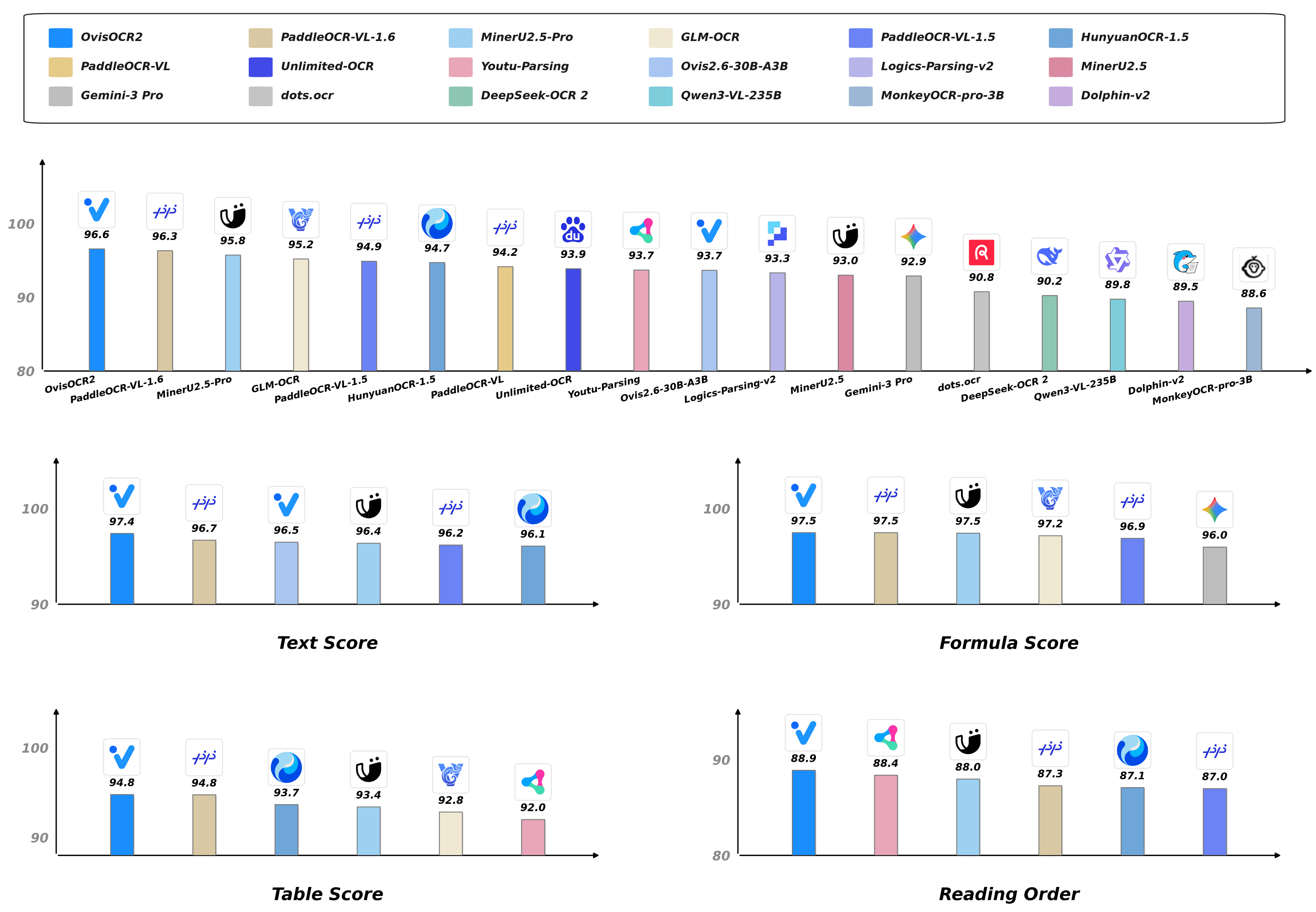
OvisOCR2, developed by Alibaba's ATH-MaaS team, post-trains Qwen3.5-0.8B, the smallest member of the Qwen3.5 family, into a dedicated page-level parser. On OmniDocBench v1.6, it scores 96.58 overall, moving ahead of every pipeline method including PaddleOCR-VL-1.6 (96.33), GLM-OCR (95.22), and MinerU2.5-Pro (95.75). On PureDocBench, its Avg3 score of 75.06 also tops the leaderboard.
How a tiny model beats the big ones
The main innovation is the training recipe, not the architecture. The team built a data engine with two complementary pipelines.
The real-world pipeline takes actual document images, runs them through PaddleOCR-VL-1.5 or MinerU2.5-Pro, parses the structured JSON output, normalizes it into a unified Markdown schema, and filters the results through both rule-based checks and manual spot-checking. This ensures that when the model sees scanned invoices or academic papers, the supervision is as clean as possible.
The synthetic pipeline starts from hard samples, pages the model initially got wrong. A multimodal model converts these into HTML templates, which are then diversified by an agent that varies both content and structure. The key insight: because the HTML source renders both the image and the Markdown ground truth, there is zero annotation noise. The model learns from perfect labels, especially valuable for tables, formulas, and long-form layouts. This kind of synthetic data generation is a proven technique, as seen in Qwen's RL-based image generation pipeline.
Reinforcement learning for structured outputs
Training proceeds in stages. First, supervised fine-tuning on top of Qwen3.5-0.8B establishes the base parsing policy. Then a 4B branch undergoes reinforcement learning (GRPO) with a multi-component reward: normalized edit distance for text, character detection matching (CDM) for formulas, and tree-edit distance (TEDS) for tables. The reward averages only the components present in each page's ground truth, avoiding noise from irrelevant metrics.
Directly applying RL to the 0.8B model caused unstable table quality. So the team used the RL-enhanced 4B model as a teacher for on-policy distillation (OPD). The student generates outputs, the teacher scores them, and the student learns via reverse KL divergence, biased toward the teacher's most confident tokens. A top-k trick reduces the per-position tensor from vocabulary-size to k, keeping memory manageable for long responses. This distillation method echoes the approach used in Mistral's cascade distillation recipe.
Finally, several candidate variants are fused through weighted parameter averaging.
Benchmark results in context
| Benchmark | OvisOCR2 | Best pipeline (prev. SOTA) | Best end-to-end (prev.) |
|---|---|---|---|
| OmniDocBench v1.6 (overall) | 96.58 | 96.33 (PaddleOCR-VL-1.6) | 94.74 (HunyuanOCR-1.5) |
| PureDocBench (Avg3) | 75.06 | 70.39 (DotsMOCR, pipeline) | 73.92 (FD-RL, end-to-end) |
| Text edit distance (OmniDocBench) | 0.025 | 0.033 (PaddleOCR-VL-1.6) | 0.039 (HunyuanOCR-1.5) |
| Formula CDM (OmniDocBench) | 97.53 | 97.49 (PaddleOCR-VL-1.6) | 95.79 (Unlimited-OCR) |
The improvements are consistent across text, formulas, tables, and reading order, not just the overall average. On OmniDocBench, OvisOCR2 reports the lowest text edit distance, the highest formula CDM, the highest table TEDS-S, and the lowest reading-order edit distance among all specialized models. This pattern of a smaller model outperforming larger competitors is reminiscent of Alibaba's Qwen2.5-Omni, a 7B model that punches above its weight class.
What this means for the field
The document parsing space has been moving toward unified models for a while. Mistral's OCR 4 added bounding boxes and typed-block classification within a single container. DeepSeek-OCR 2 introduced Visual Causal Flow and open-sourced its weights. Both are end-to-end in spirit but still rely on some modular components.
OvisOCR2 goes further: a single 0.8B model that outputs Markdown directly, with no layout parser bolted on. The trade-off is real-world robustness: on PureDocBench's Real track (phone-captured pages, photocopies, screen photography), OvisOCR2 scores 66.56, below Gemini-3.1-Pro and Qwen3.5-122B-A10B. The team acknowledges that degraded image quality remains a weak point.
Still, the model's performance on handwriting and complex tables, two pain points for pipeline methods, is notably strong. On an in-house handwriting subset, OvisOCR2 achieves a 72.28 overall score versus 69.58 for GLM-OCR. On complex tables, its missing rate (tables entirely absent from the output) drops to 7.96%, compared to 13-17% for pipeline parsers. Once a pipeline's layout analysis misses a table, no downstream recognizer can bring it back. The ability to handle challenging inputs with a compact model mirrors the trend seen in Mistral's 8B model that makes lidar optional for office robots.
The model is available on HuggingFace. At 0.8B parameters, it can run on consumer GPUs or even CPU with optimizations, making high-quality document parsing accessible beyond well-resourced enterprises.
- Source : OvisOCR2 Technical Report (arXiv)
Get the tech essentials in 3 minutes every morning
One email, every weekday, with what actually matters in AI and tech.