LLMs & Models
Mistral's cascade recipe shrinks LLMs without killing reasoning
Mistral's cascade distillation shrinks large models into small ones while preserving reasoning and vision. The 3B variant packs capabilities that used to require ten times the parameters, and it's all Apache 2.0.
Emmanuel Fabrice Omgbwa Yasse AI-assisted
2026-07-17 · Last updated: 2026-07-18 · 5 min read
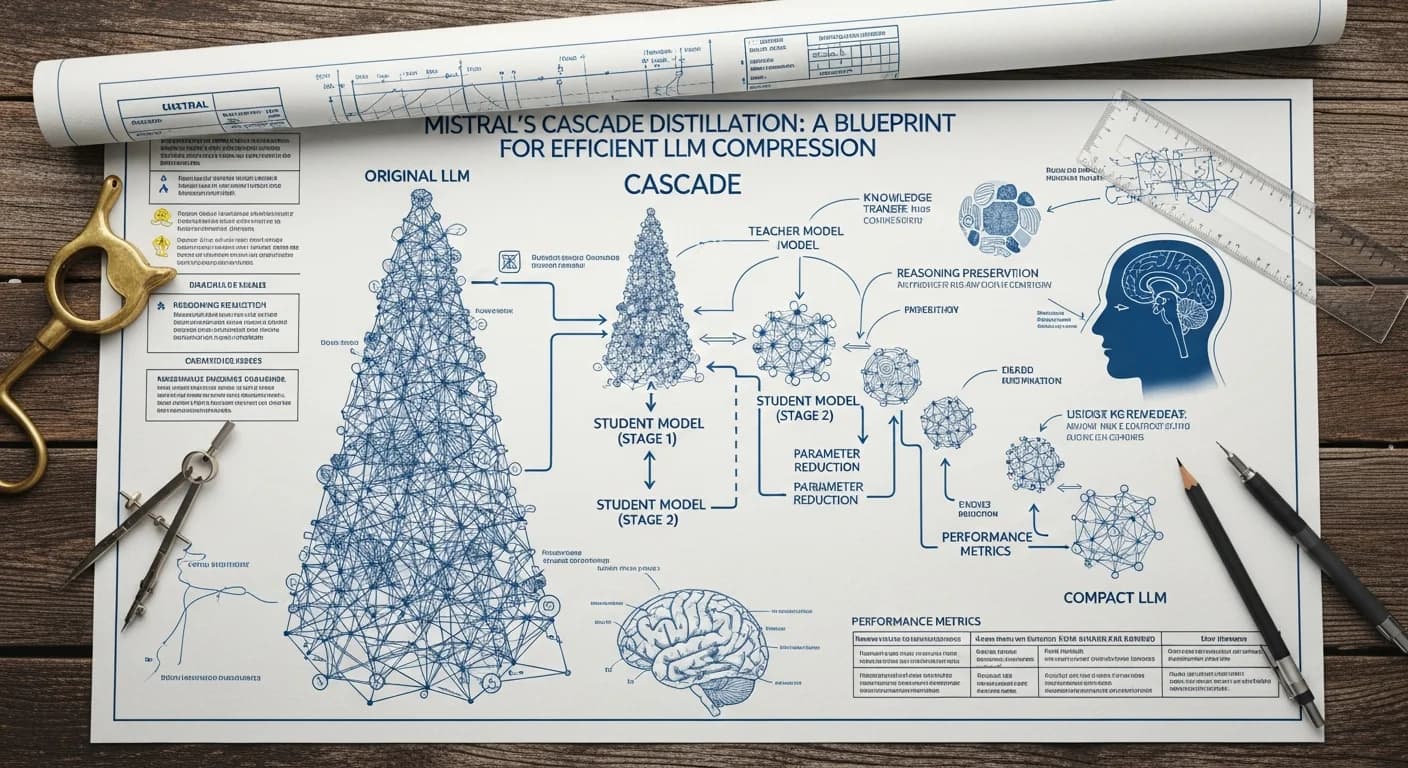
On paper, the Mistral AI team's latest release looks like a routine model family expansion: three sizes (3B, 8B, and 14B parameters), three variants per size, pretrained base, instruction finetuned, and reasoning, all under the Apache 2.0 license. But the real story is not the roster of new models. It's the method used to create them. Similar methods have shown that small models can achieve surprising efficiency when optimized for latency.
The French AI lab has detailed what it calls cascade distillation, an iterative process that prunes a larger teacher model into progressively smaller students while continuously distilling knowledge at each step. The approach, described in a technical report published alongside the models, is designed to solve a well-known tension: smaller models typically lose too much capability when simply pruned or distilled once. Cascade distillation attacks that problem by making the compression process itself a multi-stage curriculum. This mirrors insights from the debate on usable context versus raw benchmark numbers.
How cascade distillation works
Traditional knowledge distillation involves training a small student model to mimic the outputs of a large teacher model. Cascade distillation adds layers: the teacher is first pruned to an intermediate size, then that intermediate model becomes the teacher for the next, smaller student. The process repeats until reaching the target size. At each stage, the student inherits not only the teacher's predictions but also structural priors from the pruning step, which the Mistral team argues helps preserve long-range dependencies and reasoning pathways that single-step distillation tends to collapse.
"Cascade distillation enables the preservation of a broader range of capabilities, including multimodal understanding and multi-step reasoning, that are typically the first casualties of aggressive compression," the technical report states.
The 3B and 8B models were derived from the 14B version using this method. The 14B model itself was initialized from a larger, undisclosed teacher. All three sizes include a variant capable of image understanding, a feature rarely seen at the 3B scale under a permissive license. This multimodal capability aligns with findings from Pixtral 12B, which also punches above its weight class on visual tasks.
Why size matters again
The industry narrative around parameter counts has swung dramatically over the past 18 months. While the 2023, 2024 era was dominated by the "bigger is better" race that produced models like Llama 3.1 405B and DeepSeek-V3, a counter-movement has gained momentum: models between 1B and 14B parameters are being optimized for on-device deployment, private inference, and cost-sensitive applications. Microsoft's Phi-4 (14B), Google's Gemma 2 (2B, 27B), and now Ministral 3 all target this niche. Google's latest Gemma 4 further rewrites the rules for open-weight models at small scale.
The reasoning variant of the 3B Ministral 3, tested internally by Mistral, matches or exceeds the performance of Mistral Small 3.1 on several math and logic benchmarks, despite being one-fifth the size. That kind of efficiency gain is what cascade distillation was designed to deliver, and it offers a potential playbook for other labs looking to compress their largest models without starting from scratch. It also echoes the approach in Leanstral 1.5, which proves that smaller models can saturate formal verification benchmarks.
Image understanding at the edge
Perhaps the most surprising element of the release is that even the 3B variant supports image inputs. Mistral integrated a vision encoder compatible with the model's dense architecture, enabling tasks like document parsing, diagram reading, and basic visual question answering. For developers working on on-device AI assistants or private document processing, this removes a major hardware barrier: no cloud roundtrip required for basic visual understanding.
The license choice, Apache 2.0, is equally notable. While Mistral has released several models under this license before, the combination of small size, vision capability, and permissive licensing makes the 3B variant a strong candidate for embedded systems, prototyping, and applications where licensing compliance matters as much as performance.
Competitive positioning
The Ministral 3 series enters a field already crowded with capable small models. Microsoft's Phi-4 offers strong reasoning at 14B but lacks the vision capabilities of Ministral 3 at the same size. Google's Gemma 2, available in multiple sizes, is Apache 2.0 licensed but does not natively include vision. Meta's Llama 3.2 includes 1B and 3B variants but limits vision to the larger 11B model. The importance of permissive licensing for small models is also highlighted in how local LLMs like Gemma and Qwen are taming open-source project triage.
Mistral's cascade distillation approach also distinguishes it on the methodology front. While other labs have experimented with pruning (Google's Sparse models, Apple's coreml compression), few have published a reproducible multi-stage pipeline that yields consistent gains at every size tier. If the technique generalizes beyond Mistral's architecture, it could influence how the broader open-source community approaches model compression. Independent verification tools like Ai2's Olmo-Eval provide an open evaluation workbench for comparing such methods.
The open question
The one question the technical report does not fully answer is how much of the performance is attributable to cascade distillation versus the quality of the initial teacher model. Mistral has not disclosed the size or architecture of the teacher used to seed the 14B model, making it difficult for external researchers to isolate the method's contribution. That opacity is typical for state-of-the-art model releases, but it leaves room for independent verification, especially given the small-model leaderboard is becoming a strategic asset for AI labs competing for developer mindshare.
What is clear is that Mistral has fired a new salvo in the small-model arms race. Cascade distillation offers a replicable recipe, the license is uncomplicated, and the smallest variant packs capabilities that, until recently, required ten times the parameters. For developers building under compute and memory constraints, that might be the most practical news this quarter.
Get the tech essentials in 3 minutes every morning
One email, every weekday, with what actually matters in AI and tech.