AI Models
The 33B model that just beat 137B models on coding benchmarks without changing hardware
Poolside's Laguna XS 2.1 improves SWE-bench Multilingual by 5.4 points to 63.1% while keeping the same 33B-total-3B-activated MoE architecture. The release includes quantized checkpoints, speculative decoding draft models, and an OpenMDW-1.1 license, making local AI coding more practical.
Emmanuel Fabrice Omgbwa Yasse AI-assisted
2026-07-21 · Last updated: 2026-07-30 · 4 min read
Poolside released Laguna XS 2.1 today, an incremental update to its coding-focused Mixture-of-Experts model. The headline number is a 5.4-point jump on SWE-bench Multilingual, bringing the resolved task rate to 63.1%. That sounds like a minor improvement until you look at the company's benchmark table: XS 2.1 now beats models with 10 to 40 times more active parameters on several agentic coding tests. That pattern, small models eating into datacenter territory, has been building for two years. Poolside is the latest to pull it off, as the model race's second track shows.
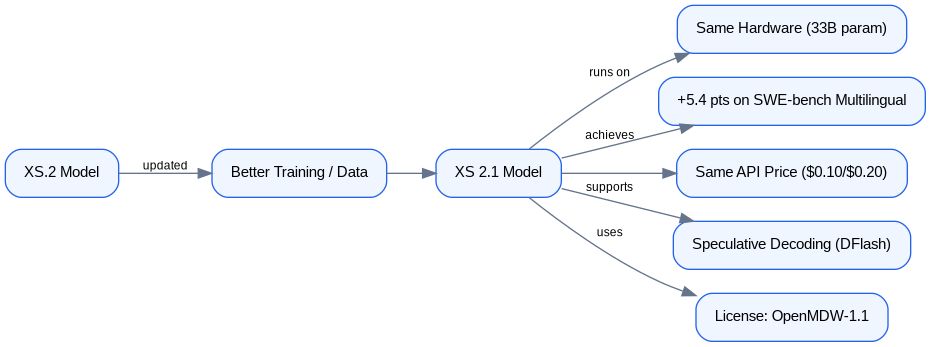
The model keeps the same architecture as XS.2, 33B total parameters, 3B activated per token, but the company says it trained longer or on better data, or both. The release post does not specify what changed in training, only that the result is "a notable improvement on SWE-bench Multilingual and stronger performance on terminal-style tasks." That kind of vagueness is standard. Here it matters more because the improvements didn't cost anything in hardware. XS 2.1 costs the same on Poolside's API as XS.2: $0.10 per million input tokens, $0.20 per million output tokens, $0.05 per million cache-read tokens. For teams already running XS.2 locally on a single GPU, the upgrade is essentially free.
What the benchmarks actually show
Poolside published scores across four agentic coding benchmarks: SWE-bench Verified, SWE-bench Multilingual, SWE-Bench Pro, and Terminal-Bench 2.0. The company compared XS 2.1 against Qwen3.6 (35B-A3B), North Mini Code from Cohere (30B-A3B), MAI-Code-1-Flash (137B-A5B), GPT-OSS-120B, and Claude Haiku 4.5. On SWE-bench Multilingual, XS 2.1 leads the comparison set at 63.1%. On SWE-bench Verified, it trails several larger models. On Terminal-Bench 2.0, it roughly ties Qwen3.6.
The takeaway is not that XS 2.1 dominates every benchmark, it doesn't. Across four tests, it leads one, roughly ties one, and trails on two. But consider the constraints: only 3B active parameters. A model that fits on a single consumer GPU competes with offerings that need datacenter hardware. That changes what a solo dev or a small team can run locally, and demand for such models continues to grow, as Ollama's subscription pause highlights.
Speculative decoding and local inference
Poolside is also releasing DFlash speculator models for each XS 2.1 checkpoint. These are small draft models trained to predict the main model's next tokens cheaply, a technique called speculative decoding. In the company's internal tests, pairing XS 2.1 with its speculator doubles the achieved tokens per second. For local setups, latency is the bottleneck. Doubling the throughput means the agent stops feeling sluggish, a speed gain reminiscent of what preprocessing tricks can achieve, as input cleaning techniques show.
The model supports vLLM, SGLang, NVIDIA TensorRT-LLM, Hugging Face transformers, and Ollama. Quantized checkpoints are available in FP8, INT4, and NVFP4, letting users trade precision for VRAM. The company says quantized GGUF checkpoints and llama.cpp support are coming soon.
License change and ecosystem play
Poolside is licensing XS 2.1 under OpenMDW-1.1, dropping whatever license XS.2 used. OpenMDW is the open model distribution framework backed by NVIDIA and the Linux Foundation. The company calls it "fully permissive" and says the change "reduc[es] licensing friction for open model releases." For teams evaluating models, this removes one more headache: no need to run a license review for a model that might end up in a commercial product. The move aligns with broader industry support for open weight models, as outlined in the open-weight letter.
What gets deprioritized
Poolside will sunset XS.2 on its own API after one week. Teams that built dedicated deployments around the older model can still access it through Baseten's Model Library, but the company is clearly pushing everyone toward 2.1. The one-week sunset window on the API is short, teams running evaluations or regression tests will need to move quickly.
The company also made a deliberate bet on agentic coding over general-purpose reasoning. XS 2.1 is designed for "long-horizon work on a local machine," meaning the kind of multi-step coding tasks that an agentic loop handles. It is not a generalist chatbot. Teams using it for anything other than code may find it narrower than the benchmark table suggests.
The bigger picture
Poolside's release fits a pattern two years in the making: small, efficient models that run locally are pushing into territory that used to need datacenter clusters. XS 2.1 is not a breakthrough; it is an incremental improvement that makes a good argument slightly better. The 5.4-point gain on one benchmark is modest. What matters is that Poolside achieved it without increasing the model's footprint, API pricing, or hardware requirements. That kind of improvement compounds over time, and it is how local AI coding becomes the default rather than a curiosity. The broader shift toward open-source models, including those from Chinese labs, underscores this, as analysis of the US's eroding AI advantage details.
- Source : Laguna XS 2.1 release blog post
Get the tech essentials in 3 minutes every morning
One email, every weekday, with what actually matters in AI and tech.