Compute economics
AI bought the GPUs; nobody owns keeping them busy
Procurement has a team. Utilization doesn't. With multi-gigawatt GPU deals closing across four vendors, the metric that decided airline economics is becoming AI's binding constraint, and idle clusters lose money by the calendar hour.
Emmanuel Fabrice Omgbwa Yasse AI-assisted
2026-08-04 · 5 min read
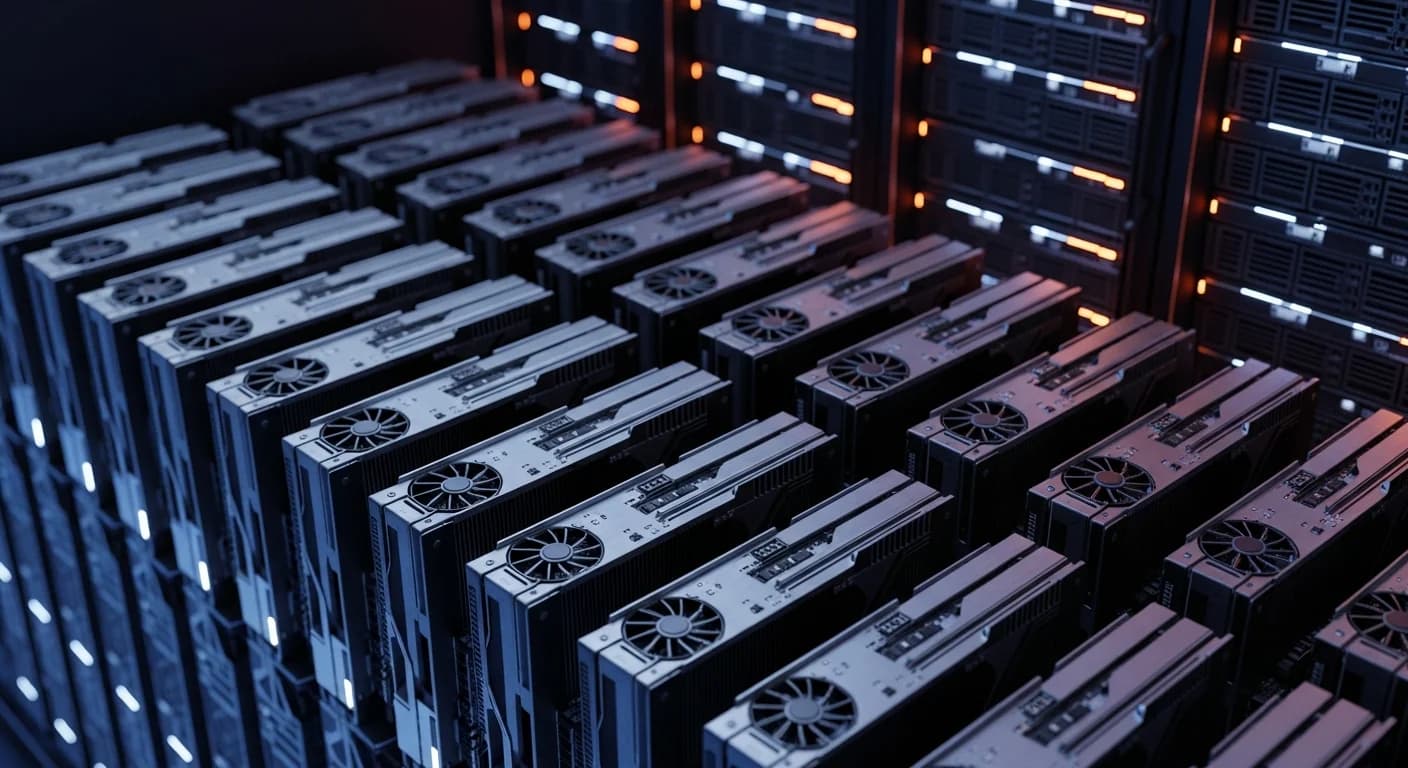
Buying GPUs has a deadline, a budget, and a procurement team. Keeping them busy has none of the three. A new essay from Dharma AI, the open-source specialized models vendor, calls that gap the structural problem of enterprise AI: a GPU accrues cost by the calendar hour, through financing, depreciation, power and cooling, whether or not it computes anything, while its output accrues only by the compute hour.
The airline lesson: revenue only accrues in the air
The essay leans on aviation history. An aircraft's costs accrue by the calendar hour: financing, depreciation, hull insurance, scheduled maintenance, crew contracts. Revenue accrues only by the flight hour. Utilization sits downstream of almost everything an airline does, from turnaround discipline to network design. Two airlines with comparable fleets can end up with very different economics; the gap traces to one measurement rather than fleet size. A bigger fleet still helps. It has never been the deciding variable.
The bottleneck moved from models to compute to idle hardware
The first wave of enterprise AI was won on model quality, at least as far as public benchmarks measure it. Frontier models that clear 96% on SWE-bench Verified barely clear 23% on private enterprise code, per recent comparisons. That capability came bundled with a dependency, because production AI runs on GPUs that are expensive, supply constrained, and in demand far beyond what is available. In 2020, Microsoft built OpenAI a dedicated supercomputer: over 10,000 GPUs and 285,000 CPU cores, built to train what became GPT-3. Six years later, that number reads like a starting point. By 2026, Anthropic was running simultaneous multi-gigawatt commitments across four hardware platforms, Amazon, Google, Microsoft, and AMD, while Meta signed a comparable deal of its own. Committing across four vendors at once is what scarcity looks like when even unlimited capital cannot get enough from a single source.
The same pattern shows up downstream in a different form. API pricing scales linearly with tokens, splitting proof-of-concept economics from production economics almost completely. A few thousand requests a month looks affordable; production volume becomes a cost line that never quite clears. The route gaining ground is owning the hardware, trading a variable cost for a fixed capital one, part of a broader fight over who controls AI infrastructure. AMD is already selling into that shift: its 128 GB developer desktop costs about six times less than equivalent cloud API usage over three years, per the company's own modeling, and runs models up to 200 billion parameters locally. The day such a cluster comes online, the question flips from "can we get accelerators" to "can we keep them busy."
Signing for the hardware is the part with a deadline and an owner. Keeping it off the ground is the part that quietly decides whether the deal was worth signing.
Busy clusters can still waste most of their capacity
GPUs run continuously while demand does not, so a share of capacity sits provisioned but unused outside the peak. Better forecasting would fix that if every GPU could absorb every kind of work equally well. Few can. The same hardware now carries training, fine-tuning, quantization, real-time inference, batch inference, embedding generation, and model evaluation, often on the same cluster, and each workload wants something different from the silicon:
| Workload | What it demands of the GPU |
|---|---|
| Real-time inference | Low latency above nearly everything else; a slow response counts as a failed one |
| Batch inference | Throughput; tolerates delays that can stretch for hours |
| Training | Continuous occupation, for stretches measured in hours or days |
| Quantization | Large capacity, but only briefly |
A scheduler tuned for one of these misallocates the other three almost by default, a waste class that scheduling research keeps attacking; the latest fix lets constraint solvers skip the slow loop. The failure does not always show up on a utilization dashboard: a cluster can report high occupancy while queued jobs wait for a GPU shape that is busy running something else. Here the aircraft analogy runs out. An idle 737 can be redeployed to almost any route. An idle GPU can only absorb a workload whose memory, latency, and duration profile it can actually serve, which makes orchestration harder than fleet scheduling and turns the question into which workload runs on which GPU, when, at what priority.
The 3 a.m. question, and the vendor's stake in the answer
Provisioning is a decision made once, at purchase time. Allocation is made constantly: every time a job finishes, every new request, every priority shift between a customer-facing service and an internal training run. No engineer is watching a dashboard at three in the morning to decide whether a finished training run should hand its GPU to a queued batch job or hold it for an incoming burst of traffic. That is why the decision is moving into an orchestration layer, a discipline the essay calls GPU management. Japan has made the same bet at national scale, building its AI strategy on orchestration rather than a frontier model of its own.
The essay's closing argument pairs that orchestration with specialization. Task-specific models can do specific jobs at a fraction of the resource cost of a large generalist, freeing capacity. The evidence keeps piling up: small models keep beating their bigger siblings. But freed capacity only converts into return if something actively decides where it goes. Specialization without orchestration frees capacity nobody reclaims; orchestration without specialization has less capacity worth reclaiming. Each raises the other's ceiling.
The logic stands on its own, with one asterisk worth naming. The essay comes from Dharma AI, which sells specialized open-source models, and closes by pointing readers to its releases on Hugging Face. The airline comparison is the strong half of the argument. The conclusion that the answer is smaller specialized models is also the product thesis of the company making it.
Nor should anyone expect efficiency to shrink total demand for compute: cheaper inference gets run more, not less. The hardware is already installed, already depreciating, already committed, and it loses money by the calendar hour. Airlines learned that the winner is rarely the biggest fleet but the one that flies what it has most completely. Enterprise AI is arriving at the same discipline from a different direction. The question is who gets assigned to own it before the idle hours compound.
- Source : AI bought the GPUs; nobody owns keeping them busy — 2026-07-30
Get the tech essentials in 3 minutes every morning
One email, every weekday, with what actually matters in AI and tech.