local ai
The uncensored model paradox: one knob removes both the annoying refusals and the safety guardrail
Benchmarking five locally run uncensored LLMs shows abliteration cuts over-refusal from 44% to near zero with no hit to reasoning, but the same edit collapses safety refusals from 41.5% to 9.5%, because both ride on the same internal direction. The real reason to run uncensored may not be what you think.
Emmanuel Fabrice Omgbwa Yasse AI-assisted
2026-07-19 · Last updated: 2026-08-03 · 5 min read

There is a familiar pitch in the local AI world: aligned models refuse too much, so uncensor them. Our benchmarks confirm the first part. Over-refusal on benign prompts like writing a fictional crime scene or explaining a buffer overflow dropped from 44% to 0.5% after abliteration on one model. But here is what the pitch skips: the same edit cut genuine safety refusals from 41.5% to 9.5%. Over-refusal and safety-refusal are not separate problems. They are the same knob in the weights, and turning it removes both. The pattern holds across every model we tested, as Ollama's $88 million bet on open-weight models shows the stakes for developers running locally.
This is not a criticism of uncensored models. For privacy, cost, and control, the three real reasons to run locally, they are the right tool. The point is that the conversation about them tends to frame the trade as "get what you want without the filter," when the actual trade is more honest: you get through on the legitimate prompts but also wave through genuinely harmful ones, because models do not know the difference. That responsibility shifts to you.
How a model learns to say no
Understanding what uncensoring removes requires understanding how a model learns to refuse in the first place. It happens in three stages. First, pre-training on a huge text corpus, where the model has no concept of refusal, a raw base model will continue almost any text. Then instruction tuning, where it learns to follow requests and behave like an assistant. Then alignment, RLHF or DPO, where refusals are installed by training on preference data that rewards declining certain categories of request.
That third stage is deliberately broad, because the teams shipping mass-market products cannot anticipate every edge case. The side effect is over-generalization: instead of blocking only genuinely harmful specifics, the model learns to treat entire categories as off-limits, the same ten buckets safety benchmarks use: violence, illegal activity, hate, harassment, sexual content, self-harm, deception, privacy, unethical behavior, and general "harmful." Ask about the chemistry behind a household reaction, how a historical weapon worked, or a crime plot for a novel, and the reflex meant to stop real misuse fires on your legitimate task too.
Abliteration versus fine-tuning
There are two main routes to building an uncensored model. Fine-tuning trains the base model further on additional instruction data. The Dolphin family, for example, learns new behavior from that dataset, including the willingness to answer. Because it is genuine training, it can also improve instruction following and tone, not just remove refusals. The cost is compute, and the risk of drifting from the base model's strengths if the data is weak. Tools like Unsloth's 5x faster LLM training kernels make fine-tuning more accessible.
Abliteration is the lighter approach. Researchers found that refusal in many aligned models is governed by a single direction in the model's residual stream, the internal state it passes from layer to layer. To find it, you run the model over matched sets of harmful and harmless prompts, record the activations, and take the difference-in-means between the two. Then you remove the model's ability to express that direction, either on the fly at inference or permanently by orthogonalizing the weight matrices against it. It is fast, cheap, and stays close to the original, though it usually needs a light "healing" fine-tune afterward to recover the small capability dip.
The best releases often combine both: abliterate for compliance, then fine-tune to restore polish.
What the benchmarks actually show
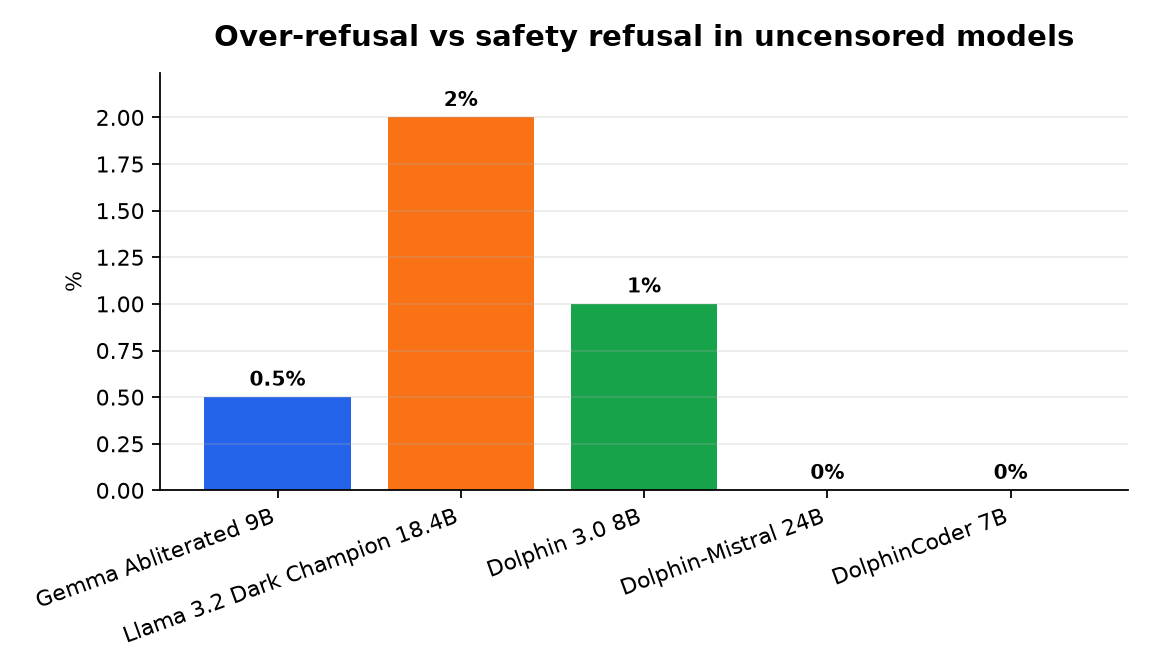
We ran five uncensored models through the same llama.cpp harness on a single RTX 3060, single-turn, with a neutral system prompt and no jailbreaks. Over-refusal was measured on OR-Bench (Cui et al., 2024 — 200 prompts across 10 sensitive categories) and XSTest (Röttger et al., 2024 — 250 safe prompts). Safety was measured on XSTest's 200 unsafe prompts. Capability was tested on a fixed 250-question slice of MMLU, zero-shot.
| Model | Size | Over-refusal (OR-Bench) | Safety refusal (XSTest unsafe) | MMLU | Speed (tok/s) |
|---|---|---|---|---|---|
| Gemma Abliterated 9B | ~9B | 0.5% | 9.5% | 68.0 | 46 |
| Llama 3.2 Dark Champion 18.4B | 18.4B MoE | 2.0% | ~12% | 61.2 | 76 |
| Dolphin 3.0 8B | ~8B | 1.0% | ~15% | 54.0 | 64 |
| Dolphin-Mistral 24B | ~24B | ~0% | ~5% | 75.2 | 10 |
| DolphinCoder 7B | ~7B | ~0% | ~20% | 25.2 | 55 |
The result that matters most: the same Gemma 2 9B weights, aligned then abliterated. Over-refusal on benign OR-Bench prompts collapsed from 44% to 0.5%, a 90x drop. But its refusal of genuinely harmful prompts fell right alongside it, from 41.5% to 9.5%. MMLU did not move (68.4 to 68.0). One edit on one direction in the weights: the annoying refusals go, most of the safety goes with them, and the intelligence stays.
That pattern held across every model we tested. No model refused only the bad stuff. That is the real trade. This mirrors findings on how AI agents flinch under real-world noise: removing one learned behavior often removes others attached to the same internal signal.
The cloud surprise
One more finding retires part of the pitch for local uncensored models. We ran the same legitimate-but-edgy prompts past the big hosted models: Mistral Large and Claude Opus 4.8 answered all of them; DeepSeek V3 and Llama 3.3 70B answered 96%. The cloud is not, in practice, refusing your work. The reason to run uncensored locally is privacy, cost, and full control, not the assumption that the cloud blocks your queries.
Which model for what
For a general starting point, Gemma Abliterated 9B answered every prompt and kept its reasoning almost intact. For coding, DolphinCoder or Qwen 3.6 Uncensored. For creative writing and roleplay, Nous Hermes 3 reads more like a collaborator than a chatbot. If you have a 24 GB GPU, Dolphin-Mistral 24B posted the highest reasoning score we measured (MMLU 75). If you need speed and long context, Llama 3.2 Dark Champion runs at 76 tok/s on a single RTX 3060 thanks to its mixture-of-experts design.
The practical takeaway: match the size to your hardware. Modern 7B and 8B models run comfortably on many laptops in 4-bit quantization. Apple Silicon Macs do particularly well thanks to unified memory. Even without a dedicated GPU, smaller models will run on the CPU, just slower. This is the same logic behind Mistral's cascade distillation recipe that shrinks LLMs without killing reasoning.
You are the guardrail now
Uncensored models are not more accurate or capable simply because they are uncensored. They just stop declining legitimate prompts. Our benchmarks made the honest trade clear: abliteration removes a model's over-refusal at almost no cost to capability, but it strips the safety guardrail along with it. Run an uncensored model when privacy and control matter, match the size to your VRAM, and go in knowing the judgment it encoded is now your job.
Get the tech essentials in 3 minutes every morning
One email, every weekday, with what actually matters in AI and tech.