Picbreeder revived with VLM agents
When AI agents rebuilt the internet's most creative experiment, they hit a wall humans never see
Sakana AI, MIT and NYU recreated Picbreeder with VLM agents to study open-ended creativity. The agents became trapped in repeating motifs, unable to make the conceptual leaps humans manage. Diverse personalities helped, but the gap between artificial and human creativity remains unexplained.
Emmanuel Fabrice Omgbwa Yasse AI-assisted
2026-07-19 · 4 min read
In the early 2000s, a website called Picbreeder let users collaboratively evolve images without any explicit goal. People simply picked pictures they found interesting, and over many generations and many hands, faces, animals, vehicles and skulls emerged from what was essentially a shared drift through visual space. The site eventually went offline, but the question it posed did not: what makes open-ended exploration work, and can machines do it?
Sakana AI, together with researchers from MIT and NYU, rebuilt Picbreeder from the ground up using vision-language model agents and published the results in a GECCO 2026 paper titled "In Search of the Ingredients of Open-Endedness: Replicating Picbreeder with Large Vision-Language Models," which has been nominated for a best paper award. The setup was a direct transplant of the original design: a shared archive of images, agents that pick ones to branch from, evolve new candidates, publish favorites, and rate each other's work. No target image, no definition of progress, just a community of agents deciding what was worth keeping.
The experiment was designed to test whether VLMs can reproduce the kind of open-ended discovery that Kenneth Stanley and others have argued is central to human creativity. The short answer is that they can approach it in certain controlled conditions, but they hit a ceiling that humans do not. This question of what enables sustained exploration is tied to broader research on training agents to handle real-world randomness without freezing.
The tyranny of the familiar
Compared with humans, the VLM agents tended to circle back to the same kinds of images and concepts. They repeatedly selected similar parents, made smaller conceptual leaps, and often refined an existing idea rather than abandoning it in search of something genuinely unexpected. The paper describes how agents would notice an interesting pattern and then lock onto it, gradually optimizing a visual motif until it became a dead end of incremental refinement.
This behavior matters because Picbreeder's original magic was the opposite: human users treated each interesting image as a stepping stone. A user might evolve a face and then, without any plan, a different user would take that face in a wholly different direction. The process depended on users being willing to let go of a promising line of exploration. The VLM agents, by contrast, seemed unwilling to abandon what they had already found promising. This pattern-hoarding behavior echoes the challenge described in teaching AI agents to reliably evaluate what is worth pursuing.
Personalities improve exploration
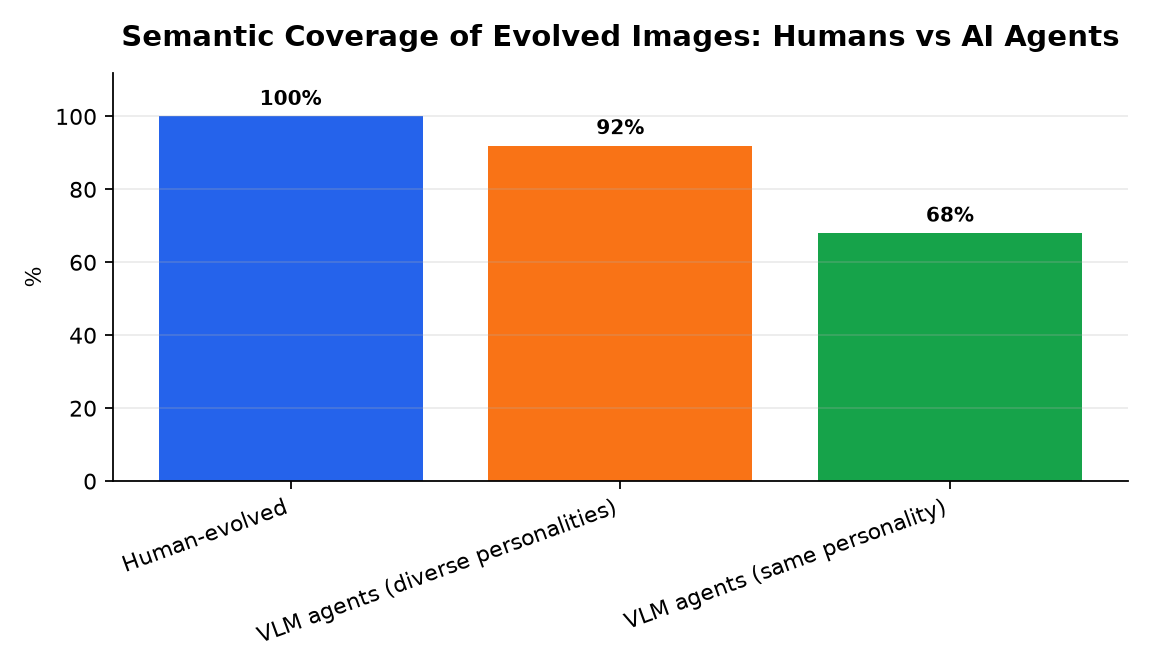
Introducing a diverse population of agent personalities improved the results substantially. When agents were given different behavioral priors some more exploratory, some more conservative the system's semantic diversity rose. In some runs, these diverse populations approached or matched the human archive on measures of semantic coverage, and they produced more balanced evolutionary trees. The implication is that on the collective level, diversity of taste can compensate for the individual agent's tendency to fixate. The broader lesson that coordination among agents can produce sophisticated results also appears in Sakana's other work on modular robotic bricks that self-recognize their shape and the Fugu multi-agent orchestration system.
The paper also reports that the evolved representations were more robust than those produced by direct gradient-based optimization. A skull evolved by the agents changed smoothly when its underlying neural representation was perturbed, less fractured than a skull directly optimized with gradient descent. But it still trailed the smoothness of human-evolved representations, suggesting that human collaboration introduces a form of regularization that current AI does not replicate.
The gap that remains
Perhaps the most interesting result is not what the agents did, but where they stopped. Humans appear better at turning fortunate accidents into sustained creative discoveries: recognizing when something unexpected is worth pursuing, refining it, and then making a larger conceptual leap. The AI agents often noticed interesting patterns too, but were more likely to become trapped in them. The paper frames this as an open question for the field.
"We still do not fully understand what enables humans to navigate open-ended search in this way, or what ingredient(s) current AI systems are missing," the authors write. "For now, the results suggest that there remains something important about human creativity that AI agents have not yet learned to reproduce." This echoes findings from the open-source model market, where scale alone is not enough to bridge certain performance gaps.
The work complements ongoing research at Sakana AI on collective intelligence in other domains. In both cases, the lesson is that coordination among many simple agents can produce sophisticated results, but the Picbreeder experiment adds a twist: coordination alone may not be enough for creativity. There may be a missing ingredient that has nothing to do with model scale or architecture and everything to do with the willingness to discard a working idea in favor of an uncertain one. The world model Alibaba open-sourced, which lets agents train inside a simulator, could be one path to testing that missing ingredient more systematically.
Get the tech essentials in 3 minutes every morning
One email, every weekday, with what actually matters in AI and tech.