Artificial Intelligence
The AI that taught itself to revise: four agents, one puzzle, no consensus
Researchers propose ARCANA, a multi-agent system that cracks ARC-AGI-2 puzzles by splitting reasoning into four steps and closing the loop with reflective feedback. Each failure teaches the next attempt. The architecture improves reasoning efficiency, but questions about generalization and compute cost remain.
Emmanuel Fabrice Omgbwa Yasse AI-assisted
2026-07-19 · Last updated: 2026-07-22 · 4 min read
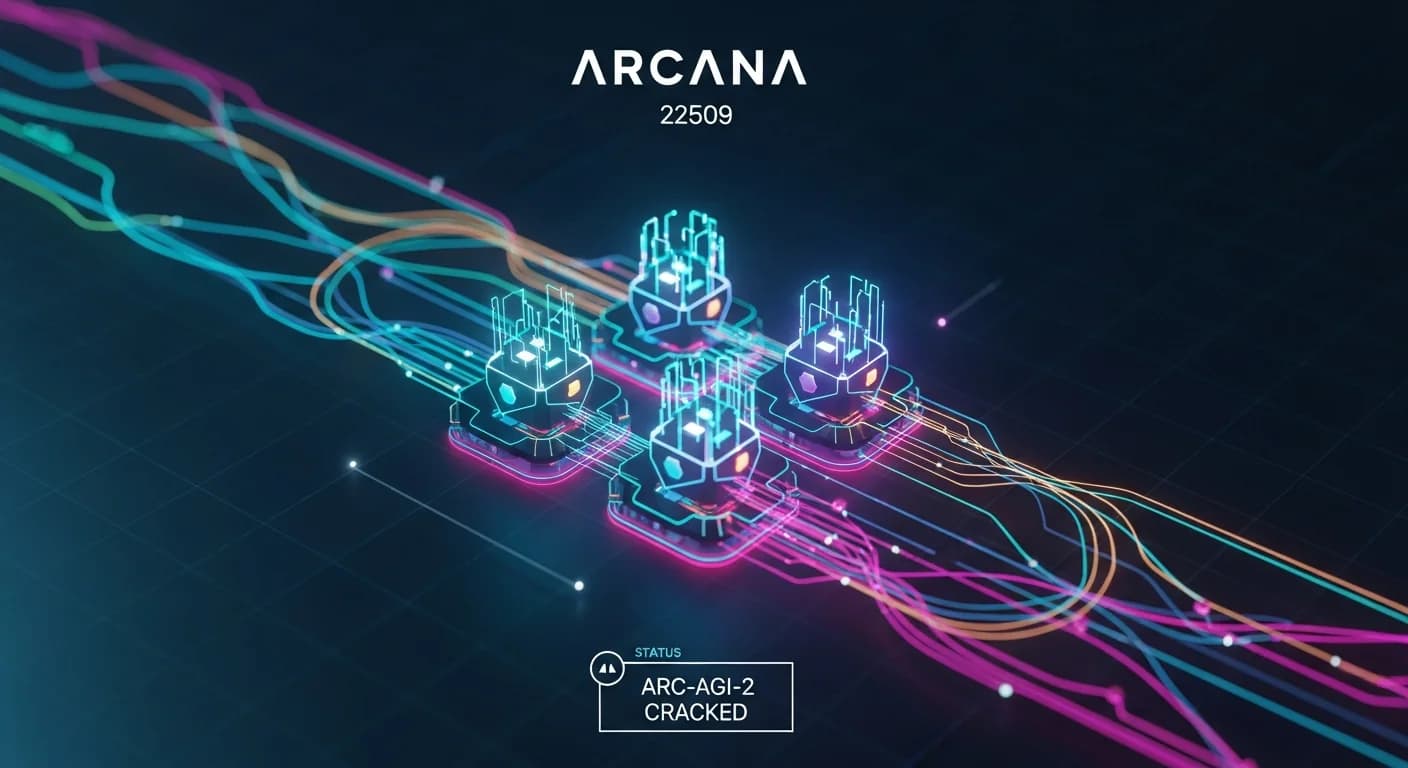
The ARC-AGI-2 benchmark has humbled many an AI system. Designed to test abstract visual reasoning with minimal examples, it demands the flexible intelligence that transformer models, even the largest ones, still struggle to achieve. Enter ARCANA, a new collaborative multi-agent framework that treats the problem not as a single model challenge but as a team sport. That approach mirrors a broader shift: labs are building compound systems that route subproblems to specialized modules rather than cramming all reasoning into a single model, a bet shared by OpenAI's quiet push into shared agents.
What ARCANA brings to the table
ARCANA, short for Reflective Multi-Agent Program Synthesis, reorganizes the puzzle-solving pipeline into four specialized agents. A perceptual grounding agent first builds object-centric scene graphs from raw pixel grids. A latent program policy then proposes diverse DSL programs that could map input grids to output grids. A symbolic executor verifies each candidate against the provided demonstrations. Finally, a reflective agent analyzes execution failures and composes feedback to guide the next iteration. This modular architecture is gaining traction elsewhere: Alibaba's Qoder bets that developers want visibility into what agents are thinking.
The agents are not siloed: they communicate through a shared differentiable blackboard, and a learned meta-controller decides which agent runs when. This architecture lets ARCANA combine structured program search with adaptive multi-turn correction, a hybrid approach the authors argue is more sample-efficient than end-to-end neural methods.
Why ARC-AGI-2 is a different beast
The ARC-AGI-2 benchmark, created by François Chollet, is explicitly designed to measure a system's ability to generalize from few examples. Each puzzle presents a handful of input-output grids depicting an abstract transformation: color fills, object rotations, mirror operations. The model must infer the rule and apply it to a new grid. It's essentially a test of fluid intelligence, not knowledge recall.
Most large language models and vision transformers still perform poorly on ARC-AGI-2, often failing to recover the underlying rule from sparse data. By contrast, ARCANA's explicit decomposition into perception, hypothesis, execution, and reflection mirrors how a human puzzle-solver might approach the test: look, guess, check, and revise. The approach echoes findings from other multi-agent research: the M3 team showed that combining expert models with evolutionary search can stop cheating and improve reasoning.
The reflective feedback loop is perhaps the most novel component. When the symbolic executor rejects a candidate, the reflective agent does not just discard it. Instead, it synthesizes a natural-language explanation of why the program failed, which the hypothesis agent uses to propose a revised program in the next round. This cyclical refinement, applied to program synthesis rather than text generation, is the kind of learning loop that makes some agents get smarter the longer they run.
Results and open questions
The paper reports improved reasoning efficiency and solution quality on challenging abstract transformation tasks, though precise numerical results are not reproduced here. The full evaluation will be available when the preprint is published. The authors also cite strict test-time and hardware constraints as design drivers, suggesting that ARCANA is resource-conscious compared to brute-force search over an exponentially large program space.
Still, several questions remain. The blackboard communication architecture relies on a learned meta-controller, whose training procedure and data requirements are not detailed. It is also unclear whether the framework's performance transfers to other reasoning-heavy benchmarks or whether the gains are specific to ARC-AGI-2's puzzle structure. The broader challenge of generalization is something the industry is still grappling with: as one analysis of coding agents pointed out, the hardest problem isn't code, it's counting the hours, a reminder that efficiency claims need human context.
The approach aligns with a broader industry trend: many frontier labs are now building compound AI systems that route subproblems to specialized modules rather than cramming all reasoning into a single model. Google DeepMind has experimented with modular agents for code generation; OpenAI's Q* project reportedly decomposes math problems into subgoals. ARCANA is part of this movement, but it goes a step further by closing the feedback loop. Research on latent-space recursion suggests that making agents think without speaking can be 2.4x faster than explicit communication.
For practitioners, the framework offers a potential template for building transparent, debuggable AI systems. If an ARCANA agent fails a task, the reflective agent's failure summary, written in something like natural language, gives a human operator a concrete point of intervention. That traceability is rare in monolithic neural models.
But the real test will be scale and variety. ARC-AGI-2 is a curated contest; the real world throws messier abstractions. Whether ARCANA's four-agent dance can handle a medical diagnosis pipeline or a physical robot's perception loop remains to be seen.
- Source : arXiv:2607.09059 — 2026-07-10
Get the tech essentials in 3 minutes every morning
One email, every weekday, with what actually matters in AI and tech.