App Store antitrust
Apple wants up to 15% on the linkout sales it says cost it nothing
Apple proposes commissions of up to 15 percent on App Store purchases made outside its payment system, while its filing says linkouts cost it "essentially zero." Epic says the proposal goes beyond what the court allowed.
Emmanuel Fabrice Omgbwa Yasse AI-assisted
2026-08-22 · 4 min read
Apple has finally put a number on what its linkouts are worth, and the figure sits awkwardly next to its own accounting. In the latest filing in the long-running Epic Games case, Apple proposed charging developers a commission on digital purchases made through external links that bypass its in-app purchase system, The Verge reports. The same filing says the "necessary costs" Apple incurs to allow those purchases "would be essentially zero."
The proposal lands in a specific legal moment. Since April 2025, Apple has been barred from taking any commission on external purchases, after California district judge Yvonne Gonzalez Rogers found the company "willfully" failed to comply with her 2021 injunction in Epic Games v. Apple. A Ninth Circuit panel later said Apple may charge a commission tied to the "necessary costs" of supporting linkouts. The Supreme Court has agreed to hear arguments on whether Apple willfully violated that April 2025 ruling.
The fee schedule Apple put on the table
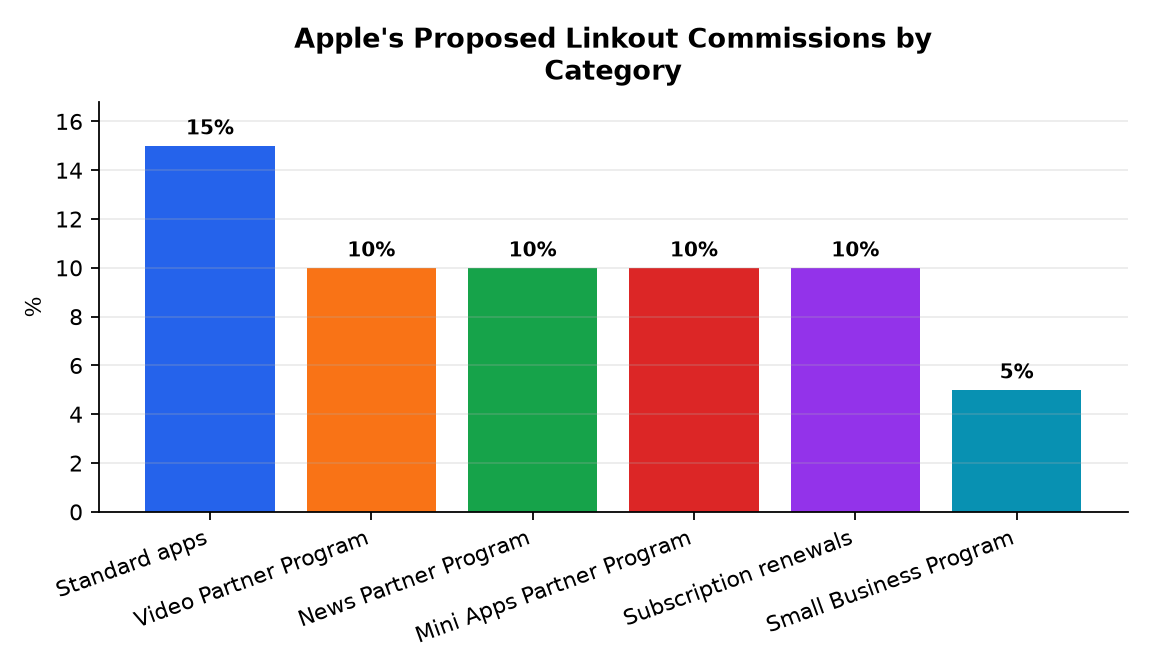
Apple's proposed rates, which would apply to purchases that never touch its payment system:
| App category | Proposed commission |
|---|---|
| Standard apps | 15% |
| Video Partner Program | 10% |
| News Partner Program | 10% |
| Mini Apps Partner Program | 10% |
| Subscription renewals | 10% |
| Small Business Program | 5% |
The justification leans on an "expert analysis" Apple says supports the structure: at these rates, "large numbers of U.S. developers collectively accounting for the lion's share of App Store revenue will be able to link out profitably." The commission, Apple adds, would let it recoup "at least some compensation" for its tools, technologies, and services.
The gap between zero and 15 percent
The tension Epic will press for the next two months is simple. Apple says the costs the Ninth Circuit asked it to measure are essentially nil once the transaction leaves its systems. If the cost of a linkout is zero, Epic counters, the permissible commission under the court's own definition is zero as well. In its response, Epic said Apple had in effect admitted as much: under the Ninth Circuit's definition of "necessary costs," the commission on purchases made via web linkouts would be 0 percent. The proposed fees are, in Epic's words, "far outside of the bounds" of what the appeals court allowed, and Epic says it has roughly 60 days to file its opposition backed by expert witnesses.
Apple's answer is that the fee should reflect the value of what it provides, not the marginal cost of a linkout. The appeals court tied any commission to "necessary costs," and that phrase is exactly what the next round of filings will fight over. The company has made the opposite call elsewhere, handing its iPhone Upgrade Program to Klarna rather than keeping the financing in-house, a shift we reported on.
What the proposal means for developers
Right now the commission on an external purchase is 0 percent, because the April 2025 ruling blocks Apple from collecting one. If Apple's rates are accepted, the math changes for every developer that steers customers to the web to avoid the in-app cut. Apple's own forecast concedes part of the argument: it predicts the developers that drive most App Store revenue will still find linkouts profitable at the proposed rates. That is an aggregate claim, though. Whether a mid-size app paying the 15 percent rate still comes out ahead is the kind of question Epic's experts will be paid to contest. Apple's broader finances, at least, are not in dispute: the company just posted a record June quarter, per our breakdown of those results.
The Verge's report does not say when Apple expects the structure to take effect, or how linkout payments would be processed in practice. Those mechanics matter, because a fee schedule without implementation rules leaves plenty of room for the next round of argument. The filing also lands as the Supreme Court prepares to weigh the willfulness question, which gives the justices a concrete rate card to measure against the injunction.
The dispute has always been the same question, reasked in different courts: how much a platform owner gets to charge when the transaction no longer touches its systems. Apple's answer is up to 15 percent of the purchase price. Its own filing says the transaction costs it essentially nothing. Both Epic's experts and the Supreme Court now get a turn at that contradiction.
Get the tech essentials in 3 minutes every morning
One email, every weekday, with what actually matters in AI and tech.