AI Agents
PsychoAgent gave AI agents emotional memory. The raters found no edge
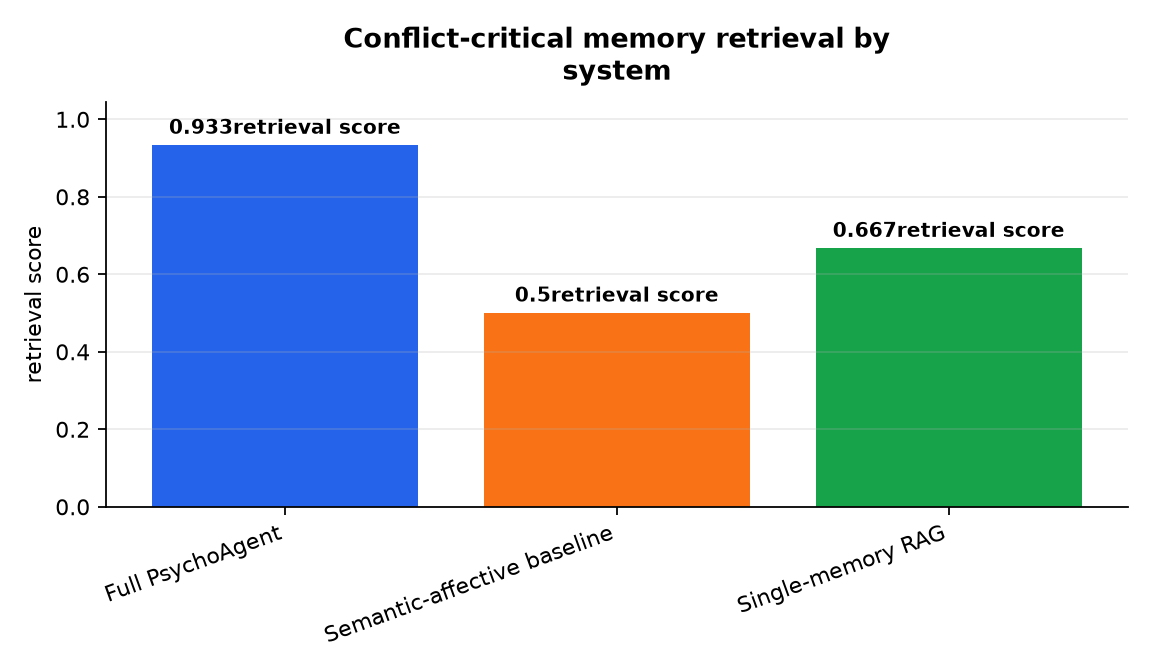
PsychoAgent gives LLM agents a separate affective memory so emotionally salient, conflict-laden traces can outweigh merely topical ones. In three conflict scenarios it retrieved more conflict-critical memories than both baselines (0.933 vs 0.500 and 0.667), yet five blinded raters found no significant quality edge.
Emmanuel Fabrice Omgbwa Yasse AI-assisted
2026-08-19 · 4 min read

Long-term memory keeps an LLM agent from asking the same question twice, and it is also how the agent gets stuck. When new evidence contradicts an old memory, the stale trace can stay retrievable and crowd out what replaced it, the same class of failure that recent work on agent working memory tackles from the state-tracking side. A preprint posted to arXiv on 7 Aug 2026 approaches that problem from an unexpected side: rather than deciding which memories are true, it asks which ones weigh on the agent.
The architecture is called PsychoAgent. It is not a new foundation model; it is a cognitive architecture for LLM agents that separates factual and affective memory and integrates both through a conflict-aware executive controller. Affective memories are filtered by semantic relevance first, then re-ranked by salience, so emotionally important traces can enter the prompt without losing topical fit. The premise, borrowed from how people remember, is that topical similarity is not the only selector: affective significance and unresolved conflict shape what becomes accessible.
This matters beyond recall scores. For an agent, the retrieval layer decides what the underlying model ever gets to see, so a bias in retrieval becomes a bias in behavior. A system that systematically favors affectively charged or conflict-laden memories does not merely recall differently. It acts on a different version of the past.
How PsychoAgent weighs emotional salience
The mechanism in the preprint is two stores and one decision point. Factual and affective memories live apart, and the executive controller integrates both. Affect-laced traces only reach the prompt after a salience re-ranking that still respects semantic relevance, preserving topical fit while letting emotionally important memories through. What the design does not do is verify that a memory is still true; validity is treated as a separate concern, and a parallel line of work covers it, including research agents that check their own output over long histories.
The retrieval numbers, and the raters' verdict
The headline figures come from three controlled conflict scenarios. The full architecture retrieved more conflict-critical memories than either baseline: 0.933 against 0.500 and 0.667, at the price of a small drop in semantic similarity.
| Three conflict scenarios | Full PsychoAgent | Semantic-affective baseline | Single-memory RAG |
|---|---|---|---|
| Conflict-critical memory retrieval | 0.933 | 0.500 | 0.667 |
Read those numbers literally: plain RAG already surfaces two of every three conflict-critical memories, so the architecture's edge is confined to the remaining third, where salience does the deciding.
The human evaluation is more sobering. Five blinded raters scored 27 outputs, and after within-rater standardization the full architecture posted the highest overall mean, +0.22 standard deviations. Corrected pairwise differences did not reach significance. In plain terms: the system surfaced more of the memories the scenarios were built to test, yet graders could not reliably score its outputs above the alternatives. The split is not unique to memory research: most teams cannot say what their AI coding agents actually did either.
What affect adds to the agent-memory race
PsychoAgent lands in a crowded season for agent-memory research. This summer alone, preprints have proposed skill layers, self-evolving rubrics, and memory revocation, though the skills lane already carries a warning: added procedural skills have been shown to backfire. One of those is TEPA, submitted the same day, which attacks the validity side of the problem head-on: it treats memory validity as an explicit state, keys observations as precedents, and revokes active precedents when fresh evidence contradicts them under the same key. Its authors call the failure mode memory pollution, degradation caused by active memories that newer evidence has superseded, and position lifecycle revocation as a core operation for agents that must falsify, audit, and later re-promote evolving knowledge. Where TEPA deletes, PsychoAgent re-weights. The product side runs the same race: one agent now carries a single persistent memory across Telegram, Discord and Signal.
The paper argues affect-sensitive retrieval is an inspectable mechanism for modeling human-like conflict effects in agents, and it includes a three-day illustrative trace showing persistent affect, offline memory recombination, and selective memory reweighting. The evidence base, though, is three scenarios, 27 outputs, and five raters. The most credible thing in the preprint is how it presents itself: the rater null sits in the same abstract as the retrieval headline.
That candor matters, because the mechanism is only useful if changing which memories surface also improves what the agent does, and the current evidence does not establish that. The obvious next step is a larger replication with a preregistered analysis. PsychoAgent changes what an agent remembers when memories conflict. Whether the agent acts better on those memories is an open question, and the preprint says so itself.
- Source : PsychoAgent gave AI agents emotional memory. The raters found no edge — 2026-08-07
Get the tech essentials in 3 minutes every morning
One email, every weekday, with what actually matters in AI and tech.