Vehicle Safety & Regulation
NHTSA probes 1.2 million Teslas over a suspension part that can fail without warning
NHTSA is investigating suspension failures in nearly 1.2 million Tesla Model 3 and Model Y vehicles after 156 complaints about the front lower lateral link detaching. No crashes or injuries have been recorded, but most failures came without warning. Tesla has been here before.
Emmanuel Fabrice Omgbwa Yasse AI-assisted
2026-08-04 · 4 min read
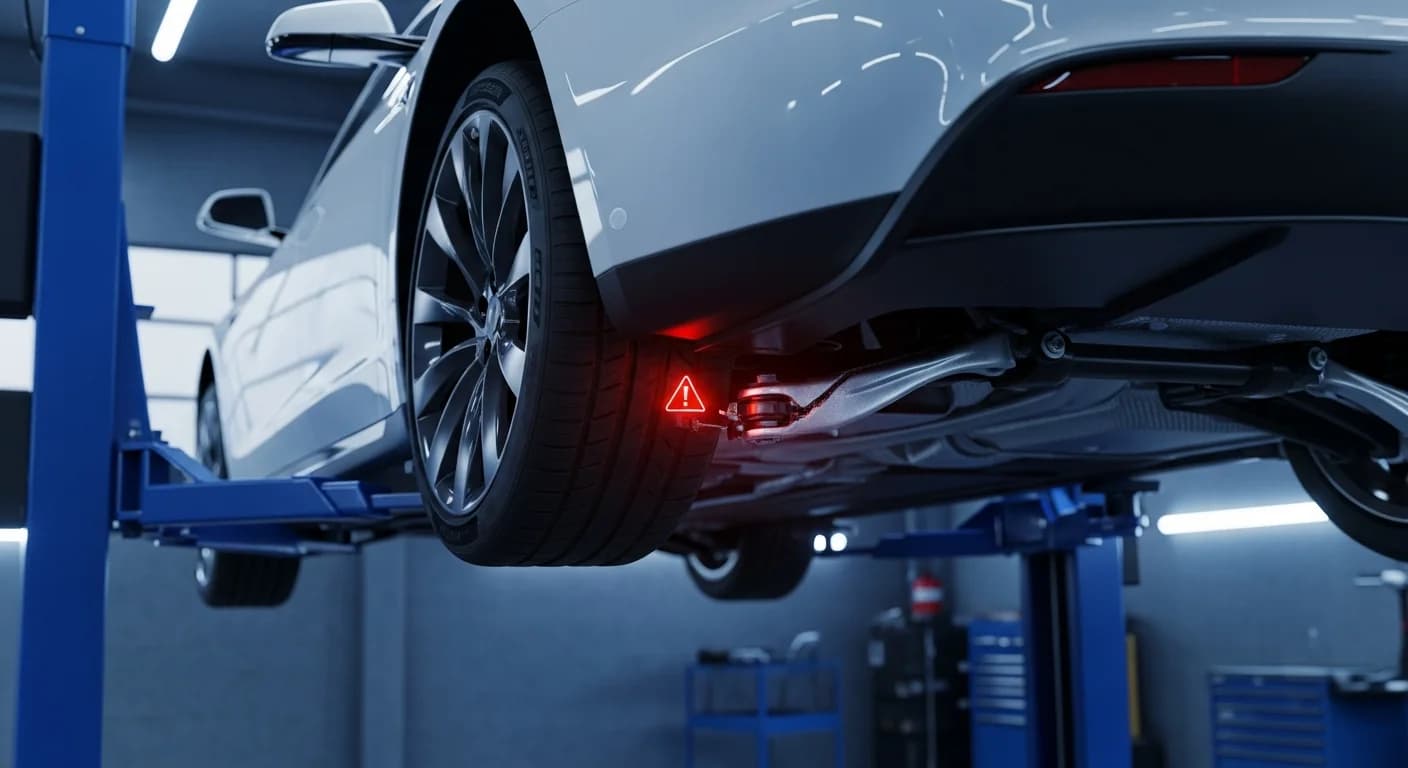
The unsettling part of the failure at the center of NHTSA's Tesla probe is the silence around it. In most of the cases the agency has reviewed, the failure came with no advance warning at all. Silent failures are not a new idea in technology: AI pipelines have their own silent leaks. On the road, the stakes are different.
One hundred fifty-six complaints sit behind a probe covering nearly 1.2 million vehicles. The National Highway Traffic Safety Administration has opened a preliminary investigation into suspension failures affecting the 2018-2020 Model 3 and the 2021-2023 Model Y, according to The Verge, citing a filing from the agency's Office of Defects Investigation that Reuters first reported. The issue involves the detachment of the front lower lateral link, the component that connects the suspension to the car's structure. When it detaches, NHTSA says, the driver can lose directional control.
The agency has recorded no crashes, injuries, or fatalities tied to the complaints. That is the reassuring part of the file. The harder part is what surrounds it: most of the failures NHTSA reviewed struck without warning, and only some owners described hearing noises beforehand. For the people driving these cars, nothing on the dashboard announces a failing lateral link. The first sign can be the car steering wrong.
What the filing covers
The preliminary investigation spans the 2018-2020 Model 3 and the 2021-2023 Model Y, a combined fleet of nearly 1.2 million vehicles. The filing describes a symptom rather than a root cause: the front lower lateral link detaching from the vehicle, with the potential to compromise control on the road.
| Figure | Number |
|---|---|
| Vehicles in scope of the probe | Nearly 1,200,000 |
| Complaints received by NHTSA | 156 |
| Vehicles recalled in 2021 (Model 3 and Model Y) | 2,791 |
| Crashes, injuries, or fatalities tied to the complaints | 0 |
Complaint counts are a crude signal: they miss the owners who never report and overweight the ones who do. The same mismatch shows up in software, where top models hit 96% on SWE-bench Verified and barely clear 23% on private enterprise code, per a comparison of those results. The reason 156 complaints matter here is the failure mode. A suspension part that comes apart without warning turns a normal commute into a test of whether one component holds together. Whether these are isolated bad parts or a defect spread across the fleet is the question the probe exists to answer.
A part with a history in Tesla's suspension
The lateral link has shown up in Tesla's suspension record before. In 2021, Tesla recalled 2,791 Model Y and Model 3 vehicles over a potential suspension defect. A later round of Model 3 recalls came after NHTSA determined that a loose fastener could let the lateral link separate from the sub-frame. That second recall names the component now at the center of the new complaints.
NHTSA says the complaints behind the current investigation do not appear related to those earlier issues. That separation matters. If the failures tied back to the previous recalls, the agency would inherit a repair history and a known fix. Cut loose from those recalls, the probe starts from the beginning on a part that has already been named once in a recall covering this family of cars.
None of this convicts the lateral link. But the repetition is what a safety regulator is supposed to notice. The escalation path is familiar in cybersecurity: CISA added a Cisco firewall flaw to its KEV catalog and required federal agencies to investigate rather than just patch, per the KEV catalog update. Tesla handled suspension problems in 2021, fixed the affected models, and now faces fresh complaints about a related component in a newer set of vehicles. Three rounds of scrutiny of this suspension family, with the lateral link named in two of them.
What the probe has to prove
Preliminary is the key word in this investigation. It is the opening stage of an assessment that can end with the case closed or escalate toward a recall reaching nearly 1.2 million vehicles. The evidence that tips it in either direction will be additional complaints and whatever pattern the agency can establish in how the parts fail. None of that has been established yet.
For owners, the scope is specific: Model 3 from 2018 through 2020, Model Y from 2021 through 2023. If the failures prove systemic, those are the cars that would be called in first. If the complaints stay isolated, the file closes and the fleet size becomes a footnote.
The most striking number in this file is the fleet size, not the crash count. The absence of recorded injuries is genuinely good news. But the quiet failure is the reason these files get opened at all, because a part that detaches without warning does not schedule its failures for a safe moment. The investigation is open, and the part, along with the 1.2 million cars carrying it, will decide where it goes. For Tesla, it is one more open question on top of a quarter where revenue rose while free cash flow went negative.
Get the tech essentials in 3 minutes every morning
One email, every weekday, with what actually matters in AI and tech.