Electric Vehicles / AI Infrastructure
Tesla's revenue is up. Its real bet is spending itself into the red.
Tesla's Q2 2026 earnings show a revenue rebound, but profit growth is anemic and free cash flow is negative. The company is pouring billions into AI, robotics, and manufacturing infrastructure, a bet that hinges on whether its car business can fund the transformation Musk keeps promising.
Emmanuel Fabrice Omgbwa Yasse AI-assisted
2026-07-28 · 4 min read
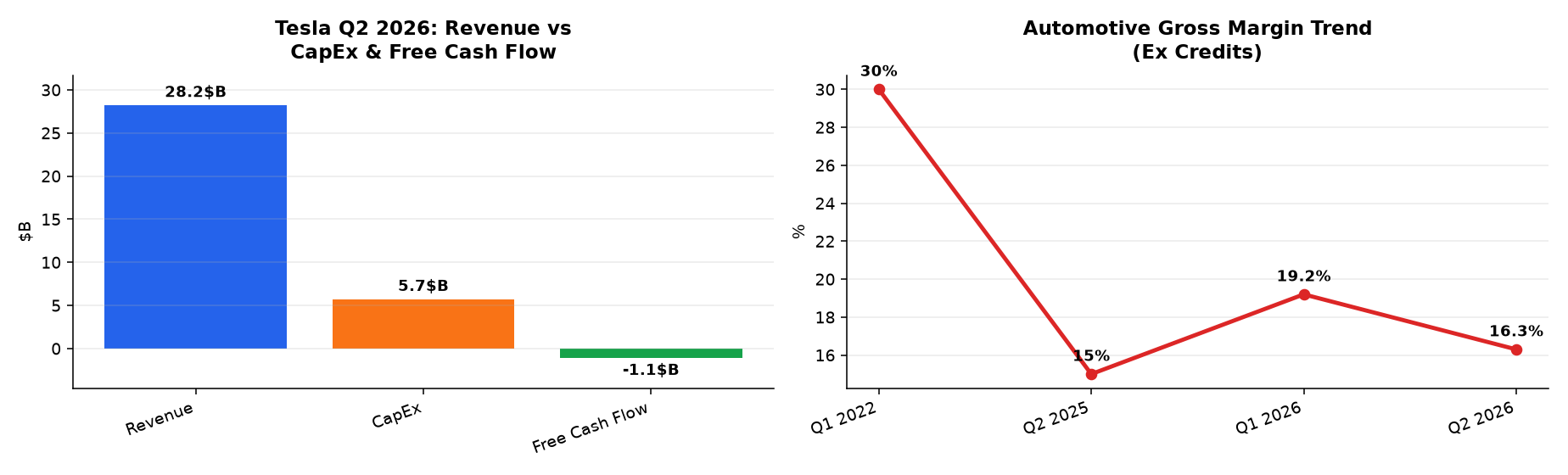
If you only skimmed the top-line numbers in Tesla's Q2 2026 earnings report, you might think the company has put two years of brand damage and demand slumps behind it. Revenue hit $28.2 billion, net income landed at $1.11 billion, and deliveries bounced back to 480,126 vehicles, a 25% increase over the same period last year. Wall Street had expected about $26.4 billion, so the beat counts as a win.
But the story beneath those numbers is less a recovery and more a high-stakes reallocation. Tesla's capital expenditures reached $5.7 billion in the quarter, up 142% year over year. The company reported negative free cash flow of $1.1 billion, meaning its operating revenue no longer covers its spending on factories, AI clusters, and robotics lines. The company said it has $43.5 billion in cash on hand, so there's no immediate crisis. But the trend line is the sort that makes analysts nervous. The broader tech investing climate, where startups burn cash on AI infrastructure, mirrors this gamble, as seen in YC's student credit bundle.
The margin story that matters
Automotive gross margins, the metric that captures what Tesla actually earns from selling cars after direct manufacturing costs, came in at 16.3%, excluding regulatory credit sales. That's up from the 15% margin in Q2 2025, which was a low point. But it's down from 19.2% in the first quarter of this year, and a long way from the 30% margins Tesla used to boast in 2022.
Regulatory credits, the revenue Tesla collects by selling emissions compliance credits to other automakers, remain a small but notable tailwind. The Trump administration's elimination of penalties for exceeding emission standards means that stream is about to dry up. Tesla didn't specify how much credit revenue contributed to the quarter, but the margin figure is now adjusted for it, meaning the real car-selling margin is already lower than what the headline suggests.
Musk has long argued that margin compression is a deliberate choice: lower prices to drive volume, then monetize the fleet through autonomy and AI services later. That strategy only works if the later part arrives on schedule.
The robotaxi gap
Tesla's autonomous vehicle project has become the single biggest disconnect between Musk's promises and what the company can actually deliver. He predicted the robotaxi network would cover 50% of the US population by the end of 2025. Instead, Tesla launched robotaxi operations in two Florida cities, Orlando and Tampa, with a crowdsourced tracker showing only a handful of cars actually available to riders. The company is still in what looks like a controlled pilot, not a rollout.
The Full Self-Driving software, now at version 14 Lite, gained a feature that lets the system learn individual driving preferences. But the safety picture is not improving. According to a report by Electrek, 207 crashes involving Tesla drivers using Autopilot or FSD were recorded in May 2026 alone. That number is growing, and regulators are paying attention. The challenge of ensuring AI systems behave reliably in complex environments is also a core theme in LiveBench's diminishing returns.
Where the money is going
Tesla's shareholder deck makes no secret of where the capital expenditure is headed. The company already started production of the Cybercab at Gigafactory Texas, it says Tesla Semi production at the Nevada facility is on track, and it has begun construction of a production line for the Optimus humanoid robot at the Fremont factory, after decommissioning the Model S and X assembly line to make room.
Optimus is a long shot. A comparison with Xiaomi's humanoid robot, which went from concept to real factory work in six months using an In-Context World Modeling approach. Xiaomi's robot can now operate a single self-tapping nut station performing repetitive screw insertions. That is a far narrower scope than Tesla is aiming for, but it is a working deployment. Tesla is still in the construction phase of Optimus production. The efficiency gains from AI-powered automation are a key factor in the broader robotics trend, as highlighted by HappyOyster's 3D world generation.
The company's energy business remains the least troubled part of the operation. Energy generation and storage revenue hit $3.1 billion, up 13% year over year. That segment still carries the company when automotive margins slip.
Tesla said in its report that it generated over $100 billion in trailing twelve-month revenue for the first time. That is a milestone worth noting. The question is whether the automotive division can sustain the investment pace needed to make Musk's transformation thesis work, or whether the spending will outrun the revenue before the AI bet pays off. The risk of over-investing in AI infrastructure without a clear payoff is something investors have seen before, as in the $314 billion assumption that broke.
Get the tech essentials in 3 minutes every morning
One email, every weekday, with what actually matters in AI and tech.