Embodied AI
A dozen physics engines are fighting for the right to train your robot
Robot simulation is the backbone of embodied AI training. As engines specialize and multiply, the question is no longer which one is fastest, but which abstractions will survive as shared infrastructure. NVIDIA, DeepMind, and Disney-backed Newton points toward an open, layered future where no single engine owns the stack.
Emmanuel Fabrice Omgbwa Yasse AI-assisted
2026-07-25 · 4 min read
The robotics simulation landscape in 2026 looks nothing like it did five years ago. Back then, the choice was straightforward: pick a CPU engine, MuJoCo, PyBullet, Gazebo, hack together a reward function, and hope the policy transferred to a real robot half the time. Today, the ecosystem is a tangle of GPU-native engines, batched simulators, differentiable physics, and rendering pipelines that barely existed two years ago. The hardest decision for a robotics team is no longer mechanical, it is which simulation abstraction to build on. The same fragmentation that shaped the LLM landscape, documented in leaderboard analysis of diminishing returns, is now reshaping how robots learn.
NVIDIA's latest overview of the physical AI simulation stack, published on Hugging Face, catalogs the fragmentation in plain sight. It covers engines designed for humanoids, quadrupeds, aerial vehicles, autonomous vehicles, and dexterous manipulators. It names MuJoCo, MuJoCo Warp, Isaac Sim, Isaac Lab, and the newly formed Newton engine, backed by NVIDIA, Google DeepMind, and Disney Research under the Linux Foundation. The breadth alone is a clue: no single engine dominates anymore because no single engine can cover the spread of requirements. The pattern mirrors what hierarchical agent architectures are doing for tool registries, replacing monolithic choices with layered stacks.
The oldest and still most widely used of these is MuJoCo. Its appeal is speed and determinism for articulated-body dynamics. It was never designed for photorealism or massive GPU parallelism, but its contact modeling and generalized-coordinate simulation remain a reliable benchmark. The real shift came with MuJoCo Warp, a GPU-accelerated reimplementation in NVIDIA's Warp framework that trades single-step latency for batched throughput. Teams training reinforcement learning policies across thousands of parallel environments now treat MuJoCo Warp as the throughput layer, not the simulation layer. This kind of specialization across layers is reminiscent of how speculative decoding separates draft and verification phases in LLM inference, each optimized for different constraints.
Isaac Sim sits on the other end of the fidelity spectrum. Built on NVIDIA Omniverse and OpenUSD, it provides photorealistic RTX rendering and a full sensor suite, cameras, depth, lidar, radar, segmentation. It is the engine you reach for when the sim-to-real gap is about perception, not dynamics. But photorealistic rendering at scale is expensive, and not every training loop needs it. Isaac Lab, NVIDIA's agent-ready framework, decouples the rendering backend from the physics backend. The latest Isaac Lab 3.0 release lets developers choose PhysX with RTX for sensor-rich workflows or a lightweight Newton physics backend for high-throughput headless simulation. The abstraction is finally modular. The modularity has practical implications for agent harness efficiency, where decoupling components often reveals where bottlenecks truly live.
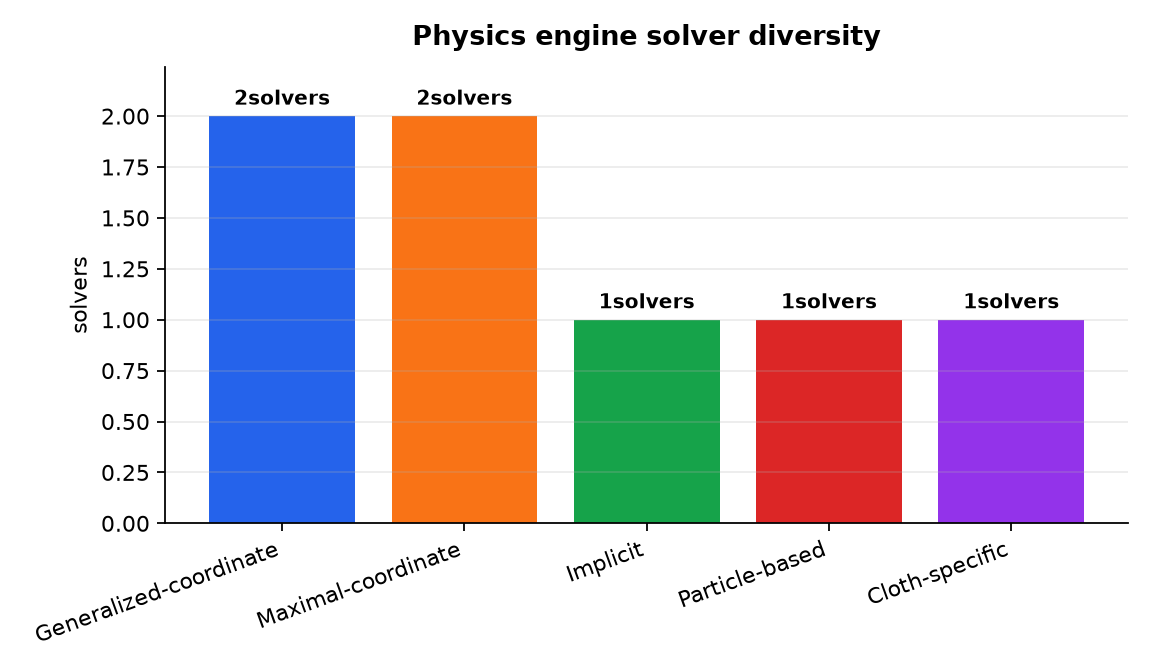
Newton itself is the most instructive piece. Mentioned as an open-source, GPU-accelerated, extensible, and differentiable physics engine, it acts as a physics layer for frameworks like Isaac Lab and MuJoCo Playground. It provides multiple solvers, generalized-coordinate (MuJoCo, Featherstone), maximal-coordinate (XPBD, Kamino), implicit (VBD), particle-based (MPM), cloth-specific (Style3D), rather than prescribing one. No other engine in the stack offers that kind of solver flexibility under a single API. That is the direction the field is moving: toward a shared physics layer that different simulators and frameworks build on top of, rather than each reimplementing contact models from scratch. The design mirrors the philosophy behind agent orchestration frameworks that prioritize speed of instantiation over feature sprawl.
The post makes a deliberate point that a growing share of this core infrastructure is open source. MuJoCo has been open since 2021. Isaac Sim and Isaac Lab are open. Newton is governed by the Linux Foundation. The barrier to entry for a student or small team with a single consumer GPU is lower than it has ever been. That is not incidental. It reflects a community consensus that simulation infrastructure benefits from shared investment rather than proprietary silos.
What the post does not settle is which abstraction will win the standardization battle. The ecosystem is still too young. But the question it raises is the right one: as the stack fragmentizes and recomposes, which pieces become the shared foundation that everyone builds on? The answer matters because it determines where the next generation of embodied AI research will invest its time, talent, and compute. Standards emerge slowly in simulation, but when they do, they tend to reshape everything built on top, a dynamic Qwen's language-based world model is already testing by treating physics as a translation problem rather than a simulation problem.
Get the tech essentials in 3 minutes every morning
One email, every weekday, with what actually matters in AI and tech.