Artificial Intelligence
The $314 billion assumption that just broke
Moonshot AI's Kimi K3, a 2.8 trillion parameter open-weight model, triggered a global revaluation of AI stocks. The combined estimated valuations of OpenAI and Anthropic lost $314 billion as investors confronted cheaper Chinese frontier AI. The analysis examines winners (Chinese chip makers, memory manufacturers, software developers) and losers (model developers, Nvidia's scarcity premium) in the new landscape.
Emmanuel Fabrice Omgbwa Yasse AI-assisted
2026-07-22 · Last updated: 2026-07-24 · 4 min read
On the surface, Moonshot AI's Kimi K3 is another big number in a field that has grown numb to big numbers: 2.8 trillion parameters, 896 experts in a Mixture-of-Experts architecture, open weights dropping July 27. But the market did not react like it had seen one more model. It reacted like someone had just handed it the receipt for a dinner it assumed cost ten times more.
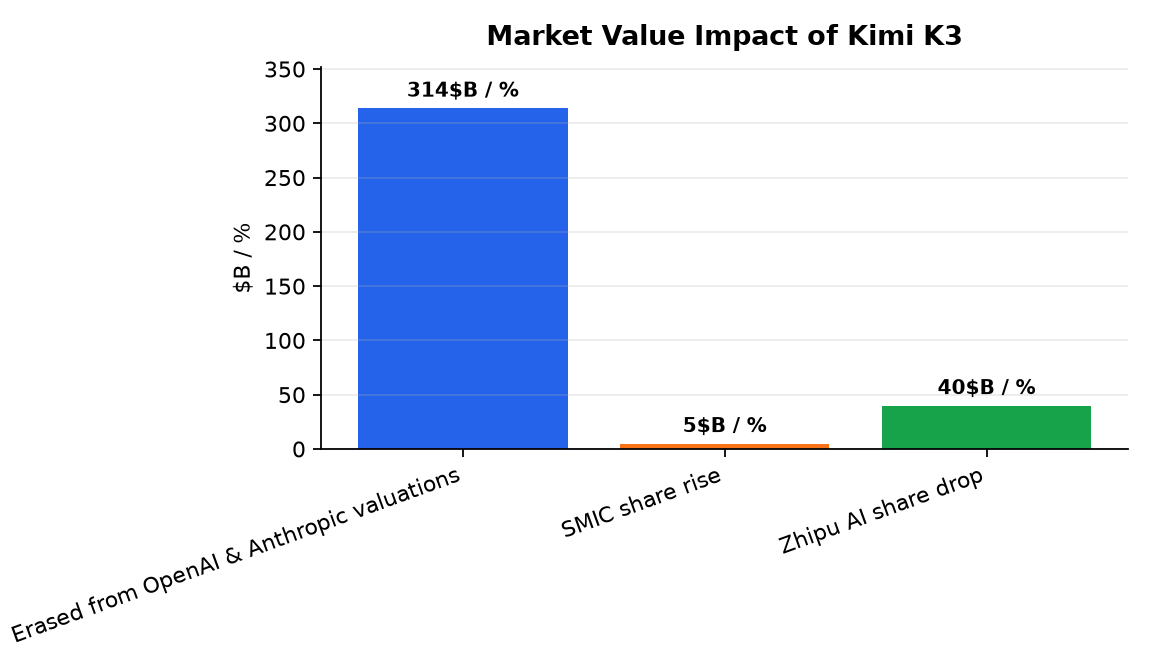
IG market analyst Tony Sycamore estimates that the announcement erased a combined $314 billion from the expected valuations of privately held OpenAI and Anthropic. That is not a funding round correction. That is a structural repricing of the entire frontier model business, triggered by a Chinese startup whose previous claim to fame was a chatbot with a token-to-points loyalty program. For context on how fast the ecosystem moved, see how K3 beat GPT-5.6 Sol on code gen.
The trigger is being called the Second DeepSeek Shock, and for good reason. DeepSeek's January release proved that Chinese teams could train competitive models under export controls and at lower cost. Kimi K3 goes further: it proves they can open-source those models at scale, letting any enterprise run them without cloud vendor lock-in. The pricing pressure that follows is not hypothetical. It is priced in.
The winners: infrastructure, memory, and the application layer
The immediate beneficiaries are not the companies that build models, but the companies that build the stuff models run on. SMIC shares rose over 5 percent on expectations that cheaper models will drive broader deployment, not less demand. Alibaba's Qwen3.8 Max announcement the following day reinforced the pattern, and the ChiNext composite index gained 3.6 percent across the two sessions. Alibaba's own recent work reflects this trend in turning world modeling into a language problem.
Allspring Global Investments portfolio manager Gary Tan put it plainly: the biggest winners remain AI infrastructure layer companies. The logic runs like this: if a frontier model costs one-tenth as much to run, companies will run ten times as many inference calls. That does not reduce demand for compute. It multiplies it. And the efficiency-driven approach is showing up in benchmarks elsewhere, as seen in how speculative decoding hides latency without changing outputs.
Memory chips are a particularly clear beneficiary. Even with aggressive sparsity and the 896-expert MoE structure, Kimi K3 still needs roughly 1.4 TB of memory after low-precision compression. That is a lot of DRAM and NAND, and it flows directly to SK Hynix, Samsung Electronics, and Chinese memory makers. Sustained demand, not a one-time bump.
The application layer also gains. Lower-cost frontier models reduce the economics of building AI agents, copilots, and automation workflows. Coding assistants, customer service bots, and industrial process models all become cheaper to run at scale. Microsoft is already preparing to test Kimi K3 inside Copilot as a cheaper alternative to OpenAI and Anthropic models, a move that could cut its inference bill by up to $600 million annually, though the model still needs to pass quality and latency checks. That $600 million figure comes from Microsoft's own cost-cutting plans with Kimi K3.
The losers: model developers and the scarcity premium
The picture is grimmer for companies whose business model depends on keeping frontier AI expensive.
Zhipu AI, previously seen as China's strongest open-source model developer, saw its Hong Kong-listed shares drop nearly 40 percent across two trading days. That is not a wobble. It is a signal that the market is reassessing which model builders survive when the barrier to entry is lowered, not raised, by a competitor's release. The race is now as much about distribution as it is about raw capability, a dynamic explored in Mistral's industrial pivot.
High-end chip makers, particularly Nvidia and AMD, face renewed scrutiny. If Chinese labs can deliver frontier performance without access to the most advanced silicon, the scarcity premium that Nvidia has commanded becomes harder to justify. The export controls that were supposed to contain China's AI progress now look like they may have accelerated a shift toward efficiency that bypasses expensive hardware altogether.
Morningstar analyst Malik Ahmed Khan pushed back on the direct causal link, arguing that US enterprises will not abandon existing cloud providers for Chinese open-source models due to security and compliance requirements. That is a real friction. But friction does not stop pricing pressure. It only delays it.
The structural shift: efficiency over brute force
The Kimi K3 and Qwen3.8 Max announcements, coming one day apart, mark something beyond individual model releases. They mark a structural shift in how the AI market values compute, openness, and geography.
The DeepSeek moment proved that Chinese teams could train competitive models. The Kimi K3 moment proves they can open-source them at a scale that forces global repricing. The question is no longer whether Chinese AI labs can compete. It is which Western assumptions about pricing, scarcity, and geography survive the competition.
Two conclusions stand out for investors and builders. First, the infrastructure layer benefits regardless of who wins the model race. Second, the model layer itself is becoming a commodity faster than most incumbents planned for. The companies that survive will be the ones that build moats in distribution, data, or application integration, not in parameter count or closed weights.
Get the tech essentials in 3 minutes every morning
One email, every weekday, with what actually matters in AI and tech.