Coding agents
Kimi K3 edges out claude fable 5 and gpt 5.6 sol on next.js code gen benchmark
Kimi K3 ties for first at 92% success rate on Next.js code tasks, finishing in under 200 seconds. AGENTS.md documentation erases gaps between top models and mid-tier ones, pushing all of them to 96%.
Emmanuel Fabrice Omgbwa Yasse AI-assisted
2026-07-18 · Last updated: 2026-08-03 · 4 min read
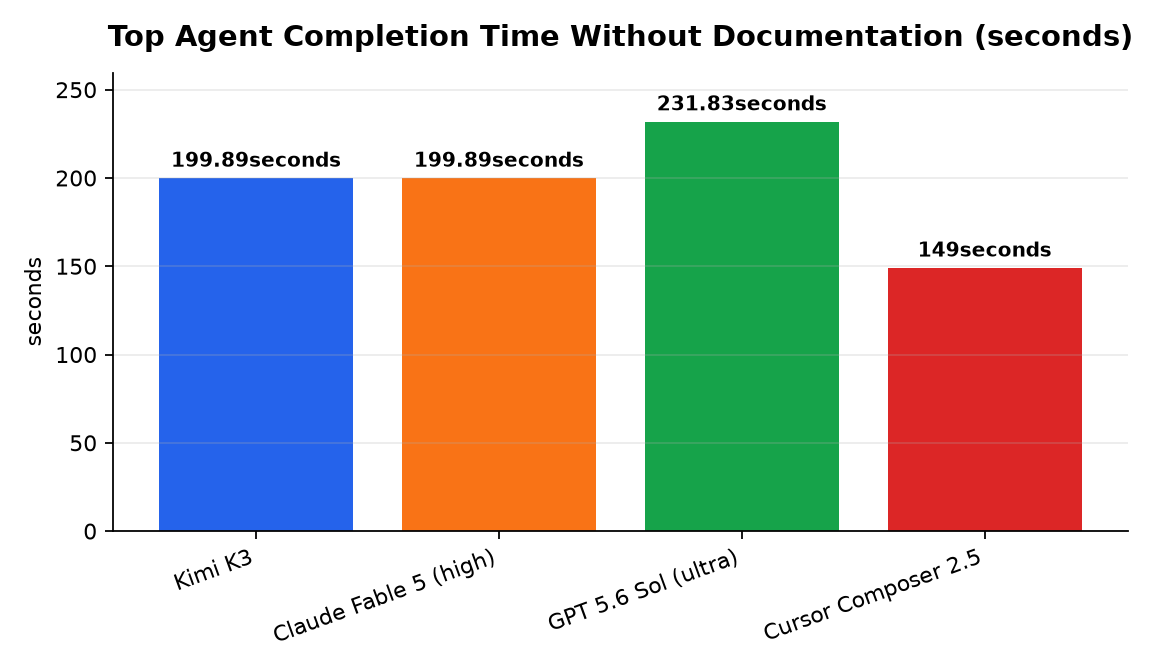
A new public benchmark measuring AI coding agents on Next.js code generation and migration tasks has a clear winner, and it's not from the labs that usually dominate these comparisons. Kimi K3, running the OpenCode agent, matched the highest success rate on the board at 92%, tied with Claude Fable 5 (high) on Claude Code, Cursor Composer 2.5, and GPT 5.6 Sol (ultra) on Codex. What separates Kimi K3 is the clock: it posted the fastest average completion time among the leaders at 199.89 seconds, more than half a minute quicker than GPT 5.6 Sol's 231.83 seconds. The dominance of Opencode and Cursor in this comparison is detailed in Gartner's first Magic Quadrant for enterprise AI coding agents.
Last updated July 17, 2026, the eval covers 24 agent-model combinations tested on a suite that includes app scaffolding, component generation, API route creation, and migration from older Next.js patterns. The results challenge a common assumption that deeper context windows and more expensive inference tiers automatically produce better code. The top four agents span wildly different pricing tiers and agent architectures, yet landed within one point of each other.
AGENTS.md: the great equalizer
The most striking pattern in the data is the impact of a single file: AGENTS.md, a bundled Next.js reference document provided to the agents during the second evaluation pass. Without it, success rates vary from 21% (Kimi K2.5) to 92% (the four leaders). With it, 15 of the 24 entries, including every model with a 75% baseline or above, climbed to 96%. Only the bottom four models (Kimi K2.5 at 58%, MiniMax M2.7 at 63%, and three others in the 79%-83% range) failed to reach that ceiling. This pattern of documentation-leveling is reminiscent of how older, well-documented models can still outpace newer rivals.
The jump is dramatic for mid-tier models. Claude Opus 4.7 (max) went from 75% to 96%. Cursor Composer 2.0 went from 75% to 92%. Grok 4.5 on OpenCode jumped from 83% to 96%. The documentation file essentially erases the gap between a $200/hour model and a budget one, as long as the agent's base retrieval can read a markdown file. This is consistent with findings from research on making agents robust to real-world randomness.
This has practical implications for teams evaluating coding agents. Success without documentation measures the model's own Next.js knowledge, how much of the framework's API surface is baked into its training data. Success with documentation tests a different skill: the agent's ability to follow explicit instructions in a reference file. For most real-world work, the latter matters more, since teams can ship their own AGENTS.md covering internal patterns, deprecated APIs, and style conventions. The challenge of measuring true productivity gains from agents is explored in an analysis of human hours saved by Devin.
The speed-performance tradeoff
Duration varies enormously across the table. Cursor Composer 1.5 posted the fastest overall time at 115.52 seconds but reached only 67% accuracy. GPT 5.5 Pro, using the Codex agent at the highest inference tier, took 771.63 seconds, more than any other entry, for a 83% success rate, placing it behind models that finished in under 150 seconds. Its AGENTS.md score of 83% was also the lowest of any model that started at 75% or above. The cost implications of such inefficiency are highlighted in Alibaba's Agentic OS transparency tool.
Gemini's performance was mixed: Gemini 3.1 Pro Preview on Gemini CLI hit 75% in 247 seconds, while Gemini 3.0 Pro Preview came in at 67% and 260 seconds. Both jumped to 83% and 83% respectively when given documentation, but neither broke into the top tier.
MiniMax M3 was a surprise on speed, 181.88 seconds at 75%, climbing to 96% with documentation, suggesting its agent loop is efficient even if its raw Next.js knowledge is unremarkable.
What this means for choosing a coding agent
The benchmark makes a few things plain. First, the biggest differentiation between agents is not their peak accuracy on raw tasks, but how cheaply and quickly they can reach a good-enough result when given proper context. Second, the top four models (Kimi K3, Claude Fable 5, GPT 5.6 Sol, Cursor Composer 2.5) are indistinguishable in outcome, all at 96% with documentation, all within a 37-second duration band except Cursor's outlier 149 seconds. Picking among them comes down to cost, latency tolerance, and ecosystem integration rather than raw code quality.
Third, the table is a warning against choosing an agent based on a single metric. GPT 5.5 Pro costs more and runs longer than any other model here for a mid-table result. Claude Opus 4.6 and 4.7 tie with 75% without documentation but land at 96% with it, same ceiling as the best models. The gap between the best and the median in AI-assisted coding is narrower than many vendors would like you to believe, and a markdown file is often the missing piece. For a deeper dive into how Gartner evaluates these agents, see this analysis of what the Cursor badge really means.
- Source : AI Agent Evaluations GitHub
Get the tech essentials in 3 minutes every morning
One email, every weekday, with what actually matters in AI and tech.