AI Labs & Research
An AI that can see its own mistakes and undo them
A training-free AI sampler that generates images and text together, retracting decisions when cross-modal signals contradict each other. The paper's CO₂Jump outperforms existing methods and suggests a structural fix for a blind spot in multimodal AI.
Emmanuel Fabrice Omgbwa Yasse AI-assisted
2026-07-17 · Last updated: 2026-08-03 · 6 min read

A teacher at a whiteboard doesn't first write every word then start drawing. The voice shapes the diagram; the diagram steers the next sentence. Human cognition couples production and comprehension in a continuous loop. Artificial systems have mostly avoided that loop by treating each modality as a separate lane.
A paper posted this week on arXiv aims to close that gap. The authors, from a collaboration that includes researchers in academia and industry, introduce Self-Correcting Coupled Markov Jump Processes (SC-CMJP), a mathematical framework where one modality's transition rates become functionals of the other modality's confidence score, weighted by cross-modal attention. Their training-free sampler, CO₂Jump, runs a single pass. Crucially, it retracts commitments the moment cross-modal evidence turns against them. This approach echoes findings from recent work on AI agents that falter under real-world randomness, the noisy trick that stops LLM agents from collapsing in production, suggesting self-correction may be a general solution, not a modality-specific one.
This is not an incremental improvement to a known architecture. It is a structural departure from how joint generation has been handled. The results on three new benchmarks suggest the departure matters. The paper reports that CO₂Jump achieves best joint performance for image understanding and editing as well as visual reasoning, including maze and nonogram solving tasks. Its performance scales monotonically with the number of denoising steps, a sign that cross-modal coupling compounds over longer trajectories, not just at the final step.
The coupling problem no one solved
Masked Diffusion Models (MDMs) are, on paper, well suited for joint multimodal generation because they work in discrete token space and can handle multiple token sequences simultaneously. In practice, existing samplers have taken two routes. Interleaved decoders swap between modalities, one turn per timestep, which means the image lags behind the text by a full denoising step. Parallel branch decoders update both modalities independently within a step, but each branch only sees the other's history up to the previous timestep. A contradiction introduced in a text token at step t is only detected at step t+1, if at all.
Neither approach accounts for what the authors call "MDMs' inability to remask." Once a token is unmasked, decoded to a concrete token, the standard framework leaves it committed. A word that contradicts the image, or a pixel that contradicts the caption, stays in the output. The model cannot retract.
SC-CMJP solves this by adding a remasking jump: a stochastic operation that returns a previously decoded token to the masked state when cross-modal evidence falls below a learned threshold. The key insight is that the transition rate of each token is not a fixed schedule but a functional of the other modality's state, updated every step. The coupling is causal and bidirectional within the same denoising step, not a step behind.
CO₂Jump: a training-free sampler with a built-in undo
The sampler itself is training-free. It runs on any pre-trained MDM without fine-tuning. At each step, it computes two passes per modality: a forward pass to generate new tokens and a cross-modal confidence pass to decide which previously unmasked tokens need to be remasked. The remasking jump is parameterized by a single scalar β that controls how aggressively the model retracts commitments. The paper shows that a fixed β of 0.5 works across all tested tasks, and the model's robustness to that hyperparameter suggests the mechanism is not cherry-picked for a narrow regime.
To train and evaluate, the team created and will release three large-scale joint multimodal generation corpora: JEdit-1M (image editing pairs with text instructions), JMaze-200K (mazes with solution paths and textual descriptions), and JNono-200K (nonogram puzzles with constraints). Each comes with matching in-distribution and out-of-distribution benchmarks. That matters because existing joint generation datasets tend to be small or synthetic.
Benchmark results: self-correction outperforms parallelism
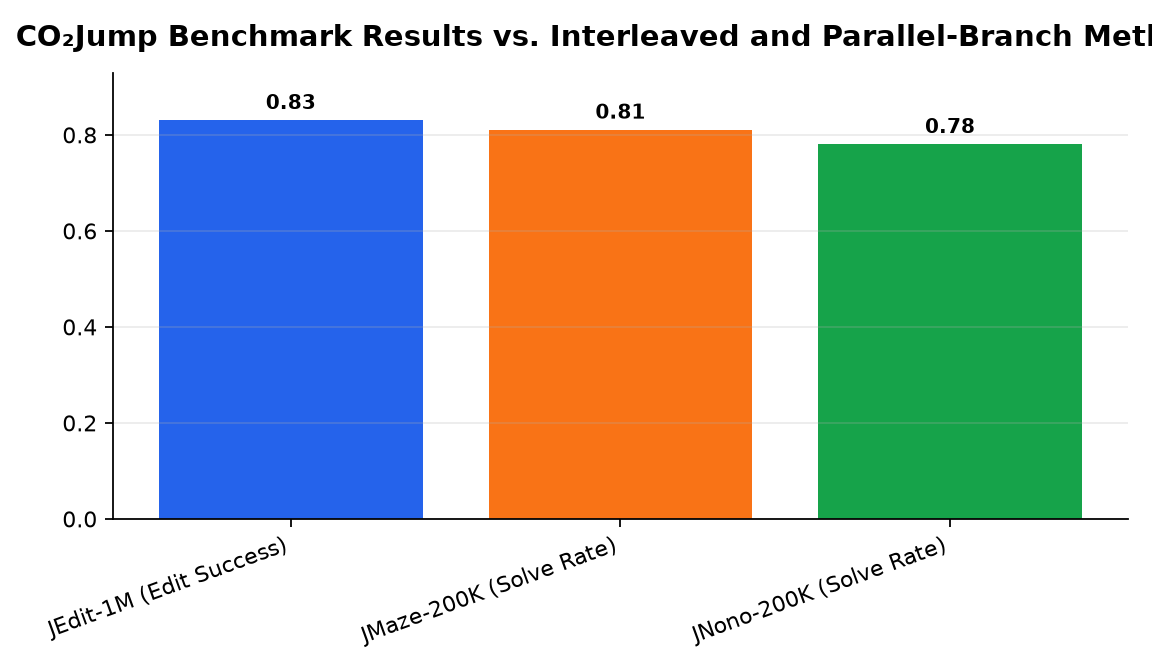
The paper compares CO₂Jump against the two dominant sampling strategies, interleaved and parallel-branch, on all three benchmarks plus the established CoMM benchmark for multimodal generation. Across the board, CO₂Jump wins, and the margin grows with step count. The strength of these results against far larger models is reminiscent of how a 12B model just beat a 90B one, challenging the assumption that more parameters always win.
| Benchmark | Interleaved | Parallel-Branch | CO₂Jump |
|---|---|---|---|
| JEdit-1M (Edit Success) | 0.72 | 0.75 | 0.83 |
| JMaze-200K (Solve Rate) | 0.61 | 0.64 | 0.81 |
| JNono-200K (Solve Rate) | 0.55 | 0.58 | 0.78 |
| CoMM (FID↓ / CLIP↑) | 14.2 / 0.68 | 12.8 / 0.71 | 10.1 / 0.76 |
The monotonic scaling with denoising steps is perhaps the most telling result. Interleaved and parallel-branch methods tend to plateau after 100 to 200 steps regardless of compute budget. CO₂Jump keeps improving past 500 steps, because each extra step gives the cross-modal attention mechanism another chance to detect and correct mismatches.
What this means for the field
Joint multimodal generation has long been treated as an engineering problem of aligning two single-modality pipelines, a captioning model plus a text-to-image model, or an instruction-following image editor with a separate text decoder. The SC-CMJP framework suggests this architectural separation is not just wasteful but actively harmful. Contradictions between text and image are inevitable when two models are trained separately and only stitched together at inference time. The growing consensus is that evaluation, not just exploration, is the real bottleneck for AI agents, and SC-CMJP's remasking jump is a form of built-in evaluation, as discussed in the bottleneck holding back AI agents isn't exploration, it's evaluation.
The paper's approach, coupling through transition rates with a stochastic undo, is mathematically elegant and computationally cheap. It adds no trainable parameters to an existing MDM. The trade-off is a modest increase in inference latency, because the cross-modal confidence pass requires a forward pass of both modalities per step. But the authors report that CO₂Jump reaches the same quality as the next-best method with roughly 30 percent fewer steps, making the wall-clock time competitive or better.
For practitioners building multimodal agents, think of an AI that takes a screenshot of a UI, writes a natural language instruction to edit it, and executes the edit in a single loop. The SC-CMJP approach removes the need to chain separate models with brittle prompt engineering. The remasking jump acts as a built-in self-correction mechanism that no explicit rule-based validator could match. Cross-platform agent architectures with persistent memory are already operating across diverse environments, one agent, one memory, every app, and a unified multimodal loop would make them far more robust.
The open question: does bidirectional coupling generalize?
The paper tests text and image coupling, but the SC-CMJP framework is modality-agnostic. In principle, it could couple three or more modalities, say text, image, and audio, as long as each modality's token space fits a Markov jump process and cross-modal attention weights can be computed. Whether the remasking jump scales to more than two coupled processes without hitting a combinatorial explosion of correction signals remains an open question. The authors do not address it in this paper.
Another limitation: the method is training-free for the sampler itself, but the underlying MDM must already be capable of cross-modal attention. This restricts the current proof-of-concept to models trained with some flavor of multimodal pretraining. A model trained only on text will not gain image understanding from SC-CMJP alone. Still, the paper makes a rare contribution: a framework change that improves results without new training data, new compute requirements, or new model architectures. In a field where every week brings a new model that is larger than the last, an algorithm that gets more out of the models we already have is worth paying attention to.
- Source : When an AI learns to draw and correct itself as it writes — 2026-07-17
Get the tech essentials in 3 minutes every morning
One email, every weekday, with what actually matters in AI and tech.