Space Launch
China's first deep-sea rocket launch just made land sites obsolete for satellite internet
Orienspace's first deep-sea Gravity-1 launch carried nine satellites and a payload experiment, signaling a shift to scaled commercial operations. Three more launches are planned in 2026, with Gravity-2, a reusable liquid rocket, targeting Q4 first flight.
Emmanuel Fabrice Omgbwa Yasse AI-assisted
2026-07-23 · Last updated: 2026-08-03 · 3 min read
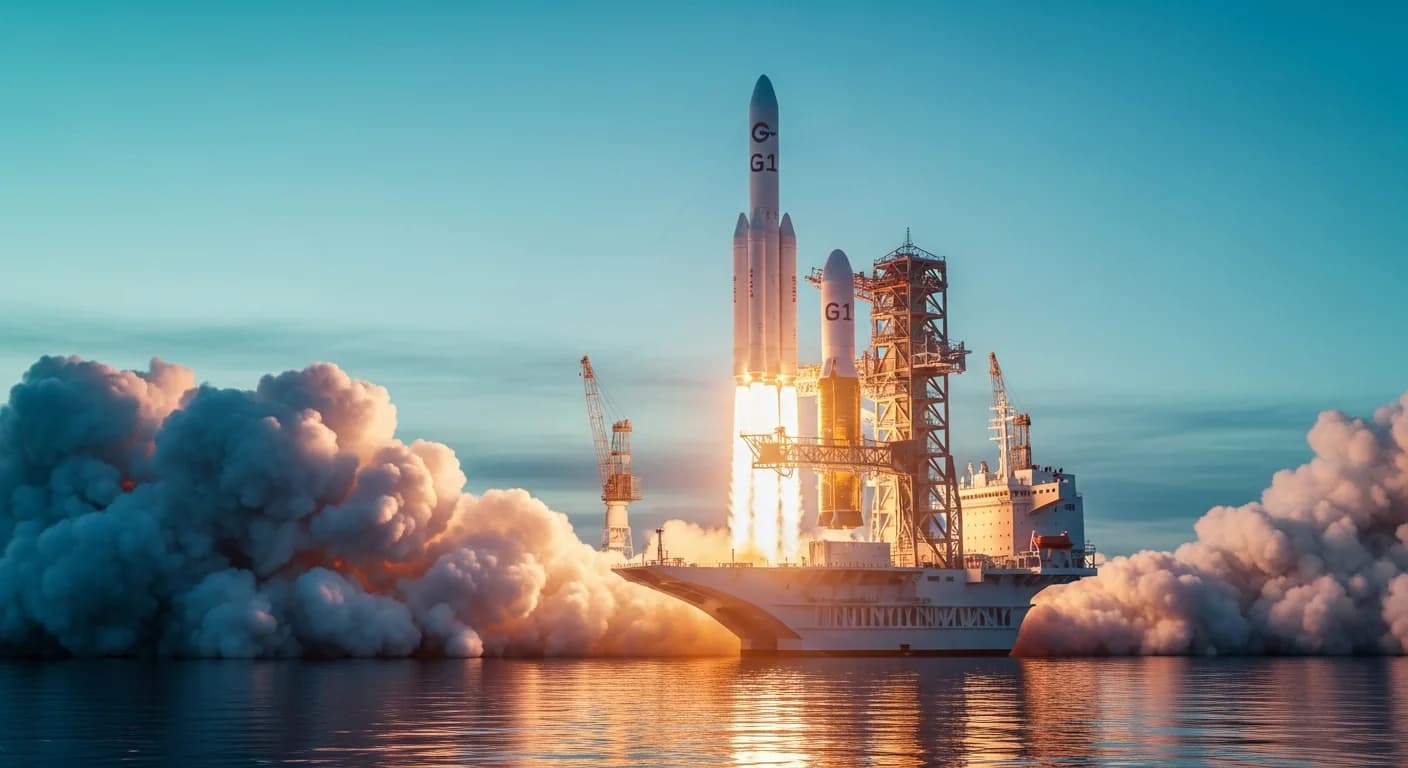
Orienspace completed the first deep-sea launch of its Gravity-1 rocket from the East China Sea on July 22, 2026, lifting nine satellites and a payload experiment into a predetermined orbit. The launch, conducted from the Dongfang Space Port vessel about 170 kilometers east of Shanghai, marks a move from single demonstration flights to a commercial cadence. Commercial launch providers are increasingly looking to sea-based platforms to bypass the constraints of land sites, a trend also evident in regulatory maneuvering in other high-tech sectors.
Three additional batch launches are planned in 2026, including a large-scale deployment for a satellite internet constellation, with hardware already prepared, the company said.
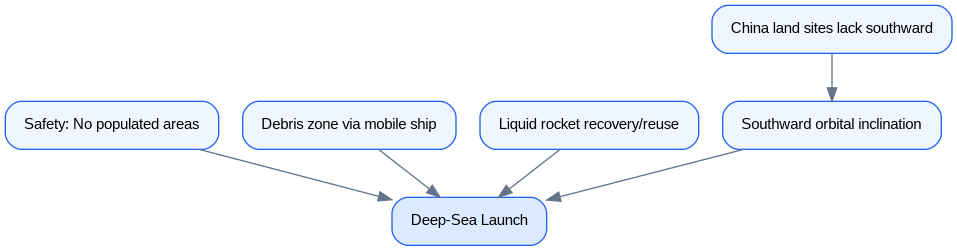
The deep-sea launch was a deliberate choice despite the higher technical difficulty. Orienspace cited four advantages over land or coastal sites: easier first-stage safety because there are no populated areas downrange; the ability to manage debris impact zones through mobile positioning; offshore launch and landing capability, which is required for future liquid rocket recovery and reuse; and the orbital inclination needed for low-orbit satellite internet constellations, which requires southward launches that China's four existing land sites cannot support directly.
The sea voyage exposed the rocket to salt spray and humidity for several days, requiring enhanced protection for sensitive components. This kind of operational constraint is common when moving from controlled factory environments to field deployments, much like the challenges AI agents face when shifting from benchmarks to real-world tasks.
Payload mix shows diversity
Nine satellites and one payload experiment rode the rocket. The Dongpo 13, 14, and 17, 20 are lightweight, high-maneuverability earth observation satellites offering all-weather wide-area coverage. Xiguang 2-01 and Tianyi 49 target commercial aerospace and quantitative remote sensing for mining, agriculture, environmental monitoring, and urban planning. Lilac 3 tests ultra-flat integrated thermal platform and novel attitude control technology. The Neptune payload experiment is a modular design for flexible solar array compatibility.
Production cadence and financing
Gravity-1 is currently the world's largest solid-fuel launch vehicle. This launch, designated Y4, follows on from the Y3 mission, which received regulatory approval after Y4's payload was already manifested, an arrangement that allows Orienspace to maintain a manufacturing flow. The company confirmed two financing rounds this year and plans a shareholding system reform in 2026 ahead of a potential listing on capital markets.
The next-generation Gravity-2 reusable liquid rocket is in pre-flight ground testing. Its self-developed JD-2 liquid oxygen-kerosene engine has completed multiple full-system tests, and Orienspace is targeting first flight readiness by Q4 2026. Gravity-2 will offer 21.5 metric tons to low Earth orbit and 15 metric tons to a 500-kilometer sun-synchronous orbit, placing it among the largest private Chinese liquid launch vehicles and directly targeting the low-orbit constellation deployment market. The economics of reusable rockets are a key consideration here, mirroring the cost disruption seen in AI when assumptions about scaling economics were upended.
Get the tech essentials in 3 minutes every morning
One email, every weekday, with what actually matters in AI and tech.