AI infrastructure
Amazon's 2040 climate pledge collides with a 33-million-ton gas plant
Amazon confirmed it purchased GW Ranch, a Texas gas plant permitted to emit up to 33 million tons of CO2, more than the largest coal plant in the country. The project feeds a new AI data center and sits awkwardly next to Amazon's pledge to be carbon neutral by 2040.
Emmanuel Fabrice Omgbwa Yasse AI-assisted
2026-08-15 · 3 min read
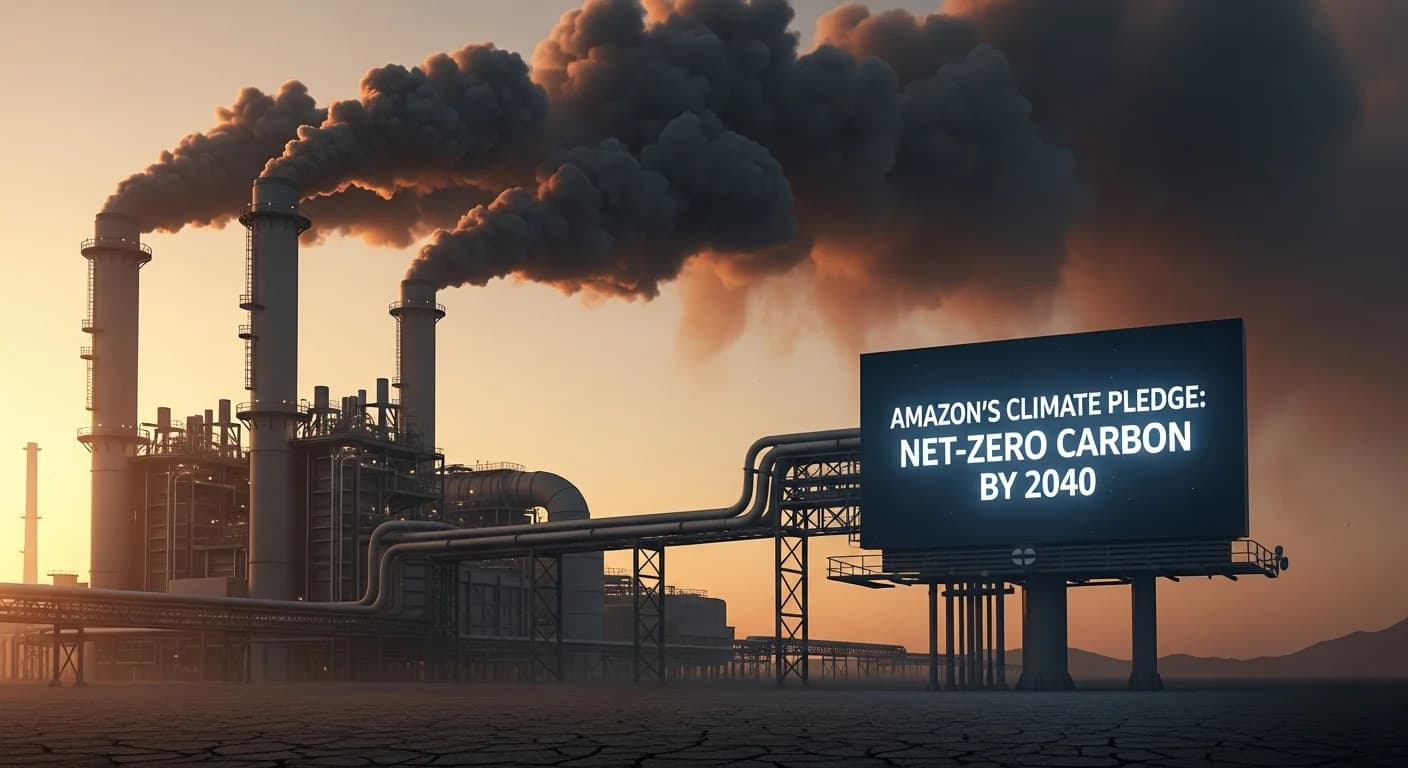
Amazon has confirmed it purchased a power plant site in Pecos County, Texas, that holds a permit to release up to 33 million tons of carbon dioxide. The ceiling is higher than the allowance held by the largest coal plant in the country, according to Cleanview, a group that tracks data centers and their power projects. Its main job would be to feed a new Amazon data center.
The disclosure, first reported by the New York Times and detailed by The Verge, puts a hard number on a contradiction Amazon has spent years trying to avoid. The company co-founded the Climate Pledge and committed to carbon neutrality by 2040. Its emissions have climbed for several years in a row, and the demands of AI are why.
A permit bigger than American coal
The site, known as GW Ranch, is Amazon-owned, and the company has confirmed it intends to buy power from the plant. The facility would run 35 natural-gas turbines producing 7.65 gigawatts of electricity, enough to make it one of the largest single producers of greenhouse gases in the US. At least initially, it would not connect to the state's power grid; the output is meant primarily for the data center, so power moves from turbine to server without touching Texas transmission lines.
Permits are ceilings, not forecasts. Plants rarely emit that much, and the report says as much. What stands out is the headroom. A cap that exceeds the largest coal plant's allowance, with pollution restrictions the report describes as lax, gives a project room to run.
The pledge versus the plant
Amazon spokeswoman Margaret Callahan told the New York Times that "the world looks different now than when we co-founded the climate pledge," and that "our commitment hasn't changed."
Keeping that commitment gets harder with every fossil plant attached to the AI buildout. GW Ranch adds a fresh source of carbon to the ledger even if it never runs at full capacity. A pledge that requires zero by 2040 leaves little room for a project like this.
This is not a peripheral purchase. Amazon has announced plans to spend over $150 billion on data center infrastructure over the next decade, part of the same contest over who owns AI compute that Groq is betting its future on.
Power has replaced algorithms as the bottleneck on AI's growth, and the hyperscalers share a playbook: build bigger, build closer to available power. Inference is turning into the same kind of location problem, as Groq's UK data center shows.
Big Tech builds its own power
Amazon is not alone. Meta and Google have started building their own power plants, turning to gas, coal, and other non-renewable sources as demand from AI data centers has skyrocketed. The Trump administration has sought to lift restrictions on such plants. Governments are placing parallel bets: EuroHPC signed a 355-million-euro contract for Alice Recoque, Europe's second exascale supercomputer.
The economics favor it. When a company owns the plant, the emissions sit on its own books rather than a utility's, which makes the accounting harder to hide. Off-grid supply also means the plant answers to one buyer instead of a system operator balancing a state grid.
What the permit says about 2040
The Climate Pledge, announced by Jeff Bezos, set Amazon on a path to carbon neutrality by 2040. The company's emissions have moved the other way for years. GW Ranch does not need to run at its permitted ceiling to make the gap worse. Every hour its turbines spin, the data center runs on natural gas.
Amazon says its commitment has not changed. The permit says something different. A company can promise carbon neutrality by 2040 and back a gas plant permitted to out-pollute the country's largest coal plant. Both things are true, and they do not add up. Amazon's answer so far is that the world changed. It did; the number on the permit did not.
Get the tech essentials in 3 minutes every morning
One email, every weekday, with what actually matters in AI and tech.