Sovereign AI in Europe
Mistral promises AI sovereignty, and its 1 GW compute bet shows the catch
Mistral's sovereignty push now has concrete products: region-locked endpoints, an SLA-backed tier, and third-party model hosting starting with GLM-5.2. The hard part is compute, which rests on a coalition of commitments and a 1 GW target for 2030.
Emmanuel Fabrice Omgbwa Yasse AI-assisted
2026-08-13 · 4 min read
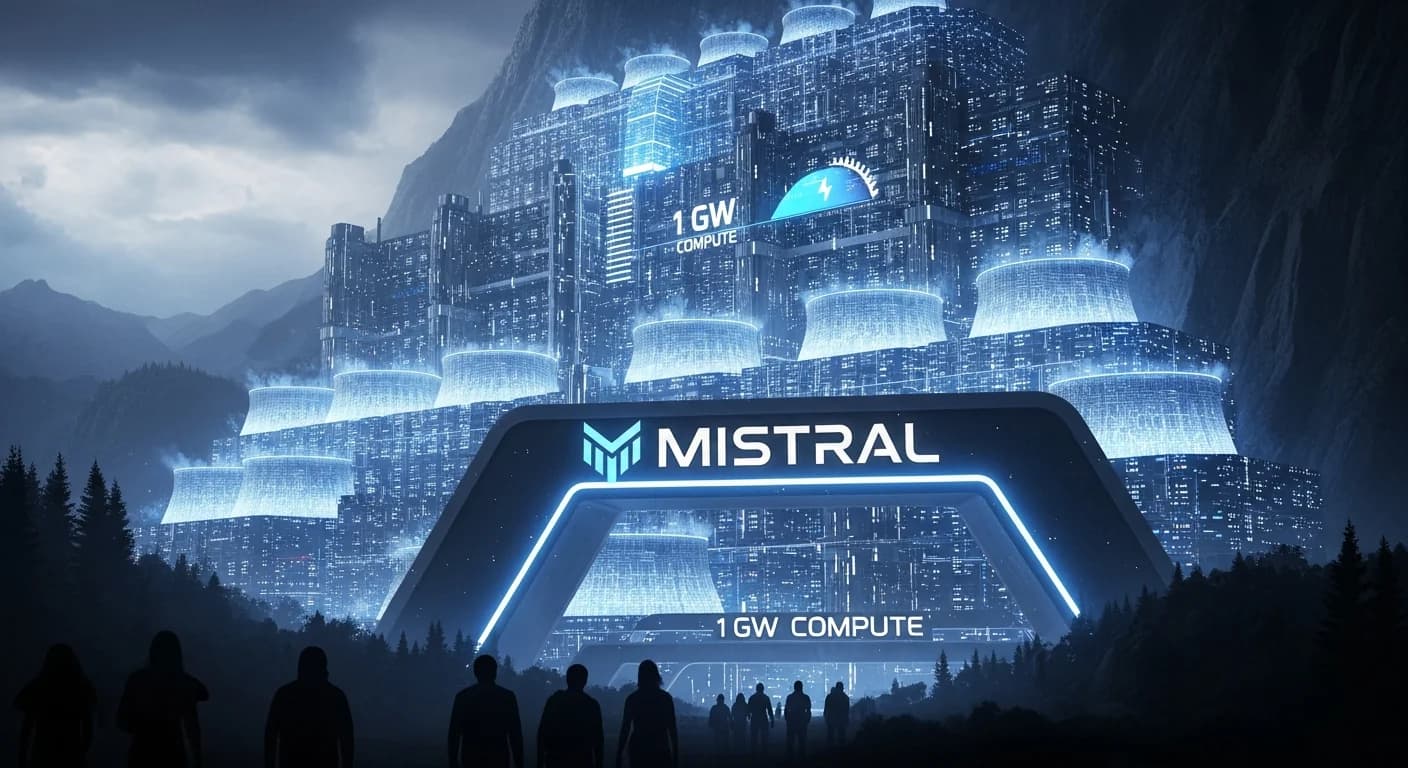
Mistral wants to sell Europe control of its AI: control over the models, over where inference runs, over the compute underneath it all. The company laid out four moves. Two are products: regional endpoints, generally available, and a priority tier in public preview. A third is hosting for third-party open models, starting with GLM-5.2. The fourth is a coalition built on commitments it has not quantified.
The tension is easy to miss under the word "sovereignty." The capacity Europe needs for production AI is, in Mistral's own words, "scarce, fragmented, and difficult to secure." So the company is doing what no participant could accomplish alone: aggregating multi-year demand from an anchor group of enterprises into European Compute Units, or ECUs, which convert commitments into access to Mistral-built infrastructure over several years. The buildout will need the kind of capital Mistral raised in the 1.7 billion euro Series C led by ASML. The stated target is up to 1 GW of capacity by 2030.
Read closely and this is a mechanism, not a finished asset. Mistral has not said how many companies are in the anchor group, what the commitments are worth, or where the first capacity will be built. The state-backed track is further along: EuroHPC has signed the contract for Alice Recoque, the second European exascale system, on track for 2026. ECUs buy access to infrastructure Mistral intends to build, not capacity it owns today. That distance between guarantee and goal is the real story here.
| Move | Status | What it delivers |
|---|---|---|
| Regional Endpoints | Generally available | Choice of Europe or US for inference and processing |
| Priority Tier | Public preview | Committed service levels, custom rate limits, uptime SLA |
| Third-party open models | Starting with GLM-5.2 | Same regional controls and service commitments as Mistral models |
| European Compute Units | Coalition phase | Multi-year access to Mistral-built infrastructure |
Where your inference runs is now a product feature
On the inference side, the promise is concrete. Mistral Regional Endpoints, now generally available, let customers choose whether their workloads process in Europe or the US, on top of the connector controls and API key scoping in Mistral's enterprise governance toolkit. The company says inference and associated processing stay in the selected region, subject to limited, safeguarded transfers to sub-processors described in its Trust Center. The new Priority Tier, in public preview, adds committed service levels, custom rate limits, and an uptime SLA. Mistral says it is the only European AI lab to offer both a processing-region choice and an SLA-backed service level.
That matters because most of Mistral's customers already run its models in their own data centers and cloud environments. The endpoints and the priority tier target the workloads that need to scale beyond self-managed capacity without giving up residency controls.
The GLM-5.2 test: what "open" means on a sovereign platform
The most interesting move is the quietest. Mistral's platform will host third-party open models, starting with Z.ai's GLM-5.2, under the same regional controls and service commitments as its own models. It is also the model Zhipu priced at $0.07 per million tokens, a 95% cut posters called "almost free," until one reply claimed the price had already 10x'd. The reasoning is that production workloads are becoming ensembles of specialized models, and a customer should not have to leave Mistral's infrastructure to run one Mistral did not build. Open weights, the company argues, give mission-critical work the ability to inspect a model, adapt it, and keep what it builds on top.
This is also a stress test for the word "sovereign." A European lab offering Chinese open weights under European residency controls is a definition of sovereignty built on jurisdiction and contracts, not provenance. Mistral presents that as a feature: control over where intelligence runs should not depend on who wrote the model. The company is a contributor to the Open Secure AI Alliance and the NVIDIA Nemotron Coalition, the open-model family Sakana AI already integrated into its Fugu orchestration system. Mistral says this and future open models will run on the same infrastructure, broadening the catalog without fragmenting where AI runs.
"Different workloads need different models, and that will keep changing as the frontier evolves," said Matan Grinberg, CEO and cofounder of Factory. "Mistral allows us to run open models under strict regional controls and service commitments, making it easy for us to maintain data residency and compliance requirements while furthering our commitment to open source."
What the coalition does and does not promise
Mistral frames Europe as the beginning of a framework it intends to export, arguing that organizations everywhere face the same choice between frontier AI and institutional control. The foundations it names are operational control, choice of intelligence, and assured access to compute.
The first two are now products. The third is a promise. ECUs, in Mistral's framing, will help determine what capacity is built, where it is located, and whom it serves. That is real market-making, but it is not the same as owning the capacity. The sovereignty Europe can buy from Mistral is genuine at the inference layer and provisional at the compute layer. The 1 GW target, and the coalition behind it, will decide which half of that promise holds by 2030.
- Source : Mistral promises AI sovereignty, and its 1 GW compute bet shows the catch — 2026-08-11
Get the tech essentials in 3 minutes every morning
One email, every weekday, with what actually matters in AI and tech.