Global AI Divide
The continent AI forgot: Grok, Xiaomi and Meta's billions bypass Africa
A look at how the global AI buildout from Grok to Xiaomi to Meta bypasses Africa, and what that means for the continent's economy, governance, and technological future.
Emmanuel Fabrice Omgbwa Yasse AI-assisted
2026-07-26 · 3 min read
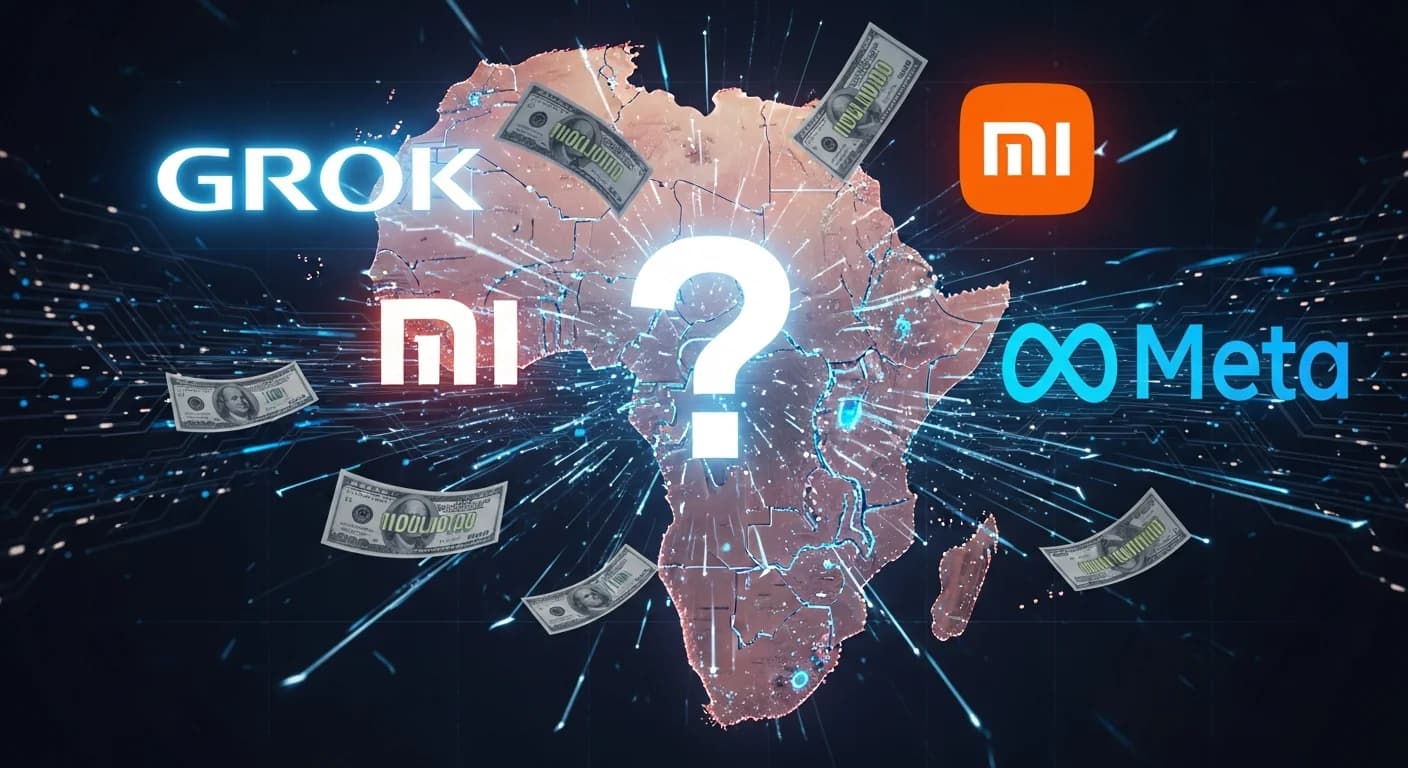
Silicon Valley and Shenzhen are in the middle of a funding and deployment frenzy that is reshaping global technology markets. Grok, xAI's chat platform, now does everything from live search to video generation inside one interface, as detailed in the Grok Build CLI update. Xiaomi's humanoid robot sorts car panels on the SU7 production line with a success rate above 90 percent. Meta just acquired Manus, an agent startup that processed 147 trillion tokens in months. Anthropic's Sonnet 4.6 beats its own flagship model on preference tests at one-fifth the cost, following the pattern seen in Opus 5's cost advantage over Fable 5. Alibaba's new coding assistant Qoder shows developers every reasoning step, with Alibaba's blind-spot fix for AI code catching vulnerabilities mid-sentence. A single word change can transform a Midjourney prompt.
None of these products or investments target Africa.
Billions pour into AI globally
Capital is flowing into AI faster than at any point in computing history. Mistral AI raised €600 million in a round led by General Catalyst, the largest fundraising by a French tech company ever. Together AI, a neocloud renting Nvidia clusters, closed $800 million at an $8.3 billion valuation. Groq, the inference chip company, raised $750 million and announced expansion into Saudi Arabia, Asia-Pacific, and Europe, all regions with energy and data center advantages that Africa cannot match. Groq also licensed its chip to Nvidia, broadening its geographic footprint with a Helsinki data center powered by Nordic renewable energy. These decisions are rational for the companies: they follow cheap power, cool climates, and reliable grids. Africa has none of those at scale.
The technology that bypasses the continent
Grok is tied to X, a platform with limited African user penetration outside South Africa and Nigeria. Xiaomi's humanoid is deployed in a Chinese automotive plant; the company has no publicly announced factory robotics for African manufacturing. Meta's Manus acquisition is about enterprise agent infrastructure that runs on cloud providers who have few data centers in Africa. Sonnet 4.6 lowers API costs for developers in wealthy markets but requires stable internet and credit cards. Qoder is built for Alibaba Cloud, which has no major African presence. Alibaba did ship a model that runs on a phone, a 3B parameter version requiring 5.8 GB peak RAM on a Snapdragon 8 chip, but the device and use case (voice chat) remain oriented toward Asian markets. The Midjourney tutorial assumes a user with a subscription and a GPU. Even efficient models designed for low-resource hardware, such as Mistral Nano, target consumer markets outside Africa. The entire stack, from training to inference to interface, is designed for infrastructure that Africa does not have.
Structural barriers that persist
The barriers are not new, but they are hardening. Data centers require reliable power grids; Africa's average grid reliability is among the lowest in the world, with frequent load shedding in key economies like South Africa and Nigeria. Liquid cooling, which is becoming necessary for high-density GPU clusters, adds cost and complexity that few African operators can bear. The talent pipeline is thin: African universities produce a tiny fraction of the AI researchers that Indian or Chinese institutions do, and the best graduates are recruited by companies outside the continent. Policy environments in many African countries are uncertain, with fragmented data regulations and no coordinated AI strategy comparable to the EU AI Act or China's AI governance framework, a gap highlighted in the joint AI policy letter signed by 41 organizations. Capital follows stability, and stability is scarce.
The stakes of exclusion
The economic cost is enormous. Global AI investment is expected to reach hundreds of billions of dollars this year alone. Africa's share of that is negligible. European startups like Mistral capture €600 million; US neoclouds raise $800 million; Chinese giants like Alibaba spend $53 billion on AI across hospitals and pig farms. When AI is applied to problems that matter to Africans, crop disease detection, off-grid energy management, low-resource language translation, the solutions are usually imported, untested
Get the tech essentials in 3 minutes every morning
One email, every weekday, with what actually matters in AI and tech.