Research
A framework that defines trust by the numbers, and the gap between a benchmark and a boardroom
TRUST-ESD aims to bake risk calibration, governance compliance, and explainability into a single enterprise AI framework. Its results look strong on paper, but the gap between a controlled benchmark and a live boardroom decision remains wide.
Emmanuel Fabrice Omgbwa Yasse AI-assisted
2026-07-30 · 4 min read

Enterprise AI adoption usually hits a wall not because the models are wrong, but because nobody can explain what they will do next Tuesday when the market moves against the recommendation. A paper posted on arXiv this week by Mahabubur Rahman Miraj proposes a framework that tries to solve that problem at the architectural level.
TRUST-ESD, a decision-support pipeline that wraps predictive models in layers of uncertainty quantification, downside-risk scoring, and policy-as-code compliance checks, tests itself against strong baselines and claims improvements across the board.
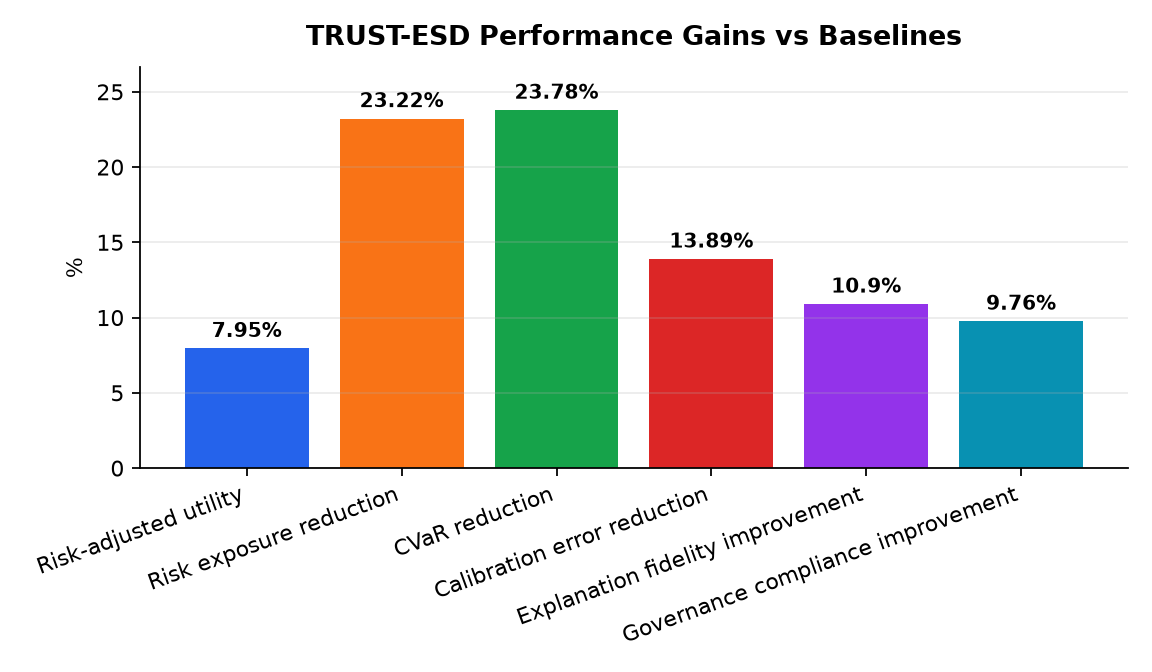
The paper's reported numbers are clean: a 7.95% gain in risk-adjusted utility, a 23.22% reduction in risk exposure, a 23.78% drop in conditional value-at-risk, 13.89% lower calibration error, 10.90% better explanation fidelity, and 9.76% higher governance compliance. That is a lot of digits for a single framework. See also: how tokenizers are rethinking understanding before generation.
What the framework actually does
TRUST-ESD is not a single model. It is a modular system that evaluates counterfactual strategies through seven components: predictive utility estimation, conformal uncertainty calibration, CVaR-based downside-risk scoring, a risk-memory retrieval module, policy-as-code governance, explainability, and a human oversight loop.
The key philosophical bet is that selecting actions by maximum expected utility alone is insufficient. The framework recommends strategies that optimize for value, reliability, risk exposure, and compliance simultaneously. That is a notably harder optimization problem, and the paper's ablation studies try to show that each component justifies its computational cost.
The metric that matters least
Predictive accuracy is the one number the paper does not lead with, and for good reason. TRUST-ESD's primary goal is not to be more accurate than a vanilla predictor. It is to be more trustworthy. The framework trades a marginal accuracy difference for significantly better calibration and lower downside risk. In a boardroom context, that trade-off is defensible. A model that is right 85% of the time but catastrophically wrong 2% of the time is harder to deploy than one that is right 82% of the time but whose errors are bounded and explainable.
The paper shows that TRUST-ESD maintains competitive accuracy while improving the other dimensions. The word "competitive" is doing heavy lifting there. Executives rarely approve a system because its calibration error is 13.89% lower when they cannot feel the difference.
Where the framework lands in the current landscape
TRUST-ESD sits in a growing line of work that tries to formalize what "trustworthy AI" actually means at the system level rather than the model level. The Agents in the Wild survey, which tracks deployment-side design patterns, covers similar ground from an engineering perspective. TRUST-ESD is closer to the optimizer side: it defines an objective function whose arguments include governance and risk, not just accuracy.
The Verification Horizon paper from Qwen makes the point that coding agents have no single verification signal either. The same structural problem, different domain. TRUST-ESD's answer is to fuse multiple signals, which is the same answer everyone is converging on, but done with more mathematical formality than most production systems can afford.
The governance gap
The policy-as-code module is the framework's most interesting and most fragile component. Translating regulatory requirements into machine-readable policy constraints that a decision optimization step can enforce is a problem the AI governance community has circled for years. The paper reports a 9.76% compliance improvement, but it does not detail how many policy rules were encoded, how complex they were, or whether the encoding itself introduced biases.
Compliance is an adversarial process: regulators update rules, lawyers reinterpret clauses, and policy-as-code needs to track those changes at the same cadence. A 9.76% gain on a static test set is not the same as a 9.76% gain in a live regulatory environment where the rules shift quarterly. For similar challenges in defining and testing AI safety, see DeepMind's framework for conceptual, epistemic, and operational rigor.
What the paper does not say
The experimental section compares TRUST-ESD against "strong uncertainty-aware baselines" without naming them until the ablation table. The reader has to infer competitors from the metrics. That is standard academic practice, but it makes the claimed deltas harder to audit.
More critically, the paper tests on simulated enterprise scenarios. There is no real-world deployment data, no integration with an existing ERP or CRM system, no user study with actual executives making live decisions. The numbers are internally consistent, but the distance between an arXiv experiment and a SAP-connected boardroom dashboard is measured in years, not percentage points. For a real-world perspective on how AI agents perform in the wild, see PawBench's analysis of harness vs. brain failures.
The case for tracking this approach
TRUST-ESD is worth following because it treats governance and risk as optimization objectives rather than afterthoughts. That framing, if it matures into production-grade tooling, could shift how enterprise AI procurement evaluates vendors: from "how accurate is your model?" to "what risk surface does your model operate on and how do you bound it?"
The 2026 paper landscape is thick with frameworks that claim to solve trust. TRUST-ESD at least has the discipline to define what it means by trust and to measure it. Whether those measurements survive contact with a real board is a question the next paper in this line will have to answer. For a related take on the challenge of translating benchmarks into real-world decisions, see how the top four models on LiveBench are separated by just 2.2 points.
Get the tech essentials in 3 minutes every morning
One email, every weekday, with what actually matters in AI and tech.