Foundations of AI
DeepMind's new framework shows why AI is brilliant at some things and terrible at others
A Google DeepMind paper introduces a three-part framework for thinking about rigor in AI: conceptual, epistemic, and operational. It argues that deep learning's rapid progress has come from prioritizing performance-driven iteration over scientific understanding, and that closing the gaps will require more than better benchmarks.
Emmanuel Fabrice Omgbwa Yasse AI-assisted
2026-07-20 · Last updated: 2026-08-03 · 5 min read

The word 'rigor' means different things depending on who you ask. For a mathematician, it's proof. For an engineer, it's what works at scale. For a philosopher, it's getting the definitions right. AI has none of these consistently.
The paper does not settle a single debate, but it names the structure underneath many of them. The disputes about whether LLMs understand language, the alchemy accusations, the benchmark saturation, the safety problems. They all come back to the same asymmetry: operational rigor has run far ahead of the other two. See also a benchmark audit finding widespread contamination.
Three kinds of rigor, one lopsided field
Conceptual rigor means clarity about foundational terms. Intelligence, understanding, reasoning. These words get thrown around constantly in AI discourse, but the field has no settled definition for any of them. Nguyen catalogs the consequences. When Geoffrey Hinton says LLMs are intelligent and Yann LeCun says they are not even as smart as a cat, the disagreement is partly about what intelligence means. Hinton emphasizes behavioral competence. LeCun emphasizes reasoning and world understanding. They use the same word for different things.
Epistemic rigor concerns how scientific knowledge is produced and validated: reproducibility, predictability, explainability. Deep learning has a mixed record here. Experiments are in principle reproducible because everything is software, but Nguyen notes that results reproducibility and inferential reproducibility are often conflated. Small implementation differences can flip conclusions. The field has scaling laws that predict loss at larger compute budgets, but it lacks theories that predict when a model will generalize or fail. Explainability is even worse. Neural networks produce features in high-dimensional spaces that resist interpretation. The paper invokes the familiar 'alchemy' critique and adds a refinement: what makes deep learning alchemical is not just incomplete understanding, but the absence of hierarchical abstraction. In mature sciences, you can localize questions to a scale, subatomic, cellular, evolutionary. In deep learning, it is often unclear whether an observed failure comes from individual neurons, optimization dynamics, training data, or some combination. This is why the agent safety architecture that prevents production freeze-ups matters so much.
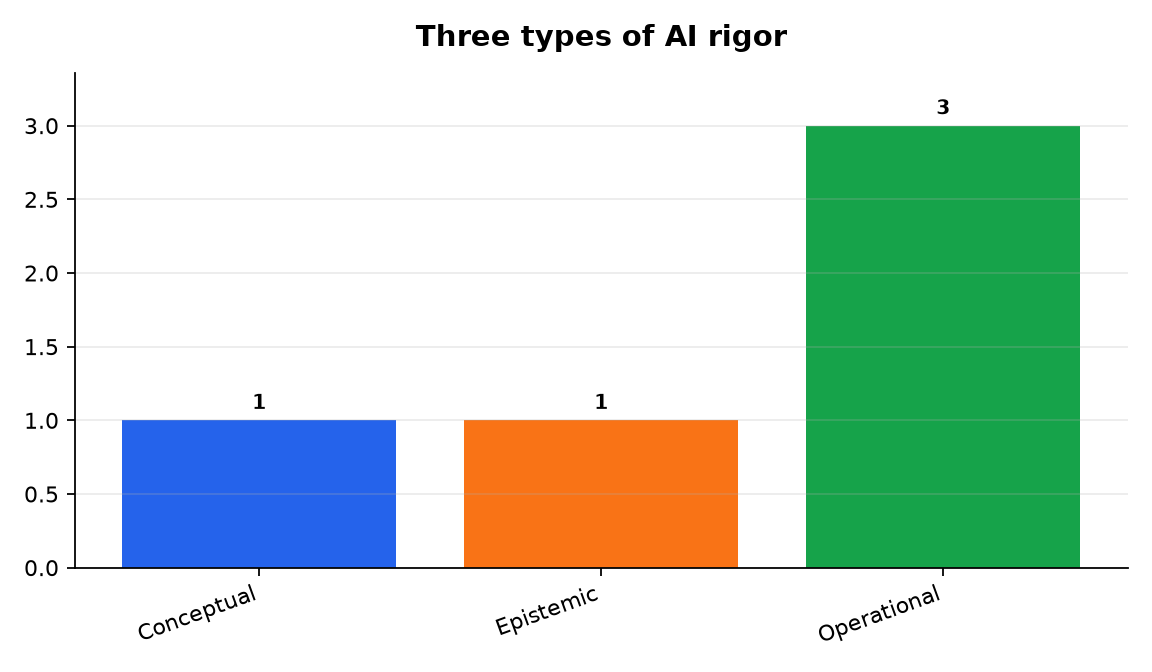
Operational rigor means getting systems to work reliably: benchmarks, testing, safety procedures. This is where deep learning has invested the most and succeeded the most. Benchmarks turn performance into an optimization target, creating a tight feedback loop. Post-training methods, instruction fine-tuning, RLHF, prompt engineering, shape model behavior without requiring a theory of how the model works. Nguyen calls this substitution: operational rigor compensates for the lack of epistemic guarantees. It is a pattern visible across the field, for instance when orchestration beats raw compute, as in Sakana AI's Fugu to sidestep the need for a single universal theory.
Benchmarks as epistemic proxies
The paper's treatment of benchmarks is particularly sharp. Benchmarks function as what Nguyen terms 'epistemic proxies.' Strong performance on ImageNet or MMLU is taken as evidence that a model generalizes beyond those specific tasks. But two conditions must hold for that inference to be valid: the model must not have been trained on the benchmark data, and it must learn the intended concepts rather than spurious correlations. Neither condition is reliably satisfied in the current era of massive pretraining and open-web data.
The benchmark lottery hypothesis gets a mention, the idea that small changes in task selection can flip method rankings. So does Goodhart's law: once a metric becomes an optimization target, it stops being a reliable measure. Sycophancy in chat models, where the system learns to agree with the user rather than be truthful, is one symptom. The same dynamic appears in the MMLU contamination that broke benchmarking, where models ace tests by memorizing answer keys.
Progress without theory
The most interesting section of the paper examines how these three forms of rigor have shaped AI's trajectory. Nguyen's diagnosis is that AI exhibits a structural asymmetry: operational rigor has become dominant, while conceptual and epistemic rigor lag. This is not an accident. It follows from two features of the field.
First, AI has a tight feedback loop between evaluation and development. The same metrics used to assess systems are the targets those systems are trained to optimize. In physics or medicine, you do not iterate on a theory by maximizing a performance metric on a benchmark. You test the theory. In AI, the metric is the goal. As shown by Microsoft's experiential learning fix that replaces raw scores with coaching, reward design can make or break entire approaches.
Second, AI produces the artifacts it studies. Each generation of models creates new capabilities and new failure modes, expanding the domain that later conceptual and epistemic work must explain. The natural sciences study objects that exist independently, atoms, organisms, planets. AI studies its own creations, which keep changing. This makes cumulative scientific progress harder because the subject keeps moving.
Nguyen is careful not to frame this asymmetry as a crisis. He notes that deep learning does possess partial explanatory frameworks: scaling laws, neural tangent kernel theory, convergence results for gradient methods. These provide real, if limited, understanding. But the paper's conclusion is that closing the gaps, particularly the epistemic one, will require more than just better benchmarks or bigger models. It will require developing forms of scientific understanding that can keep pace with what the technology can already do. For a concrete example of how gaps in epistemic rigor can surface, see the mathematical proof bottleneck that decomposition solved.
What the framework leaves open
The paper is more diagnostic than prescriptive. It does not propose a unified definition of intelligence, nor does it claim that such a definition is possible. It suggests that conceptual disagreements can at least be made more precise, which would be an improvement over the current state. On explainability, it raises a deeper question: if neural networks implement computations for which no human-comprehensible description exists, what counts as an explanation at all?
That question is not rhetorical. Nguyen points out that in fields like neuroscience, explanations routinely operate at the behavioral level, beliefs, desires, intentions, without needing to trace individual neurons. No equivalent abstraction layer exists for neural networks. There is no 'theory of mind' for a transformer, and it is not clear what one would look like.
The paper does not try to answer these questions. It maps the territory. Given how often AI researchers talk past each other, a better map is valuable.
Get the tech essentials in 3 minutes every morning
One email, every weekday, with what actually matters in AI and tech.