Research
Six words that could break the AI agent safety ceiling: disrupt, validate, broker
A novel heterogeneous agent cohort architecture separates divergent exploration, runtime safety gating, and cross-domain knowledge retrieval into specialized roles. The Disrupter generates high-entropy proposals, the Validator enforces hard tool-call checks, and the Broker imports out-of-domain analogies via contrastive novelty retrieval. Execution failures are compiled into signed constraint patches called Scars, cached for future generations. In evaluations, the cohort achieved 95% remote target discovery, zero executed breaches, and 15.1% token savings from Scars, with a 55.9% cost reduction under resource constraints via credit-based bandwidth allocation.
Emmanuel Fabrice Omgbwa Yasse AI-assisted
2026-07-30 · Last updated: 2026-08-03 · 5 min read
For years, the field of autonomous AI agents has faced an uncomfortable trade-off: let them roam freely and they break things; lock them down and they never find anything interesting. A new preprint by Liu Tengjiao, titled "Heterogeneous Agent Cohorts for Safe Open-Ended Exploration with Runtime Constraint Memory," throws a deliberate wrench into that binary. The paper builds on a growing recognition that scaling agent teams without role separation quickly produces communication chaos, as a separate line of work on latent-space recursion also demonstrated.
Rather than asking a single model to juggle both creativity and caution, the paper proposes a three-role agent cohort that separates the concerns. A Disrupter is tasked with generating unconventional, high-entropy proposals, the kind of out-of-distribution (OOD) hypotheses that a solitary agent would typically self-censor. A Validator operates at the tool-call gateway, running deterministic checks that hard-block unsafe actions before they execute. A Broker retrieves distant but relevant analogies from external knowledge bases, using a technique Liu calls Contrastive Novelty Retrieval (CNR) to actively avoid the homophily trap that keeps standard RAG systems tethered to the conversational past. This kind of structured agent coordination matters in practice: best practices for AI coding agents emphasize similar role separation for production reliability.
The results, tested in a custom spatial-semantic sandbox over 20 seeds, are striking. The full cohort discovered two remote scientific target zones, a Quantum-Bio Synthesis zone and a Thermoelectric Monolayer zone, 95% and 100% of the time, respectively. In contrast, a homogeneous multi-agent debate configuration (AutoGen-style) managed only a 10% discovery rate for the same remote targets, with token costs 68% higher.
The Scar mechanism: failures as reusable assets
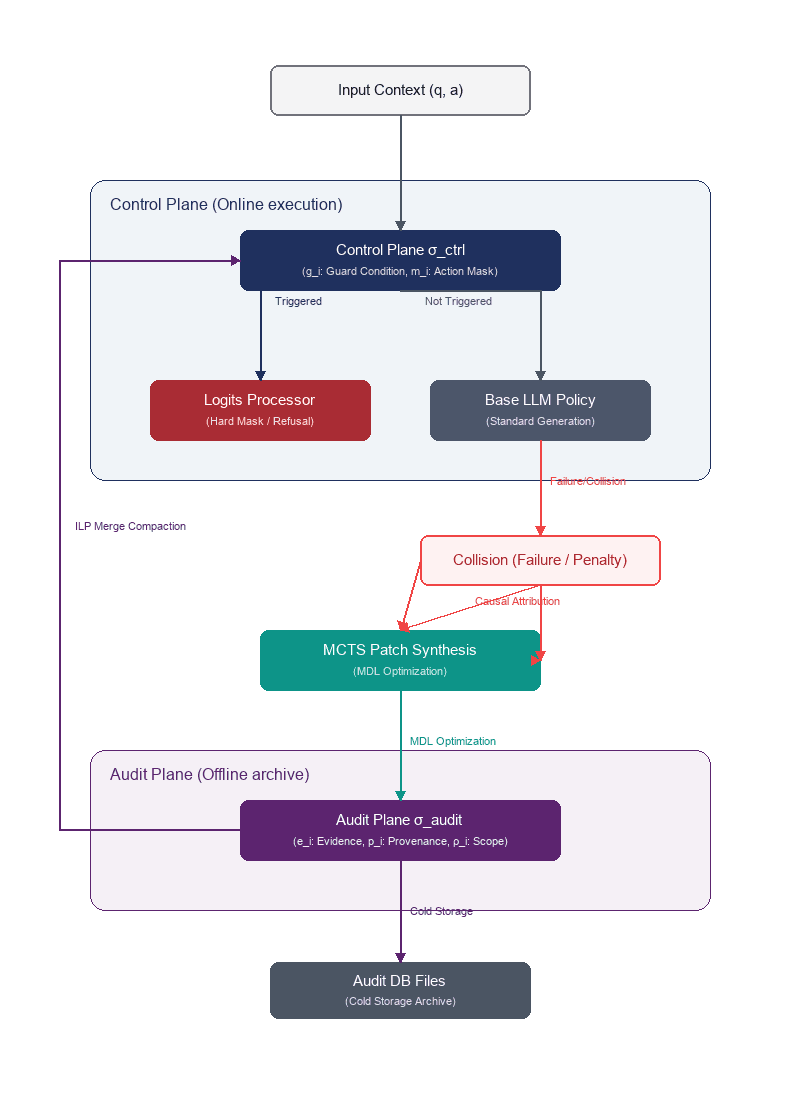
The paper's most distinctive contribution may be its approach to failure. Rather than discarding execution traces that violate safety boundaries, the system compiles them into signed constraint patches called Scars. The compilation uses Monte Carlo Tree Search (MCTS) over a grammar-restricted abstract syntax tree to produce compact DSL rules that block the offending tool calls in future runs. Scars are cryptographically signed with the operator's Ed25519 key, preventing malicious injection in decentralized settings, and are inherited by offspring cohorts at zero training cost. This idea of caching safety knowledge resonates with recent work on persistent user preference tracking, as VitaBench 2.0's findings on agent memory also suggest.
Liu demonstrates that this caching mechanism is not the primary safety gate, that role belongs to the live Validator, but it dramatically improves token economics. Removing the Scars cache increased token cost per successful discovery by 15.1% (from 72,180 to 83,060 tokens), as agents repeatedly proposed known out-of-bound commands and triggered redundant validator checks. Over 100 generations, redundant safety collisions dropped from 10.2 per run to virtually zero by generation five.
"Scars act as an efficiency-optimizing constraint cache rather than the primary safety gate," Liu writes. The distinction is crucial: the system never relies on static rules for safety; it layers a dynamic, compiled memory on top of a live gatekeeper.
CNR: breaking the homophily lock
The Broker node uses Contrastive Novelty Retrieval, which Liu contrasts with traditional Maximal Marginal Relevance (MMR). Where MMR diversifies within a static document list, CNR is goal-conditioned: it maximizes similarity to the task verification goal while penalizing similarity to the entire multi-agent dialogue history. This anti-homophily constraint forces the Broker to import knowledge from semantically distant domains.
The effect is most visible in the Target 1 discovery rate. Without the Broker, the cohort found the Quantum-Bio Synthesis zone exactly 0% of the time, the target lay outside the "normal walking range" of the agents. With CNR, the rate jumped to 95%. In a real-world retrieval experiment using 10,000 biology and materials science preprints, CNR achieved 89.4% out-of-domain recall versus 24.1% for standard dense RAG. Three PhD reviewers rated CNR-retrieved documents at 4.5/5 for creative novelty and utility, compared to 2.3/5 for standard RAG.
Safety without sterility
The Validator's design reflects a careful calibration to avoid overblocking. In tests against 1,000 adversarial episodes from the AgentHarm benchmark, the full cohort achieved 0% executed breaches, compared to 11.5-19.2% for prompt-only guard configurations like ReAct and AutoGen. Importantly, benign task success remained high at 88.5%, with a false blocking rate of just 4.8%. On WebArena Lite, a realistic web navigation benchmark, the cohort achieved a 78% success rate (vs. 58% for ReAct and 54% for AutoGen) in fewer average steps (11.5 vs. 14.2-18.5). This balance between safety and task completion echoes the design principles behind a recent safety framework for critical systems.
The paper also addresses the communication chaos that plagues unconstrained multi-agent systems. The Communication Allocation Score (CAS) uses a temperature-scaled softmax to allocate outbound token bandwidth based on role-specific rewards, preventing low-utility agents from triggering "conversational broadcast storms." Ablation confirms the necessity: removing CAS throttling caused both remote target discovery rates to drop to 25% and token costs to explode to 163,520 per success, more than double the full cohort's 72,180.
What this means for the field
Liu's work sits at the intersection of several active research threads: multi-agent collaboration (AutoGen, CAMEL, MetaGPT), runtime safety (NeMo Guardrails, ToolEmu), and diversity-aware retrieval. But the synthesis is novel. By externalizing the exploration-safety trade-off into separate roles and by treating failures as compilable constraints rather than noise, the cohort architecture offers a path where creativity and caution are not zero-sum. This structural approach to agent collaboration has parallels in how Alibaba's Qwen family powers diverse hardware agents through specialized roles.
The paper is frank about its limitations. The evaluations are conducted in a pilot sandbox with projected semantic spaces, and the MCTS compiler's sublinear growth hypothesis, while supported by empirical data up to 500 failures, awaits validation at much larger scales. The safety monotonicity property holds only before revocation, and the revocation mechanism itself (demethylation) is sketched rather than rigorously evaluated.
Nonetheless, the results are provocative enough to warrant attention from anyone building autonomous agent systems for scientific discovery, code generation, or any domain where the cost of failure is high. Liu's central insight, that you don't need to choose between a creative agent and a safe one, if you're willing to give each job to a different agent, may be the six-word summary that the field has been missing.
Get the tech essentials in 3 minutes every morning
One email, every weekday, with what actually matters in AI and tech.