Alibaba Qwen-Music Model and Melody Chain-of-Thought
Alibaba's Qwen-Music composes melodies first, then fills in the band, and out-sings Suno
Qwen-Music breaks new ground by explicitly planning melodies before generating full songs, a technique the team calls Melody-CoT. The model achieves state-of-the-art results on 13 of 16 objective metrics and, in blind tests, wins against Suno V5 and MiniMax Music 2.6.
Emmanuel Fabrice Omgbwa Yasse AI-assisted
2026-07-20 · Last updated: 2026-08-03 · 4 min read
Alibaba's Qwen team released the technical report for Qwen-Music, and it is worth reading for how it manages melody alone. The core idea: don't ask the language model to figure out composition and arrangement at the same time. Instead, have it plan the vocal melody first, then fill in everything else around it. It addresses a persistent problem that has complicated every text-to-music model, as explored in models that split into specialists.
The team calls this Melody-CoT, short for chain-of-thought. Before generating the full music token sequence, the model produces an intermediate set of melody tokens describing a coarse vocal contour. This is not a fine-grained pitch trace; it is a low-frame-rate representation at 6.25 Hz that preserves the shape of the melody while discarding vibrato, ornaments, and other performance-level details. The model then generates the rest of the song conditioned on that plan.
Melody-CoT does double duty as an interface for cover song generation. For covers, the reference melody tokens are extracted from a source audio file and inserted into the prompt prefix alongside target style tags and lyrics. The model then generates new tokens that follow the reference contour while allowing timbre, arrangement, and genre to change. This chain-of-thought approach draws on ideas similar to those explored in CoT efficiency studies.
Separating composition from rendering runs through the entire architecture. The system uses three main components: a tokenizer that compresses audio into 25 Hz semantic tokens, a 3-billion-parameter language model (initialized from Qwen3.5-Omni) that generates those tokens, and a renderer that converts the discrete token sequence back into 48 kHz stereo waveforms through diffusion and spectral refinement. This design means the language model never has to worry about phase coherence or high-frequency detail. It works in a compressed semantic space, and the renderer handles the acoustic fidelity. This mirrors the same modular thinking behind Qwen's approach to turning environments into language problems.
Training data helps explain the results. Qwen-Music-LLM trains on over 5 million hours of multilingual music data covering hundreds of languages. That is a lot of music, and the team does not just throw it all in at once. They train a separate MOS-based reward model to estimate audio quality, then rank every sample within its genre into seven buckets. Q1 is the best, Q7 is discarded. Training then progresses through a three-stage curriculum: first on Q3, Q6 data for broad coverage, then Q2 data for quality consolidation, and finally Q1 data for high-quality refinement. This staged approach to data quality is reminiscent of Qwen's composite reward system for image generation.
The post-training pipeline follows a similar stair-step. Supervised fine-tuning on high-quality curated data establishes a clean generation prior. Then iterative DPO cycles refine alignment with human musical preferences and instruction following. Finally, on-policy GSPO optimization pushes musicality further. The team reports that this staging is deliberate: each phase builds on a stable foundation from the previous one, rather than trying to fix alignment issues after exploration.
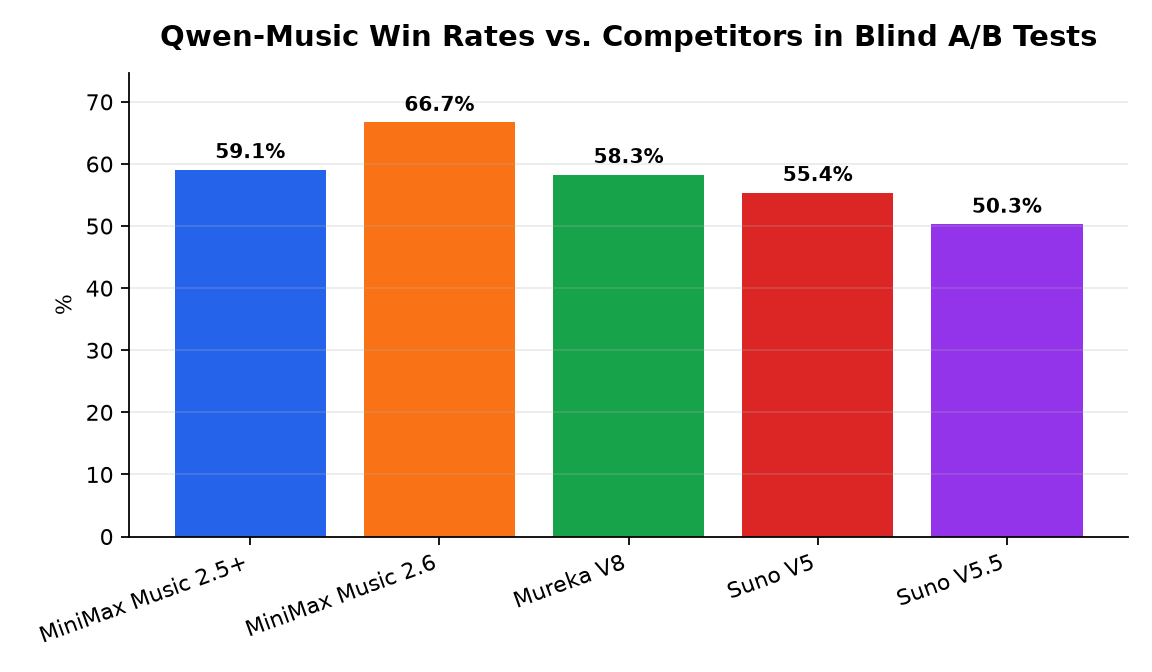
How well does it work? The evaluation results are competitive. On 600 Chinese and English prompts, Qwen-Music achieves the best result on 13 of 16 objective metrics across three benchmarks: SongBench, SongEval, and AudioBox-Aesthetic. In blind A/B preference tests with professional human raters, Qwen-Music wins against MiniMax Music 2.5+ (59.1%), MiniMax Music 2.6 (66.7%), Mureka V8 (58.3%), and Suno V5 (55.4%). Against Suno V5.5, the win rate is 50.3%, essentially a tie. The system also appeared on the Artificial Analysis Music with Vocals Leaderboard under the name JazzCat, ranking third among English vocal music generation systems. These numbers come with the usual caveats about benchmark design, as discussed in what benchmarks can miss about real performance.
Cover song generation is tested against Suno V5.5, Suno V5, and MiniMax Cover. On the AI-generated reference set, Qwen-Music preserves reference melodies more accurately than all three. On real-world popular song references, it outperforms MiniMax Cover on most metrics. That covers where reference audio is available.
One detail worth noting about the melody tokenizer. The team also experimented with chromagram-based representations for melody conditioning, similar to what other systems use. They found that chromagrams often retain too much information about the background arrangement, making the conditioning signal too strong and reducing the model's ability to follow global style tags. So they settled on a
Get the tech essentials in 3 minutes every morning
One email, every weekday, with what actually matters in AI and tech.