Artificial Intelligence
The hardest lesson for AI reasoning engines: when to shut up
MIT researchers propose OS-Pruner, a plug-in that dynamically stops chain-of-thought reasoning when further computation isn't worth the token cost. Tests show 20-60% length reduction with minimal accuracy sacrifice.
Emmanuel Fabrice Omgbwa Yasse AI-assisted
2026-07-29 · 4 min read
Every time a large language model solves a math problem or writes code, it produces a chain of thought, a trail of reasoning steps that can stretch to thousands of tokens. But not all of those tokens serve the final answer. Models routinely overthink: restating conclusions, verifying already-settled points, or chasing dead ends. The cost is real, higher latency, higher inference bills, and, perversely, sometimes lower accuracy. See also: why a session's token count maps poorly to real human hours saved.
Overthinking as a computational tax
The phenomenon is well-documented. DeepSeek-R1, built to scale test-time computation through long reasoning traces, often continues generating after the correct solution has been decoded. The same behavior appears in GPT-OSS-20B and distilled models like DeepSeek-R1-Distill-Qwen-7B. Studies by O1-Pruner and DRPO have shown that up to 60% of generated tokens can be redundant.
Earlier attempts to prune this waste fall into three camps. Model-side methods such as O1-Pruner and DRPO retrain the base model to produce shorter traces, effective but expensive, and risk degrading performance on out-of-distribution tasks. Budget-control methods like s1's budget-forcing impose a fixed token limit externally, ignoring that some problems genuinely need more reasoning. And training-based early-exit classifiers, HALT-CoT, Answer Convergence, FlashThink, treat stopping as a threshold on confidence, which misses the sequential nature of the decision.
OS-Pruner reframes the problem
The MIT team behind OS-Pruner argues that the standard formulation is wrong. From their paper: "We argue that CoT pruning is more naturally a sequential decision problem." Their key insight is that after each reasoning step, the system faces a choice between two actions, stop now and produce a final answer, or continue reasoning and pay more tokens in hope of improvement. This is an optimal stopping problem, not a classification one.
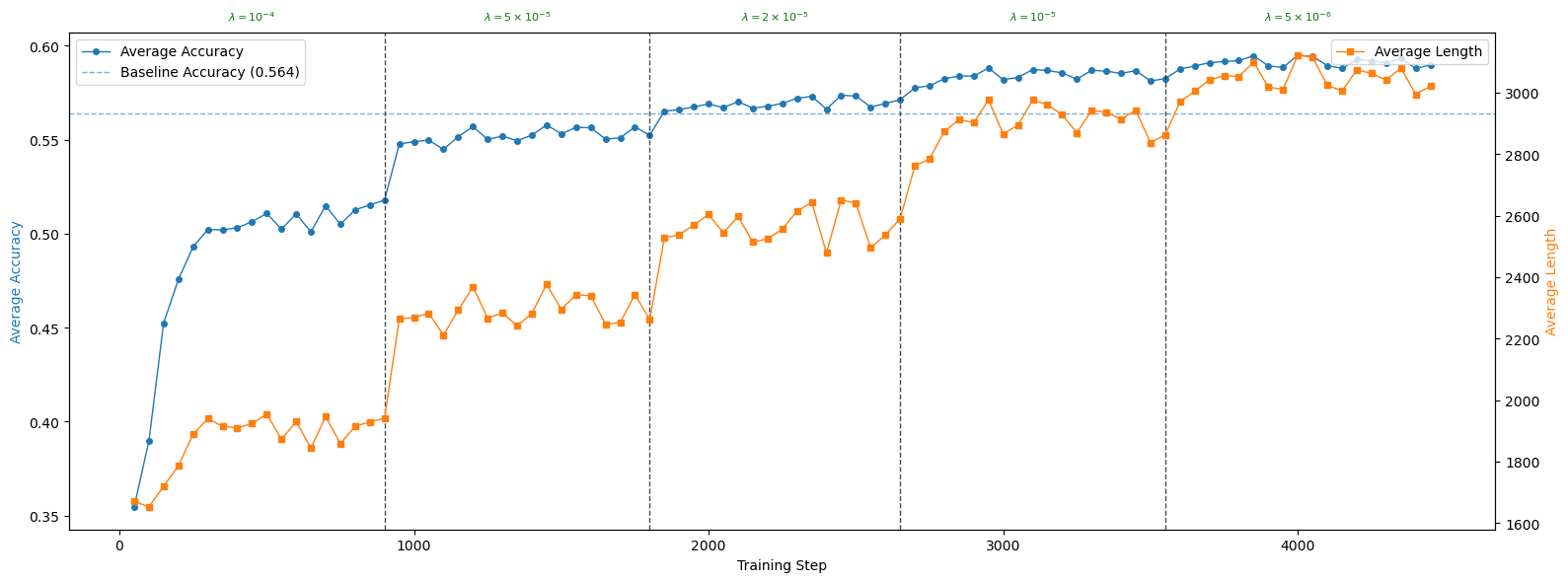
The framework learns a lightweight policy head, just a linear layer plus fine-tuning of the last two transformer layers, that maps each reasoning prefix to a probability of stopping. The reward function explicitly trades off accuracy against length: "r(y≤i|x) = A(y≤i|x) - λL(y≤i)". A single scalar λ controls the aggressiveness of pruning, letting users dial in the desired operating point on the accuracy-efficiency frontier, a neat contrast with the one-size-fits-all approach of budget-forcing methods like s1's token-budget approach.
Why classification methods fall short
The paper provides both theoretical and empirical reasons. The authors prove Theorem 1: threshold-based classification can lose arbitrarily large value compared to optimal stopping. The intuition is that two partial reasoning chains with the same estimated correctness can have very different continuation values, one might be on the verge of a breakthrough, the other stuck in a loop. A classifier treats them identically; optimal stopping sees the difference.
On benchmarks across DeepSeek-R1-Distill-Qwen-7B, GPT-OSS-20B, and DRPO-7B, the latter already optimized for brevity through model-side compression, OS-Pruner consistently outperforms baseline methods on the Accuracy Efficiency Score (AES). The strongest gains are on easier problems where overthinking is most rampant: 59.3% length reduction on GSM8K, 52.8% on MATH-500, with accuracy changes of -0.7% and +2.7% respectively.
Training efficiency as a design principle
Because the base model is frozen, OS-Pruner can precompute rewards by terminating reasoning at every paragraph boundary and checking whether the answer would be correct. No costly on-policy rollouts are needed during training. The policy head processes each prefix in parallel during inference, invoked only at paragraph boundaries, a design choice aligned with modern serving frameworks like vLLM.
The progressive training schedule tackles a practical challenge: for low λ values, naive training gets stuck in a trivial local minimum where the policy never stops. Starting with a high λ and annealing it periodically yields a clean Pareto frontier of accuracy-length trade-offs.
Implications for deployment
OS-Pruner's plug-in nature means it can be appended to any frozen reasoning model, even one that has already been compressed. The authors tested it on DRPO-7B, a model explicitly trained for length efficiency, and still recorded 20% average AES improvement, with 17% on AIME specifically.
For practitioners running high-volume inference pipelines, the token savings are not marginal. A 50% reduction in generated tokens at near-identical accuracy cuts infrastructure costs and latency in half. The λ parameter provides a calibrated lever: set it high for latency-sensitive applications, low for high-stakes accuracy requirements. This kind of efficiency pressure is why Sonnet 4.6's cost-efficiency curve matters just as much as raw benchmark scores.
Limitations and open questions
The current work focuses on mathematical reasoning benchmarks. The authors acknowledge that scaling to coding, scientific reasoning, and frontier models over 20B parameters remains future work. The ablation study also reveals a key limitation: models with poor instruction-following may continue reasoning in the "answer" section after forced stopping, undermining the pruning. GPT-OSS-20B handles this well; DeepSeek-R1-Distill-Qwen-7B does not.
Still, OS-Pruner makes a compelling case that the paper's title, "Pruning Chains-of-Thought of Reasoning Models via Optimal Stopping", is more than a methodological contribution. It's a practical tool for an era where every token counts. As the cost of inference continues to dominate deployment decisions, the question of which models survive the cost-efficiency winnowing may well hinge on tools like OS-Pruner.
Get the tech essentials in 3 minutes every morning
One email, every weekday, with what actually matters in AI and tech.