Research
Explainable RL takes on air traffic control, one saliency map at a time
A team of researchers applies explainable RL to air traffic control, training an agent to avoid no-fly zones and using saliency maps to reveal its reasoning. The work is a preliminary step toward trust in high-stakes AI.
Emmanuel Fabrice Omgbwa Yasse AI-assisted
2026-07-27 · 1 min read
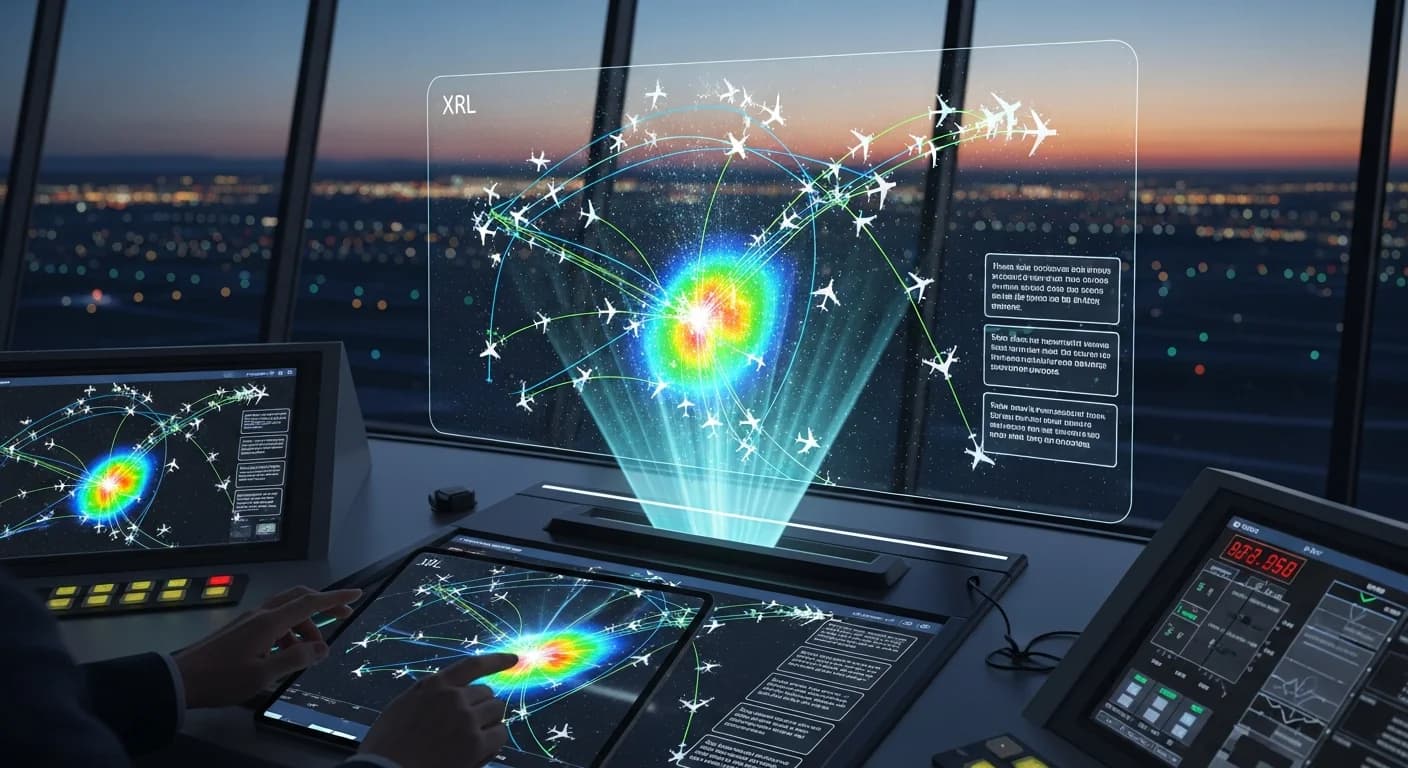
Air traffic controllers may one day get help from an AI that explains its reasoning. A new paper posted to arXiv on July 24, 2026, applies explainable reinforcement learning to a simplified air traffic control environment, training an RL agent to reroute flights around no-fly zones. The researchers then use a saliency map to highlight which input features, such as distance to a zone or approach angle, most influenced each decision, a form of transparency with counterparts in other high-stakes domains, such as agentic finance tracking.
The authors argue that building trust in AI is essential for high-stakes domains like aviation, and that explainability is a key part of that trust. This work is a first step; the environment is basic and the explainability technique is preliminary, but it demonstrates how RL-based routing can be made transparent. The effort parallels developments in neuro-symbolic reasoning and RL-driven brain-computer interfaces, where interpretability also takes center stage. More broadly, RL systems require careful reward design to avoid instability, a challenge explored in recent reward collapse research.
Get the tech essentials in 3 minutes every morning
One email, every weekday, with what actually matters in AI and tech.