AI Research
The gradient wall that blocked neural networks from reasoning just got a soft demolition
SoftReason is a fully differentiable neuro-soft-symbolic architecture for deductive reasoning. It removes the gradient barrier between perception and deduction, enabling end-to-end training over high-dimensional perceptual data and knowledge graph triples. On KVQA, it shows how soft reasoning can unify grounding, evidence injection, and closure.
Emmanuel Fabrice Omgbwa Yasse AI-assisted
2026-07-26 · Last updated: 2026-08-03 · 4 min read

The gap between perception and deduction has been one of the stubborn walls in AI. A neural network can learn to recognize objects in an image, but when it needs to chain those observations into logical conclusions, it hits a discrete barrier: the output of a classifier is a probability, while the input to a symbolic reasoner is a fact. The gradient cannot cross that boundary, so the two systems train separately and the reasoning half never helps the perceptual half improve. This is precisely the kind of bottleneck that recent unified estimators have attacked in other contexts.
A new preprint on arXiv proposes a way to tear that wall down. SoftReason, from a team of researchers, introduces a fully differentiable architecture for deductive reasoning that keeps every step of the inference chain learnable. Instead of feeding discrete facts from perception into a separate reasoner, the system represents the entire deductive state as a soft interpretation tensor over candidate constants and predicates. Every update, every witness aggregation, every query-conditioned head fact proposal stays inside a differentiable computation graph.
How soft reasoning works
The core idea is a learned differentiable lift of the immediate-consequence operator, the logical engine that derives new facts from known ones. In a classical deductive database, the operator is deterministic: if premises A and B are true, then conclusion C is true. SoftReason makes this operation soft by using predicate-definition embeddings and latent composition channels to form mixtures of body predicates, then aggregates over all possible witnesses to propose query-conditioned head facts. The interpretation is updated through a monotone probabilistic OR, which ensures the network converges to a fixed point without breaking differentiability. This monotonicity principle echoes the dynamics explored in how to stop RL from collapsing.
This design is not a small trick. It changes how the system can allocate credit. If a visual model misrecognizes an object and the reasoner fails to answer a question, the gradient can flow back from the query answer all the way into the perceptual encoder, adjusting the weights that produced the faulty recognition. Traditional neuro-symbolic pipelines cannot do this because their discrete fact interface blocks the gradient at the boundary. A similar tension between discrete and continuous representations was the target of ViQ's recent solution for visual tokenizers.
Instantiation on KVQA
The authors instantiate SoftReason on Knowledge-aware Visual Question Answering, a benchmark that requires both visual grounding and KG-based reasoning. The architecture takes an image, a natural language question, and a set of KG triples, and must produce an answer. Perception proposes probabilistic base facts from the image. KG triples enter as high-confidence soft evidence, weighted but still differentiable. The reasoning module then performs soft deductive closure, propagating belief through the predicate space until a fixed point is reached.
Results reported in the paper show that SoftReason matches or exceeds the accuracy of discrete baselines on KVQA, while also enabling end-to-end training. The gap in accuracy is most visible on questions that require multi-step chain reasoning, where the soft deduction module can use the gradient signal to refine the perceptual model's confidence distribution. This kind of cross-modal refinement aligns with findings from the VLM hallucination research.
What this means for the neuro-symbolic landscape
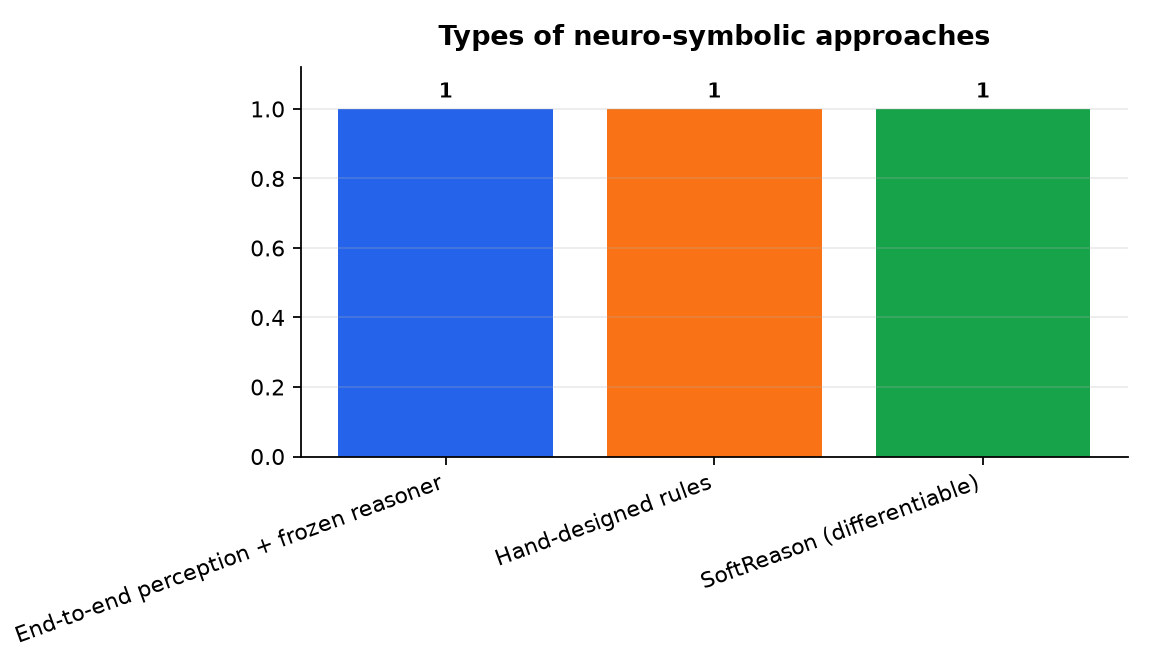
Most current systems that combine neural perception with symbolic reasoning fall into two camps: either they train perception end-to-end and freeze it before feeding facts to a separate symbolic module, or they hardcode hand-designed rules that bypass learning altogether. SoftReason attacks both limitations. The fully differentiable design means the same backpropagation algorithm that trains the vision encoder can also shape the deductive rules.
This is particularly relevant for domains where the perceptual input is inherently ambiguous. In medical imaging, for instance, a lesion boundary might be uncertain, and a chain of diagnostic rules needs to reason over that uncertainty. SoftReason's soft interpretation tensor can represent conflicting evidence and propagate it without forcing a discrete choice early in the pipeline. The same logic applies to autonomous driving, legal document analysis, or any scenario where high-dimensional data must support structured reasoning with evidential uncertainty. These are exactly the kinds of outputs that VLMs struggle with when left to their own devices.
Still open questions
SoftReason is a preprint, and several questions remain unaddressed. The paper demonstrates the architecture on KVQA, which is a relatively controlled setting. Scaling the soft interpretation tensor to larger KBs with thousands of predicates and millions of entities will test the computational feasibility of the approach. The monotone probabilistic OR update ensures convergence, but at a cost that grows with the product of the candidate constants and the predicate count.
Another open question is how well the approach transfers across domains without retraining the deductive operator. The predicate-definition embeddings are learned for a specific knowledge graph. Generalizing to new domains or new rule schemas likely requires retraining or fine-tuning, which limits the plug-and-play appeal.
Still, the conceptual advance is real. If the research can scale, it offers a principled path toward systems that learn to reason and reason to learn, without a discrete wall between the two.
Get the tech essentials in 3 minutes every morning
One email, every weekday, with what actually matters in AI and tech.