Multimodal AI
The three-stage rhythm that stops AI from seeing things that aren't there
New research reveals a stable three-stage redistribution of multimodal attention in VLMs, operationalized as the Visual Relay Window (VRW). The TRACE framework uses lightweight trained modules to schedule this window per task, improving grounding-sensitive benchmarks by 4.33 points on average and up to 6.6 points.
Emmanuel Fabrice Omgbwa Yasse AI-assisted
2026-07-23 · Last updated: 2026-07-30 · 4 min read
Vision-language models can answer questions about images pretty well at this point. But when they hallucinate, describing objects that aren't there or getting spatial relationships wrong, it's often not because the visual information is missing. The model just lost track of it somewhere inside its own reasoning stack.
New research from Tongji University and Hong Kong Polytechnic University, published on arXiv, offers the most detailed mechanistic account yet of how this happens and what to do about it. The authors identify a three-stage internal rhythm across the transformer layers of VLMs. They formalize the critical middle stage as the Visual Relay Window (VRW) and introduce a lightweight inference-time control framework called TRACE that adaptively schedules this window based on what each question needs. A similar principle of adaptive stopping emerges in other inference control research, as shown in work on optimal chain-of-thought stopping.
The three-stage rhythm of multimodal attention
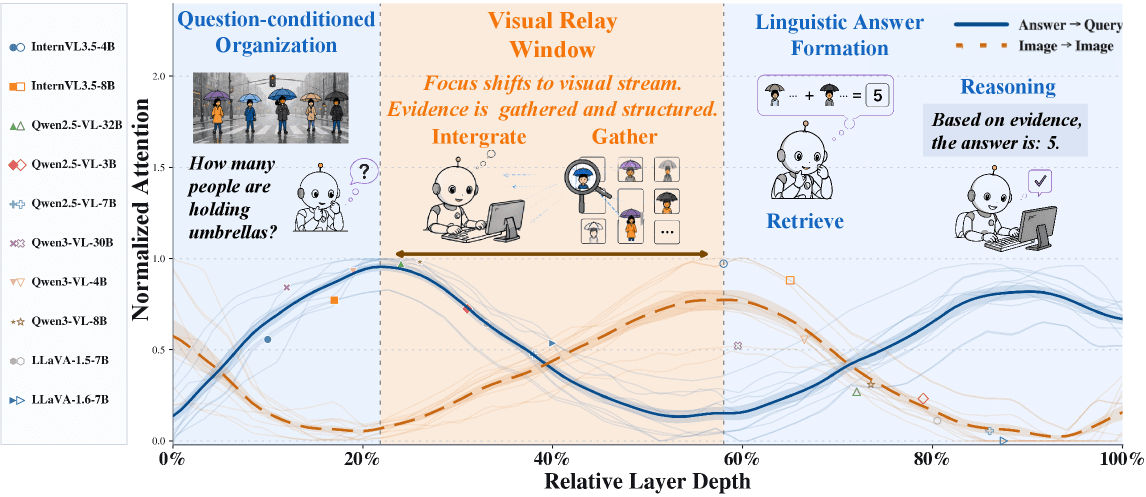
The researchers tracked two attention probes across layers of ten open-weight VLMs, including variants of Qwen-VL, InternVL, and LLaVA. The first probe measured how strongly answer tokens look back to the question. The second measured how strongly visual tokens attend to one another. They found a consistent pattern across all models: early layers emphasize question-conditioned organization, middle layers shift to intra-visual consolidation, and later layers return to answer formation.
That middle phase, the Visual Relay Window, is where visual evidence gets actively assembled before being handed off to the language side for reasoning. Its geometry is not fixed. Detail-heavy tasks like counting tend to need longer and later relay windows, while high-level reasoning tasks benefit from an earlier handoff. This kind of task-adaptive scheduling mirrors the efficiency gains seen in smaller multimodal models, such as Pixtral-12B's ability to outscore models seven times its size.
Why unsupported answers emerge
The study demonstrates a causal link between relay mismatch and hallucination. Using the HaloQuest benchmark, the authors compared grounded and unsupported continuations generated from the same image-question pairs. Unsupported answers consistently showed narrower relay windows, earlier relay termination, and weaker visual anchoring after the handoff. In a patching experiment, replacing visual-token residual activations inside the estimated VRW with grounded-branch activations recovered correct responses in 41.4% of unsupported cases. For comparison, pre-relay patches recovered only 8.7%, and post-relay patches 11.2%.
Thinking variants of the same base models (e.g., Qwen3-VL-4B Instruct vs. Thinking) showed better relay alignment with task demands and stronger post-handoff anchoring. This suggests the advantage partly comes from better internal scheduling of visual evidence. The idea of learning from one's own internal signals aligns with recent work on hindsight-based RL fixes, where agents learn from their own past trajectories.
TRACE: scheduling visual support without retraining the model
Building on these findings, the team built TRACE (Task-adaptive Relay Anchoring and Controlled Evidence Scheduling), a framework with only 199,244 trainable parameters for 4B models and 297,548 for 8B models. It works in three stages. A lightweight MLP predicts each layer's relay score from prefill-time attention statistics. A task-aware scheduler expands or contracts the relay window by applying a soft bias to visual-to-visual attention logits. A post-handoff anchoring module preserves access to the selected visual support during answer generation, with strength modulated by decoding uncertainty.
The modules are trained from pseudo-labels induced by the VRW estimator, keeping the base VLM frozen. Training takes roughly 8 hours on four NVIDIA RTX 5090 GPUs. The approach of using a lightweight scheduling layer echoes the design philosophy behind Nvidia's AV-Flamingo, which also handles temporal attention across long video sequences with a compact architecture.
Results: grounding gains without trade-offs
TRACE was evaluated on four open-weight backbones (Qwen3-VL-4B/8B and InternVL3.5-4B/8B) across seven benchmarks covering document understanding, visual reasoning, and hallucination-sensitive settings. On grounding-sensitive benchmarks (HallusionBench, VlmsAreBlind, CountBench), it delivered an average improvement of 4.33 points, with gains up to 6.6 points on HallusionBench with InternVL3.5-8B. It also improved reasoning-heavy benchmarks like MathVista, suggesting the mechanism addresses both hallucination and logical reasoning via a single control principle. As with any benchmark-driven evaluation, the limitations of the test sets matter, as documented in studies on benchmark blind spots.
Compared to eight baselines, including chain-of-thought prompting, visual contrastive decoding, and several attention-reallocation and activation-steering methods, TRACE achieved the highest average score on every backbone, with total gains of 2.84 to 3.18 points over vanilla inference across the full benchmark suite.
The team's code is available on GitHub.
Get the tech essentials in 3 minutes every morning
One email, every weekday, with what actually matters in AI and tech.