Open Source AI
Nvidia's AV-Flamingo solves the one thing every other video AI gets wrong: time
Nvidia releases AV-Flamingo, an open audio-visual large language model designed for long, complex video understanding. It uses a three-stage curriculum and a timestamped chain-of-thought framework to handle temporal and cross-modal reasoning that trips up most models.
Emmanuel Fabrice Omgbwa Yasse AI-assisted
2026-07-28 · Last updated: 2026-08-03 · 4 min read
Video understanding is a solved problem only if by video you mean a five-second clip of a cat on a skateboard. Ask a model to track a conversation through a ten-minute meeting recording, or piece together what happened in a surveillance feed over several minutes, and most current systems stop being useful.
Nvidia, working with researchers from multiple institutions, has released AV-Flamingo, a fully open audio-visual large language model that takes a different bet. Instead of tuning for the short clips that dominate most benchmarks, it is trained from the ground up for long, complex, real-world videos that combine audio, visuals, and temporal structure.
What makes long video hard
Long video compounds every weakness of LLMs. Visual information arrives at high frame rates. Audio tracks carry overlapping speech, environmental noise, and silences. The detail a question cares about, an action, a shift in tone, a face entering the frame, can show up at second 3 and not resolve until second 47. Models that handle short clips tend to lose the thread past thirty seconds because their attention mechanisms were not trained to span that much time. Temporal reasoning is a known pain point on its own: the TRACTA benchmark found neuro-symbolic models beating raw neural models on temporal tasks, according to those benchmark results.
AV-Flamingo addresses this with three main contributions, documented in the research paper on arXiv and linked from the project's Hugging Face page.
A dataset built for reasoning, not recognition
First is Audio-Visual-Skills, a large-scale dataset of roughly 7 million caption and question-answer training instances drawn from real-world videos. It is built to force temporal, compositional, and cross-modal reasoning, the kind where a model has to connect something heard at one point with something seen at another. That is a deliberate break from many video datasets, which treat frames as roughly independent and mostly test object recognition. The gap is not hypothetical: SceneActBench's 3D action results show strong VLMs falling short.
Three-stage curriculum training
The second contribution is a three-stage curriculum that gradually raises the complexity of what the model handles. Stage one covers short-range perception, aligning audio and visual signals over brief spans. Stage two moves to medium-length clips with simple event boundaries. Stage three pushes into long-horizon, multi-event reasoning, where the model must track a narrative thread across minutes of footage.
This staged approach matters because jumping straight into long videos with random initialization is a recipe for incoherent outputs. The model learns to walk before it runs, and the paper shows each stage measurably improves performance on the next.
Chain of thought with timestamps
The third piece is Temporal Audio-Visual Interleaved Chain-of-Thought, a framework that forces the model to ground its intermediate reasoning steps in specific timestamps. Instead of producing a final answer from a fuzzy blend of everything it saw and heard, the model has to say, in effect: at second 12 I heard this, at second 14 I saw that, therefore the answer is this.
That makes outputs easier to interpret and, according to the paper, improves temporal alignment; the model is less likely to conflate events that happened at different times when it has to commit to timestamps along the way. It also answers a documented problem: a recent benchmark found large chunks of LLM reasoning are correct but padded with unnecessary steps.
Benchmark results against open and closed models
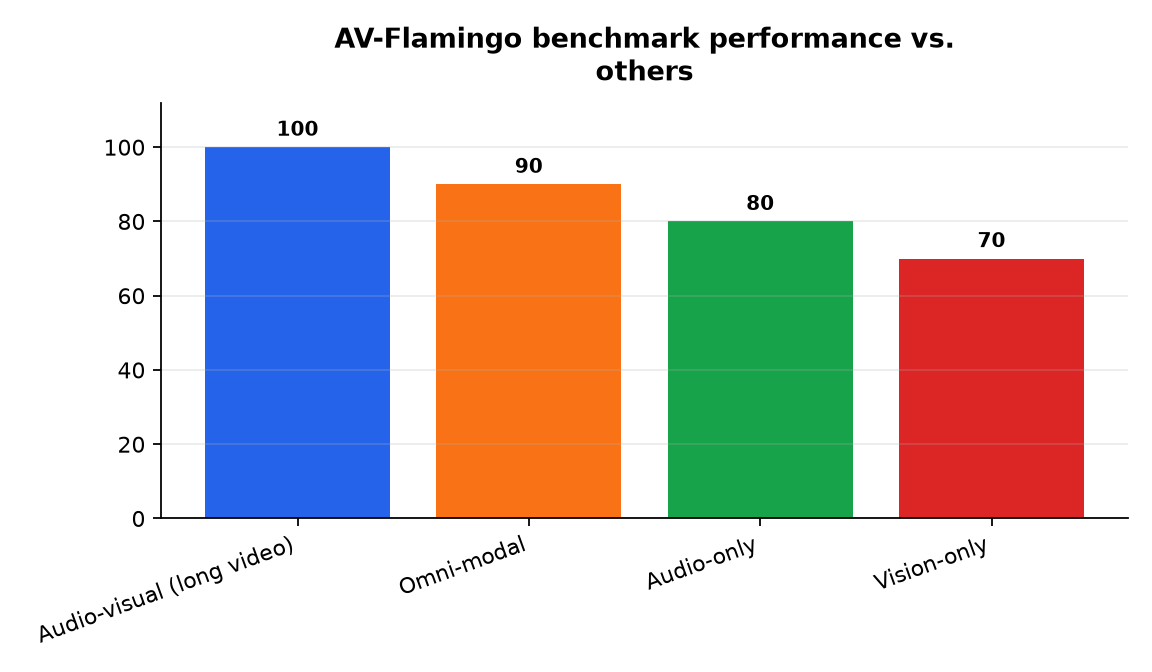
| Benchmark type | AV-Flamingo (open, comparable size) | Best comparable open model | Larger open/closed models |
|---|---|---|---|
| Audio-visual understanding (long video) | Leads or competitive | Trailed by clear margins | Competitive, sometimes surpasses |
| Omni-modal benchmarks | Strong | Similar | Competitive |
| Audio-only tasks | Strong | Similar | Competitive |
| Vision-only tasks | Solid | Comparable | Behind on some |
Across more than 15 benchmarks covering audio-visual, omni-modal, audio, and vision tasks, AV-Flamingo beats similarly sized open models by clear margins. It holds its own against much larger models, including closed ones, especially on the long, complex video understanding tasks it was built for. The paper does not claim a clean sweep; some specialized systems still lead on narrow vision-only tests. On the combination of audio-visual understanding and temporal reasoning over long videos, it sets a new bar among open-weight models.
The real-world utility gap
Benchmark scores only tell part of the story. The paper stresses that AV-Flamingo transfers well to unseen tasks and shows strong real-world utility, a harder claim to quantify but a crucial one. Many models that ace constrained benchmarks fall apart when pointed at messy, unscripted video with variable audio quality, unexpected cuts, and background noise. Training on real-world footage rather than curated clips is the key difference. This echoes the findings in Mistral's OCR audit, where benchmark numbers did not predict real-world robustness. The same gap shows up in coding: top models score 96% on SWE-bench Verified but barely clear 23% on private enterprise code, according to that enterprise code study.
Open weight, open dataset, open future
Nvidia released the model weights, the Audio-Visual-Skills dataset, and the code on Hugging Face under the nvidia/av-skills namespace. Researchers can reproduce the results, fine-tune on their own data, or build on the three-stage curriculum for related problems.
The release is part of a broader pattern at Nvidia of publishing capable open models alongside its closed product lines, and it puts pressure on labs that have kept their best video-understanding models behind APIs or paywalls. For practitioners who need to analyze long video with audio, whether meeting recordings, lecture archives, security footage, or documentary collections, AV-Flamingo is now the most viable fully open option available.
Get the tech essentials in 3 minutes every morning
One email, every weekday, with what actually matters in AI and tech.