TRACTA Benchmark
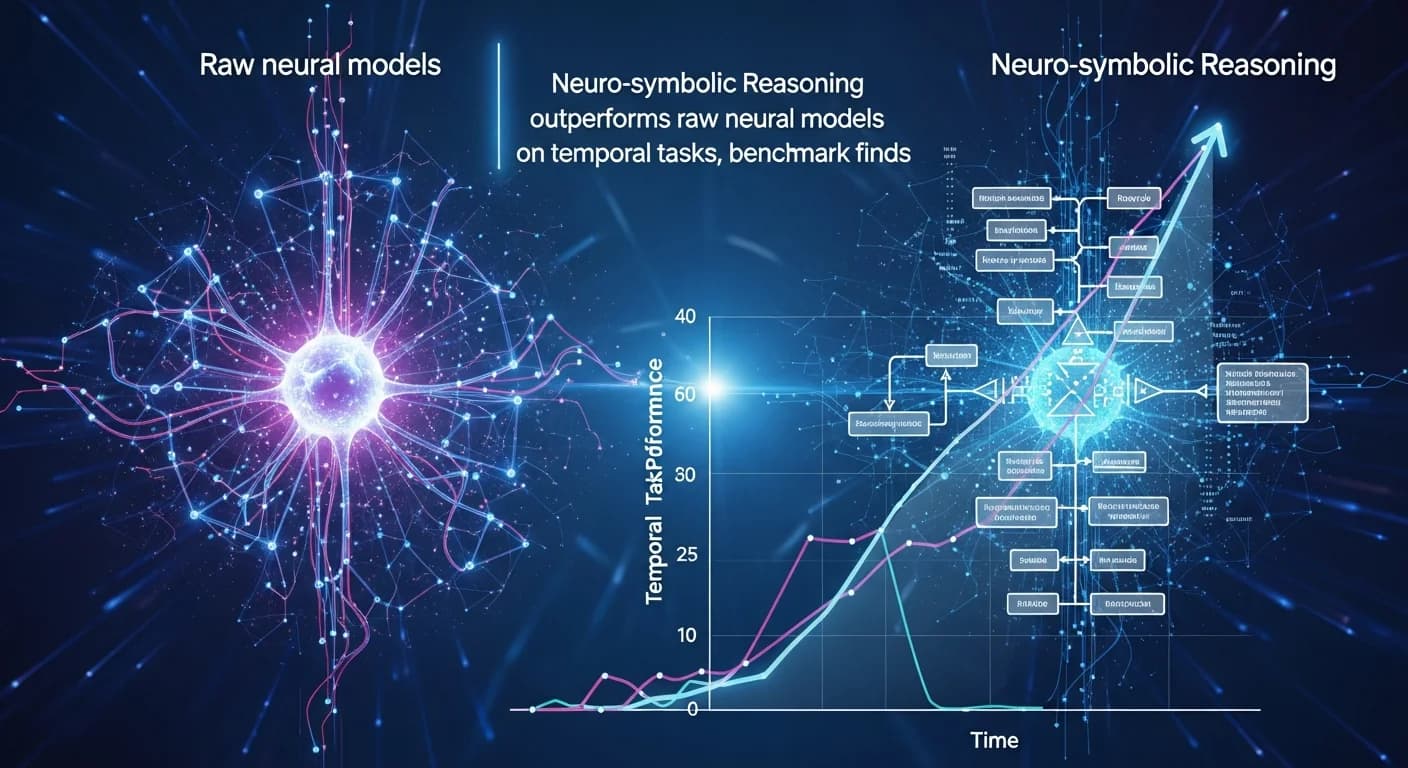
Neuro-symbolic reasoning outperforms raw neural models on temporal tasks, benchmark finds
TRACTA benchmark reveals neuro-symbolic AI beats raw neural models on three temporal reasoning tasks, with largest margins on early warning and pattern detection.
Emmanuel Fabrice Omgbwa Yasse AI-assisted
2026-08-02 · Last updated: 2026-08-03 · 3 min read
High-complexity environments, like military operations, financial markets, and disaster response systems, do not hand their patterns to a classifier on a platter. Events unfold over time, and the relationships between them matter more than the events themselves. A new benchmark called TRACTA puts that problem under a microscope and asks which AI architectures actually solve it, a question that broader reasoning benchmarks have also explored.
TRACTA stands for Temporal Reasoning and Capability-Trajectory Analysis. It simulates coordinated military maneuvers where signals arrive over hours and the model must anticipate what comes next. The benchmark defines three tasks: early_warning, pattern_detection, and run_classification. The aim is to test whether a model can detect and anticipate temporally distributed patterns, not just classify isolated events, a challenge that a differentiable neuro-symbolic approach is designed to address.
What the benchmark compares
The authors pit three approaches against each other: raw-event neural models (feed the model the raw stream of events), a contract-lite semantic baseline, and a neuro-symbolic configuration that operates on semantically grounded trajectories. The neuro-symbolic approach first maps raw events into structured semantic representations, specifically capability dynamics and contextual direct-impact trajectories, then learns temporal patterns on top of that structure.
Results: semantics wins on time
Raw event-level learning remains informative, but the neuro-symbolic configuration achieves the highest aggregate point estimates, with the largest margins on the temporal tasks. This echoes findings from a study showing that structured self-improvement can lift smaller models above larger ones. An ablation analysis shows that capability dynamics, contextual impacts, and temporal structure each contribute complementary information. No single piece of the semantic representation carries the whole load.
| Task | Best approach | Margin |
|---|---|---|
| early_warning | Neuro-symbolic | Largest |
| pattern_detection | Neuro-symbolic | Largest |
| run_classification | Neuro-symbolic | Largest |
The benchmark's design emphasizes structural convergence: combining event-level data with semantic trajectories to achieve better generalization across runs. The ablation analysis confirms that each component of the semantic representation adds value: capability dynamics tracks how an entity's actions evolve, contextual impacts capture ripple effects, and temporal structure captures the ordering and spacing of events. This granular decomposition is reminiscent of the issues tackled by a memory-focused framework for long-context agents.
The paper also runs shortcut diagnostics to make sure the models are not cheating by using easy cross-run identifiers. The most direct global-identifier shortcut is controlled in the primary neural input view, though residual shallow signals remain. That is a careful design: the benchmark attempts to force genuine temporal reasoning rather than pattern-matching on spurious features.
The bounded conclusion
This is not a sweeping claim that neuro-symbolic AI beats everything. The authors frame their conclusion carefully: in controlled synthetic settings, semantically grounded trajectories provide an effective representation for temporal structural reasoning. The real value is in the interface between event data, structured representations, and temporal learning that TRACTA sets up for further investigation. This measured conclusion aligns with broader assessments that LLMs can describe data but cannot truly reason through it.
The results have practical implications for any domain where timing matters. Autonomous systems coordinating in real time, algorithmic trading, and network intrusion detection all rely on spotting patterns that stretch across sequences. TRACTA provides a controlled environment to test whether a model is genuinely reasoning about time or just memorizing surface features. The next step, presumably, is to see whether the same advantage holds in real-world domains where the semantic mapping is less clean, a gap that production deployments of agentic systems have already exposed.
Get the tech essentials in 3 minutes every morning
One email, every weekday, with what actually matters in AI and tech.