Autonomous Driving Research
XCoT-VLA: driving AI that reasons in six tokens, not a paragraph
XCoT-VLA replaces descriptive chain-of-thought in vision-language-action driving models with 2 to 6 executable tokens, cutting trajectory error while staying within real-time planning budgets. The tradeoff: reasoning that compresses well stops reading like a human explanation.
Emmanuel Fabrice Omgbwa Yasse AI-assisted
2026-08-18 · 4 min read
Chain-of-thought gave language models a way to reason step by step before answering. A paper posted to arXiv on August 11, 2026 argues that habit is the wrong fit for the driver's seat. In an autonomous vehicle, verbose reasoning is a liability, for reasons the paper spells out. XCoT-VLA, the method the paper proposes, compresses driving reasoning into 2 to 6 executable tokens that condition trajectory generation directly.
Vision-Language-Action models connect scene understanding, semantic reasoning, and trajectory generation. That's what makes them candidates for self-driving stacks. But when the reasoning layer narrates in natural language, every extra token adds autoregressive latency, and the planning budget does not wait.
Why verbose reasoning fails real-time control
The paper names three problems with descriptive chain-of-thought in this setting. Reasoning is open-ended, so the model has no natural stopping point. Decoding is costly, which matters when the output feeds a control loop in real time. And the representation is hard to optimize into something the action side of the network can condition on. XCoT-VLA's answer is to change the representation rather than the model: replace explanatory rationales with compact executable tokens learned specifically for driving.
Executable tokens built from logs, not prompts
The reasoning tokens come from Reason-Action supervision, built automatically from logged data rather than written by hand. Logged trajectories provide the action evidence; scene context supplies the causal semantics. During inference, the predicted XCoT sequence stays in context and conditions fixed trajectory queries through shared multimodal self-attention. Routing is deterministic: a Reason feed-forward network processes the XCoT tokens, a Control FFN handles the trajectory queries, and flow matching generates the final trajectory. The bet is that two to six tokens can carry enough meaning to steer the action, the same compactness trade-off ViQ maps for discrete visual representations.
The numbers: smaller error, smaller reasoning footprint
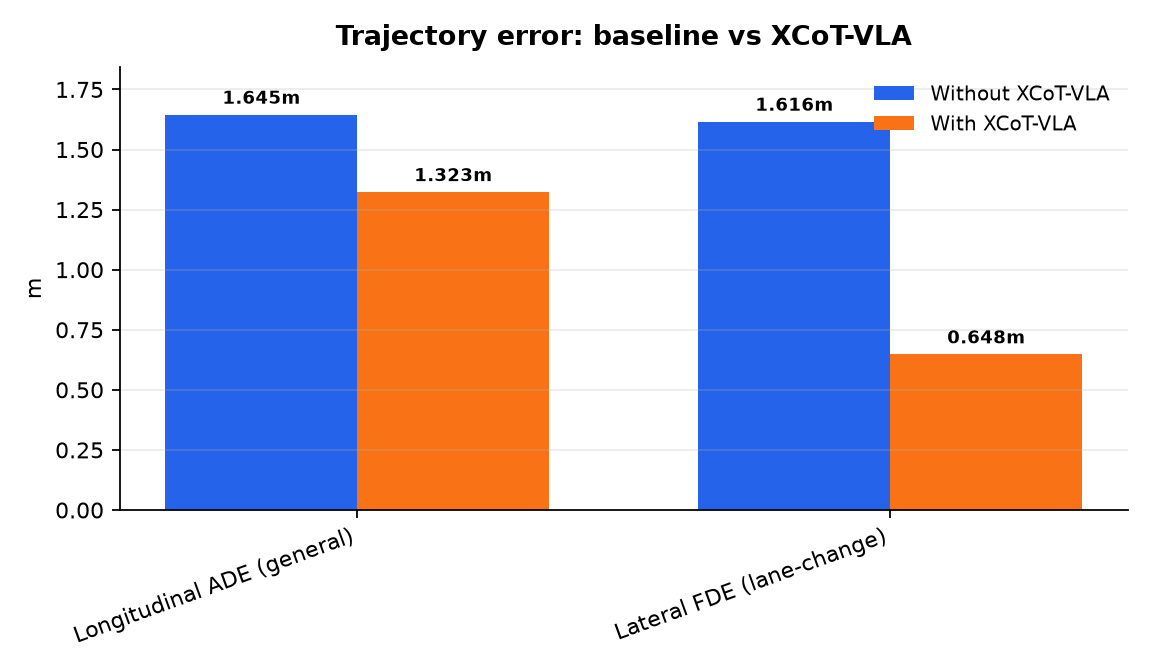
On a general-distribution evaluation set, longitudinal average displacement error drops from 1.645 to 1.323. In lane-change scenarios, lateral final displacement error falls from 1.616 to 0.648, less than half of the baseline. The paper attributes the gain to the token economy itself: with only 2 to 6 executable tokens representing driving-oriented reasoning, autoregressive overhead shrinks enough to stay within a real-time planning budget.
| Metric | Without XCoT-VLA | With XCoT-VLA |
|---|---|---|
| Longitudinal ADE, general-distribution set | 1.645 | 1.323 |
| Lateral FDE, lane-change scenarios | 1.616 | 0.648 |
ADE and FDE are standard trajectory metrics. Average displacement error measures how far the predicted path drifts from the logged trajectory on average; final displacement error checks the endpoint, the position that matters most in a lane change.
The abstract reports these results without detailing the evaluation data or the experimental scale. Those details will matter if the approach moves from arXiv to a vehicle.
XCPO and the legibility tradeoff
The paper also introduces XCoT Policy Optimization, or XCPO, an optional refinement extension that works in the same executable token space. The abstract presents it as a way to polish the policy without abandoning the compact representation. It does not say how the extension is trained, a gap that matters: RDPO shows reward signals in multi-task RL often work against each other.
Compactness has a cost the paper does not dwell on: executable tokens are no longer human-readable. A descriptive chain-of-thought, whatever its latency problems, left an audit trail a human could follow. A token that optimizes well under a real-time budget is harder to inspect; in explainable RL for air traffic control, the priority runs the other way, with saliency maps keeping the agent's decisions readable. The paper frames the work as evidence that driving-oriented reasoning can be compact, executable, and directly connected to trajectory generation. It does not claim the reasoning stays legible.
XCoT-VLA also sits inside a wider push to make reasoning cheaper than serialized text. Penelope, a July 2026 arXiv paper, localizes recurrent computation for structured reasoning specifically to avoid generating a long visible reasoning trace. Penelope keeps the reasoning latent; XCoT-VLA keeps it explicit but minimal, two to six tokens that point straight at the action. The shared premise: chain-of-thought is one way to implement reasoning, not the only one. SoftReason makes the same case from a different angle, removing the gradient barrier that blocked neural networks from truly reasoning.
Whether compressed reasoning is also trustworthy reasoning is the open question. XCoT-VLA's results suggest driving reasoning can be short and executable. But a trajectory that matches logged behavior is the only visible product, and video models have already been shown to drop details a human would catch: Gemini 3.6 Flash counts state changes but misses blinks. In a car, nobody gets to read the model's homework.
- Source : XCoT-VLA: driving AI that reasons in six tokens, not a paragraph — 2026-08-11
Get the tech essentials in 3 minutes every morning
One email, every weekday, with what actually matters in AI and tech.